GE Wall Oven Repair in West Los Angeles

GE wall oven repair in West Los Angeles for not heating, uneven baking, slow preheat, temperature swings, and control issues.

Local West Los Angeles service 90-Day warranty Licensed & insured
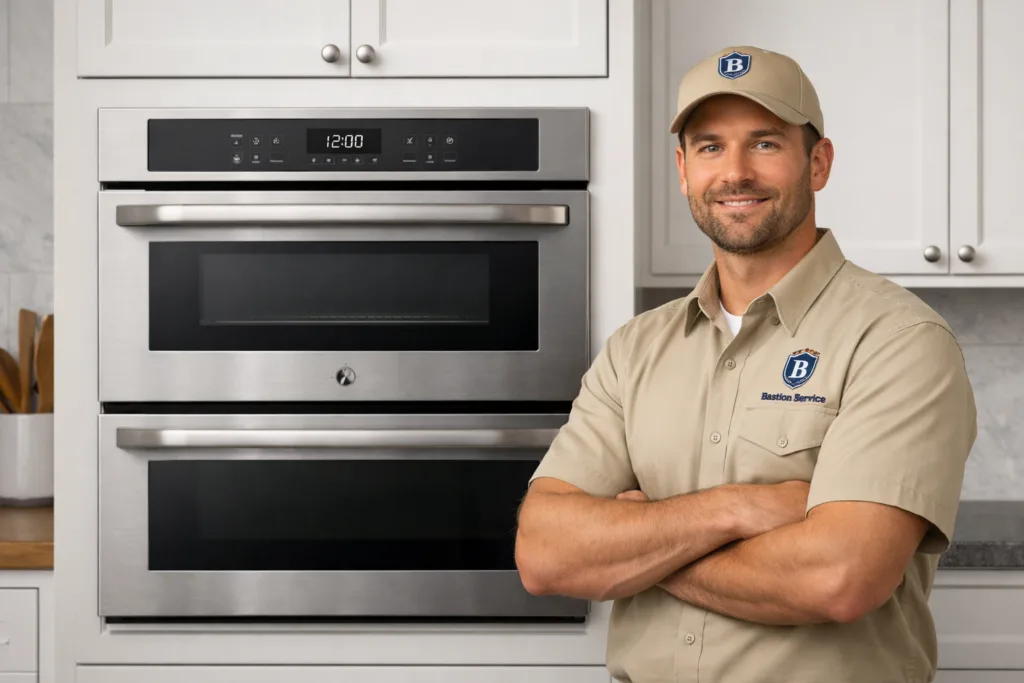
GE Wall Oven repair technician in West Los Angeles
Xavier Hernandez review profile photo Ami Radunskaya review profile photo James Marostica review profile photo Christian Villasenor review profile photo Diane Witherspoon review profile photo
Real Google feedback 5.0 out of 5 80+ Google reviews
  • GE wall oven support in West Los Angeles
  • Clear diagnosis before repair decisions
  • Warranty for labor and parts
  • Fast scheduling based on availability
GE Wall Oven Repair

GE Wall Oven repair in West Los Angeles for focused household appliance problems

When a GE wall oven starts acting up in West Los Angeles, the most helpful first step is a clear diagnosis and a practical repair plan based on the exact symptom pattern.

Bastion Service helps West Los Angeles homeowners diagnose GE wall oven problems and decide whether repair is practical based on the symptom, appliance condition, and repair path.

GE wall oven repair support for West Los Angeles homes.

Wall ovens tend to fail in patterns. One household may notice longer preheat times for weeks before the oven stops reaching temperature, while another may see a blank display or a locked door all at once. With GE built-in models, those patterns matter because the same symptom can come from very different components.

Common GE wall oven problems homeowners notice

If your oven is acting differently than it used to, the symptom itself often points to the system that needs attention. The goal is to separate a heating problem from a sensor issue, an electronic control fault, or a door and latch problem.

Oven will not heat

When a GE wall oven powers on but never gets hot, the issue may involve the bake element, broil element, igniter on gas models, temperature sensor, wiring, or the control sending power to the wrong place. In some cases, the cavity warms slightly but never reaches a usable cooking temperature. That difference matters because partial heat can suggest a weak component rather than a complete failure.

Slow preheat

Slow preheat is easy to dismiss at first, but it often signals a developing problem. A weakening element, inaccurate temperature sensor, failing relay, or control issue can stretch preheat times well beyond normal. If dinner prep keeps getting delayed and the oven seems to take longer every week, it is worth having the cause checked before it becomes a no-heat call.

Uneven baking and hot spots

Cookies browning on one side, casseroles finishing around the edges but staying cool in the center, or two racks cooking very differently can all point to uneven heat delivery. On GE wall ovens, this may relate to element performance, temperature sensing, airflow, calibration drift, or convection-related components on models equipped with them. Uneven baking does not always mean the oven is “just old.” It often means a specific part is no longer doing its job correctly.

Temperature swings during cooking

Some cycling is normal, but wide swings that affect results are not. If the oven overshoots the set temperature, drops too low, or seems unpredictable from one meal to the next, the problem may be tied to the sensor, control board, relay function, or calibration. This is especially frustrating for baking, where consistency matters more than maximum heat.

Display or keypad not responding

A blank display, flashing screen, unresponsive keypad, or random beeping usually points to an electronic issue rather than a heating issue. Depending on the model, the fault may be in the user interface, main control, ribbon connection, or power supply to the unit. If the controls work intermittently, that can be just as important as a total failure because intermittent faults often get worse over time.

Error codes and reset behavior

GE wall ovens may show fault codes when the control detects a problem with temperature sensing, latch operation, or internal communication. Repeated resets, clocks that lose power, or controls that freeze after a cycle can indicate more than a simple glitch. If the same code returns after clearing it, the oven usually needs diagnosis rather than repeated resetting.

Door, latch, or self-clean problems

A door that will not shut squarely, a latch that stays engaged, or a unit that acts up after self-clean can make the oven unusable even when the heating system is fine. On built-in wall ovens, latch and door issues may involve switches, motors, hinges, alignment, or the control logic that monitors lock status. Forcing the mechanism can create additional damage, so it is better to stop and have it evaluated.

Breaker trips, burning odor, or sudden shutoff

If the oven trips the breaker, shuts down in the middle of cooking, or gives off a burning smell, discontinue use until the cause is identified. Those symptoms can come from failing elements, overheated wiring, terminal issues, or electrical faults inside the control area. A problem that starts as occasional shutdown can quickly turn into complete loss of operation.

Why symptom-based diagnosis matters

Two ovens can look like they have the same problem and need entirely different repairs. An oven that is not heating could have a failed element, a bad sensor, a relay that is not closing, or a power issue feeding only part of the appliance. Replacing parts based on guesswork often increases cost without fixing the real fault.

For homeowners in West Los Angeles, symptom-based evaluation helps determine whether the repair is likely to be straightforward, whether parts availability will shape timing, and whether the appliance is still a good candidate for repair. That is especially important with built-in units, where replacement is usually more involved than swapping a freestanding range.

What changes after a self-clean cycle can mean

Many wall oven failures seem to appear right after self-clean. High internal temperatures can stress aging components, especially door lock assemblies, thermal protections, electronic controls, and nearby wiring. If a GE wall oven worked normally before self-clean and then developed a blank display, locked door, or no-heat condition, that timing is useful diagnostic information.

It does not always mean self-clean directly “broke” the oven, but it can expose a part that was already near failure. Sharing that detail during service can help narrow the repair path more quickly.

When to schedule service

It makes sense to schedule service when the oven no longer preheats normally, misses the set temperature, bakes unevenly, shows recurring error codes, or has controls that only work part of the time. You do not need to wait for a complete breakdown. Performance changes are often the first warning that a component is weakening.

More urgent symptoms include breaker trips, burning odor, visible sparking, repeated shutdowns, or a door that remains locked with food inside. If your model is gas and you notice a gas smell, stop using the appliance. If the odor is strong or persistent, leave the area if needed and contact the gas utility or emergency service before arranging appliance repair.

Repair or replacement: how to think about it

Many GE wall oven problems are still worth repairing, particularly when the issue is isolated to a heating element, igniter, sensor, latch assembly, fan motor, or specific control-related component. Repair becomes less attractive when the unit has multiple major faults, severe interior or door damage, ongoing electrical problems, or a repair cost that is too close to replacement value.

Built-in appliances also bring sizing and installation considerations that can complicate replacement. In West Los Angeles homes, keeping an existing wall oven in service is often the easier path when the fault is limited and the rest of the appliance is in good condition.

Helpful checks before your appointment

Without disassembling anything, a few observations can make service more efficient:

  • Note whether the problem happens in bake, broil, convection, or every mode.
  • Pay attention to whether the oven fails during preheat or loses heat later in the cycle.
  • Write down any error code exactly as shown.
  • Notice whether the issue started after a breaker trip or self-clean cycle.
  • Check whether the display and oven light still have power.
  • Listen for unusual clicking, humming, or cooling fan behavior.

Those details can help narrow the fault faster, especially with intermittent problems that do not happen on every cycle.

Built-in wall oven issues are different from standard ranges

A wall oven is integrated into the kitchen cabinet opening, which changes both access and repair planning. Components are often tighter to reach, and safe removal may be necessary for certain repairs. That is one reason homeowners are usually better off avoiding do-it-yourself disassembly on heating, control, or wiring issues.

When the unit is built in, even a “simple” symptom can involve more than one system. A thorough assessment helps prevent accidental cabinet damage, misdiagnosis, or replacing the wrong part first.

What homeowners in West Los Angeles usually want to know

Most people are not looking for a technical explanation as much as a practical answer: is the oven fixable, is it safe to use, and is the repair worth doing? The answer depends on the exact symptom pattern, the age and condition of the appliance, and whether the failure is isolated or spreading across multiple functions.

For many households, the most useful next step is to stop using the oven if there are electrical or overheating symptoms, gather the model information, and have the problem evaluated based on how the unit is actually failing rather than on a general guess. That approach usually leads to a more accurate repair decision and a better chance of restoring reliable cooking performance.

Service options

GE appliances we service in West Los Angeles

Choose the GE appliance type you need serviced in West Los Angeles.

Customer reviews

Real customer feedback

Recent customer feedback for Bastion Service.

Maria Rodriguez review profile photo
Maria Rodriguez
Google review

“Fast and efficient, affordable prices, does not have hidden agenda, and are honest. Thank you”

Ruth Douglas review profile photo
Ruth Douglas
Google review

“Quick response. Very pleasant interactions. Diagnosed and offered professional opinion. Would recommend and would use again. Less expensive than others. Very appreciated.”

P K review profile photo
P K
Google review

“Wonderful service. Knowledgeable and professional technician and quick turnaround. Thank you!”

Nu Wade review profile photo
Nu Wade
Google review

“I appreciate you guys trying to take care of us, and I'm gonna keep you guys' number. I will definitely be sending everyone that I know that's interested in getting any repairs done on any of their appliances.”

Peezy Flowers review profile photo
Peezy Flowers
Google review

“On time , very fast and affordable .. before you get rid of you appliance give him a chance to save it and save some money lets be real ppl times is a bit rough we can all save some cheddar - very professional ! 10⭐️ rating”

Mona Jimenez review profile photo
Mona Jimenez
Google review

“Knowledgeable and pleasant technician”

FAQ

GE Wall Oven Repair questions

Answers about diagnosis, repair options, timing, and next steps.

What are the most common reasons a GE wall oven stops heating in West Los Angeles?

Common causes include a failed bake or broil element, a bad temperature sensor, a control board problem, an igniter issue on gas models, or an electrical supply fault. A proper diagnosis is the best way to tell which part is actually causing the failure.

Should I keep using my GE wall oven if it is tripping the breaker?

No. Repeated breaker trips can point to an electrical fault, failing component, or wiring problem. Continued use may worsen the damage, so it is best to stop using the oven until it is diagnosed.

Is it worth repairing a GE wall oven instead of replacing it?

Often yes, especially if the problem is limited to a heating element, sensor, igniter, latch, or another single repairable component. Replacement becomes more relevant when there are multiple major issues, repeated electronic failures, or repair costs that are too close to the value of the unit.

What should I do if my GE wall oven has a gas smell?

Stop using the appliance right away. If the gas smell is strong or persistent, leave the area if needed and contact the gas utility or emergency service before scheduling appliance repair. If there is no strong gas smell but ignition seems delayed or inconsistent, the oven should still be diagnosed before normal use.

Ready to schedule?

Schedule GE Wall Oven Repair in West Los Angeles

Schedule GE wall oven repair in West Los Angeles with clear diagnosis, practical repair guidance, and dependable local service.

Call (323) 433-6360