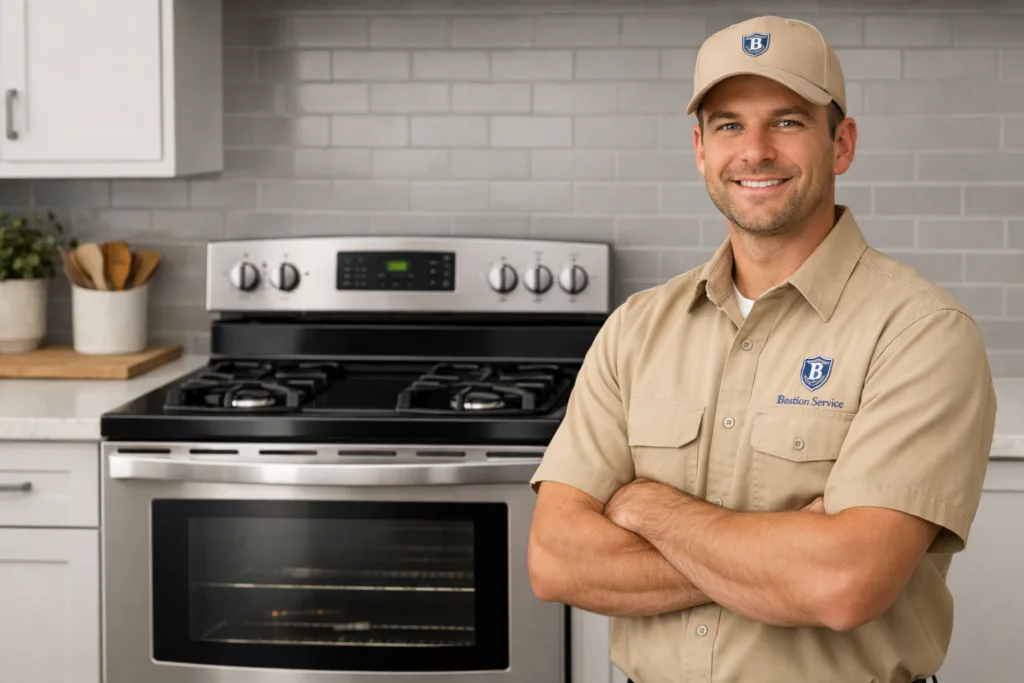
Cooking problems with a range rarely stay limited to one meal. A burner that clicks over and over, an oven that runs cool, or a control panel that responds only part of the time can turn everyday use into trial and error. With Amana models, the most helpful approach is to match the repair plan to the exact symptom instead of assuming every heating or ignition issue has the same cause.
Common Amana range symptoms in West Los Angeles homes
Most service calls fall into a few recognizable categories: cooktop ignition trouble, weak or uneven heating, oven temperature problems, and electronic control faults. While the symptoms may seem straightforward, the underlying cause can vary from a simple burner-area issue to a failed sensor, igniter, switch, or control component.
Burner clicks but does not light
If a surface burner sparks without lighting, start by noticing whether the clicking is strong and consistent or irregular. Common causes include a misaligned burner cap, residue blocking gas flow, moisture around the igniter, or a fault in the spark ignition system. In some cases, the burner lights only after several tries, which often points to a problem that is getting worse rather than one that will resolve on its own.
Clicking continues after the flame appears
When the burner lights but the clicking keeps going, the range may have contamination around the burner head or an ignition switch issue. This can be especially frustrating during normal cooking because the burner may still heat while the spark system continues to fire. Repeated sparking should be checked rather than ignored, since it can lead to added wear on related components.
Oven will not heat or takes too long to preheat
An oven that stays cold, heats very slowly, or never reaches the selected temperature may have a failed bake element, a weak igniter, a sensor problem, or an electronic control issue. Some Amana ranges show this gradually. At first, preheat simply seems slower than usual. Later, food comes out undercooked unless extra time is added.
Food bakes unevenly
If one side of a sheet pan browns faster, casseroles stay cool in the center, or cookies suddenly bake differently from one batch to the next, the problem may be more than recipe variation. Uneven results can come from sensor drift, inconsistent element performance, poor heat circulation, or a door seal that no longer holds heat properly.
Display or controls act unpredictably
Flashing displays, error codes, unresponsive buttons, or controls that work intermittently often point to a failing interface, wiring problem, or control board fault. Because electronic symptoms can overlap, replacing parts without testing can easily lead to unnecessary expense.
Symptoms that should not be put off
Some range issues are mostly inconvenient, but others deserve quicker attention. If the oven overheats, will not shut off normally, or cycles in a way that seems erratic, continued use can create a larger repair problem. The same is true for burners that spark unpredictably, smell unusual during ignition, or heat inconsistently.
For homeowners in West Los Angeles, the real question is whether the appliance is still operating in a controlled and predictable way. If it is not, waiting often means more disruption later, especially when the problem affects both the cooktop and the oven.
How oven heating problems are usually diagnosed
When an oven is not performing correctly, the symptom pattern matters. A range that does not heat at all is different from one that preheats, but runs 25 to 50 degrees off. Diagnosis usually focuses on whether the appliance is failing to generate heat, measure heat correctly, or maintain heat consistently once the cycle begins.
Oven stays cold
If there is little or no heat, the likely causes usually include the bake element on an electric model, the igniter on a gas model, or a control issue that prevents the heating system from starting. This kind of failure is usually easier to isolate because the complaint is clear and repeatable.
Oven heats, but not correctly
When the oven does warm up but cooking results are inconsistent, attention often turns to the temperature sensor, calibration, cycling behavior, or a weakening heating component. Homeowners sometimes notice this first through baking results rather than through a complete loss of heat.
Broil works but bake does not
If one cooking mode works and the other does not, that often helps narrow the repair to a specific heating circuit or part rather than the entire appliance. This is one reason symptom-based testing is so useful on Amana ranges.
Cooktop issues that often seem small at first
Cooktop problems are easy to put off because one or two burners may still be usable. But a burner that lights poorly, heats unevenly, or sparks constantly can interfere with daily cooking long before it fails completely.
- One burner will not ignite, but the others work normally
- The burner lights only with repeated attempts
- The flame looks uneven or weak around the burner head
- Clicking starts again during cooking
- An electric element heats inconsistently or cycles strangely
These are often repairable issues, especially when the problem is isolated to one burner position or one specific function.
When repair is usually worth considering
Many Amana range problems are practical to repair when the fault is limited and the appliance is otherwise in solid condition. A service decision often comes down to whether the issue can be traced to a specific failed part and whether the rest of the range is operating normally.
Repair often makes sense when:
- Only one burner or one oven function is affected
- The display and controls are otherwise stable
- The problem appeared recently instead of repeating over a long period
- The range still fits the kitchen and meets the household’s cooking needs
- The failure points to a defined component such as an igniter, element, switch, or sensor
Replacement may be part of the conversation when:
- Several major functions are failing at the same time
- There are recurring electronic problems after prior repairs
- The appliance shows broader wear beyond the original complaint
- The repair scope becomes too large compared with the condition of the range overall
What to notice before scheduling Amana range service
A few observations can make diagnosis easier and help narrow the issue faster. Before service, it helps to note:
- Whether the problem affects the cooktop, the oven, or both
- If the symptom happens every time or only intermittently
- Whether a specific burner or mode is involved
- If the display shows an error code
- Whether the issue started suddenly or developed gradually
Even simple details like “broil works but bake does not” or “the front right burner clicks after lighting” can point the repair in the right direction.
Household-focused service for a heavily used kitchen appliance
Ranges tend to be used daily, so even minor faults can quickly disrupt routines. In many West Los Angeles households, the immediate concern is not the technical name of the failed part. It is whether dinner can be made safely, whether the oven can be trusted for consistent results, and whether the repair is likely to restore normal use without guesswork.
If your Amana range is not igniting properly, not heating as expected, or showing unstable control behavior, having the symptom evaluated early is usually the best way to prevent a small problem from turning into a larger one.