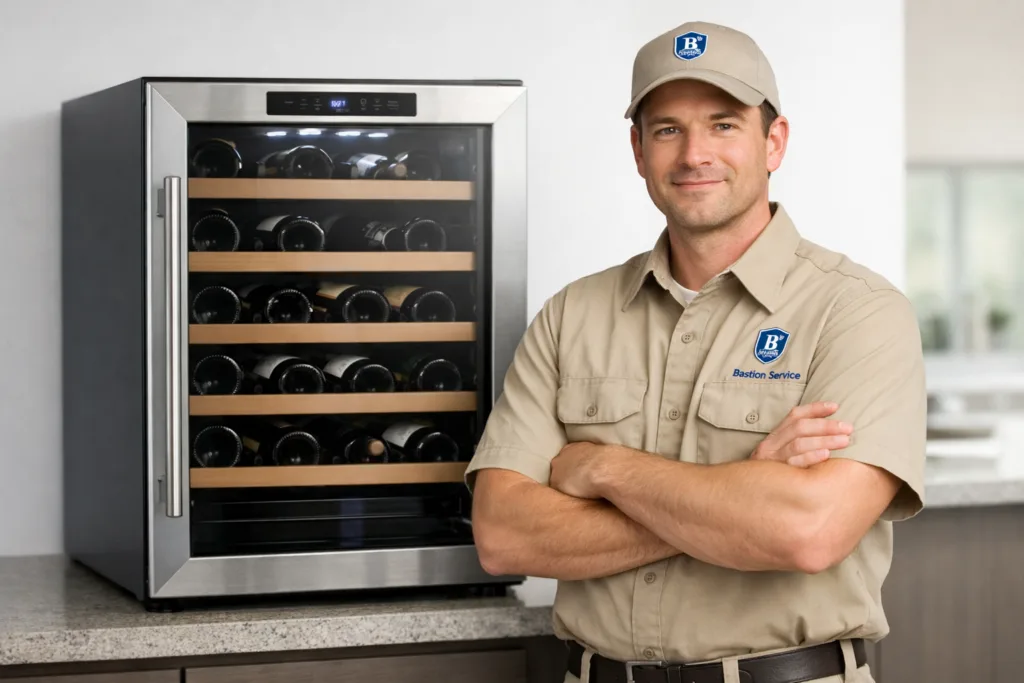
An EdgeStar wine cooler that starts running warm, icing up, leaking, or cycling irregularly can put a collection at risk faster than many homeowners expect. Because wine storage depends on stable cabinet conditions, small cooling or airflow problems often show up early through warmer bottles, uneven temperatures, extra condensation, or unusual noise.
What to check first when an EdgeStar wine cooler is not performing normally
Wine coolers are designed to maintain a narrower temperature range than a standard refrigerator, so minor faults can have a noticeable effect. When an EdgeStar unit in a Fairfax home begins drifting out of range, the most useful first step is separating the problem into one of a few categories: cooling performance, airflow, controls, moisture management, or door sealing. That makes it easier to understand whether the issue is likely a repairable component problem or something more serious.
Symptom patterns matter. A cooler that is slightly warm but otherwise quiet can point to a different issue than one that is warm, noisy, and running nonstop. Likewise, frost in one area means something different from general moisture on shelves or along the glass.
If the cabinet is too warm
When the interior is warmer than the setting, possible causes include a weak evaporator fan, poor condenser airflow, sensor or thermostat problems, control board issues, or compressor-related trouble. In some cases, the display may show a target temperature even though the actual cabinet temperature is higher. That is why the real condition inside the cooler matters more than the number shown on the panel alone.
On dual-zone EdgeStar models, one compartment may cool while the other drifts warm. That often suggests a zone-specific sensor, control problem, or airflow imbalance rather than a complete loss of cooling across the entire unit.
If temperatures swing too much
Temperature swings are especially hard on wine storage. If the unit cools correctly for a while and then climbs well above the set point, the problem may involve inconsistent fan operation, control response, restricted ventilation, or a component that works intermittently. A cooler that alternates between too cold and too warm may also have sensor feedback issues that prevent normal cycling.
Homeowners sometimes notice this first when bottles feel cooler near one shelf and warmer near another, or when the cabinet seems fine in the morning but warmer by evening. Those clues can help narrow down whether the issue is airflow-related or tied to the cooling system itself.
Moisture, frost, and leaking are signs worth addressing early
Excess moisture inside a wine cooler is more than a cosmetic annoyance. It can affect labels, shelving, door sealing, and overall temperature stability. In EdgeStar units, condensation and frost often point to warm air entering the cabinet, airflow restrictions, defrost-related trouble, or a blocked drain path.
Condensation on shelves or glass
If water droplets are forming inside, the door gasket may not be sealing tightly, the door may be misaligned, or humid air may be entering each time the unit cycles. Repeated condensation can also show up when the cooler is struggling to maintain its target temperature and the cabinet never fully stabilizes.
Frost buildup on the back panel
Frost in one section of the interior often suggests an airflow or evaporator issue. A fan that is not moving air properly can allow cold to collect unevenly, while a door seal problem can introduce moisture that later freezes. Heavy frost should not be ignored, because it can reduce efficiency and make temperature control less accurate over time.
Water collecting at the bottom
Pooled water near the base of the cabinet may come from a drain restriction, excess condensation, or repeated warm-air intrusion. If leaking continues, it can affect nearby flooring or cabinetry, especially in built-in or under-counter installations common in Fairfax homes.
Noise and runtime changes often reveal the type of failure
Many wine cooler problems first become obvious through sound. A unit that suddenly buzzes, rattles, clicks, or hums more than usual is giving useful information about what may be happening mechanically.
Fan noise
A scraping, humming, or uneven fan sound can point to a worn motor, blade obstruction, ice interference, or loose internal parts. Because fan movement is essential for even cooling, noise paired with temperature inconsistency is often more significant than noise alone.
Rattling or vibration
Some vibration is simple and may come from shelving, bottle placement, or a cabinet that is slightly out of level. But if the sound is new, stronger than usual, or tied to longer run cycles, it may also indicate strain in the cooling system or a mounting issue that should be corrected before wear increases.
Constant running or short cycling
An EdgeStar wine cooler that runs almost nonstop may be dealing with poor heat exchange, dirty airflow paths, a weak seal, or declining cooling efficiency. Short cycling, where the unit starts and stops too frequently, can suggest control trouble, sensor errors, or compressor-related stress. In either case, unstable runtime usually means the cabinet is working harder than it should to maintain storage conditions.
Door and installation issues can mimic larger cooling failures
Not every cooling complaint begins with the sealed system. In many cases, the root problem is air entering where it should not or heat failing to leave the cabinet properly. Door gaskets, hinge alignment, and ventilation space all affect how well the unit holds temperature.
If the door does not close evenly, needs an extra push, or pops open slightly, warm room air can enter the cabinet and create a chain reaction of condensation, frost, and extended runtime. For built-in EdgeStar wine coolers, restricted airflow around the cabinet can also cause performance problems that resemble more expensive failures. That is why installation conditions should be considered alongside internal component testing.
When continued use can make the problem worse
Some symptoms are manageable for a short time, while others are signs to stop waiting. If the cooler is steadily warming, building heavy frost, leaking repeatedly, or making new mechanical noises, continued operation can add compressor strain, increase internal moisture, and reduce the chance of restoring normal storage conditions without further damage.
This is particularly important when the cooler is used daily in a kitchen, dining area, or entertainment space. What begins as mild temperature drift can turn into a complete loss of cooling or a much less stable storage environment for the bottles inside.
Repair or replacement: how the decision usually makes sense
For most Fairfax homeowners, the decision depends on three things: the age of the wine cooler, the exact failed component, and whether the repair is likely to restore reliable temperature control. Repairs are often reasonable when the issue involves a fan motor, sensor, thermostat-related control issue, gasket, hinge alignment, or drainage problem.
Replacement may make more sense when diagnosis points to major sealed-system trouble, compressor failure, or several overlapping issues in an older unit. The key question is not simply whether the appliance can be made to start again, but whether it can return to stable, dependable wine storage.
What homeowners should expect from a service visit
A useful visit should focus on symptom-based testing rather than guessing at parts. That typically includes checking actual cabinet temperature, comparing it with the display, evaluating fan operation, inspecting airflow and ventilation, examining the gasket and door closure, reviewing moisture or drain issues, and looking at how the cooler cycles over time.
For homeowners in Fairfax, the most helpful outcome is a straightforward explanation of what failed, whether continued use is advisable, and whether repair is a sensible investment. That keeps the decision simple and avoids turning a wine cooler problem into repeated temporary fixes.