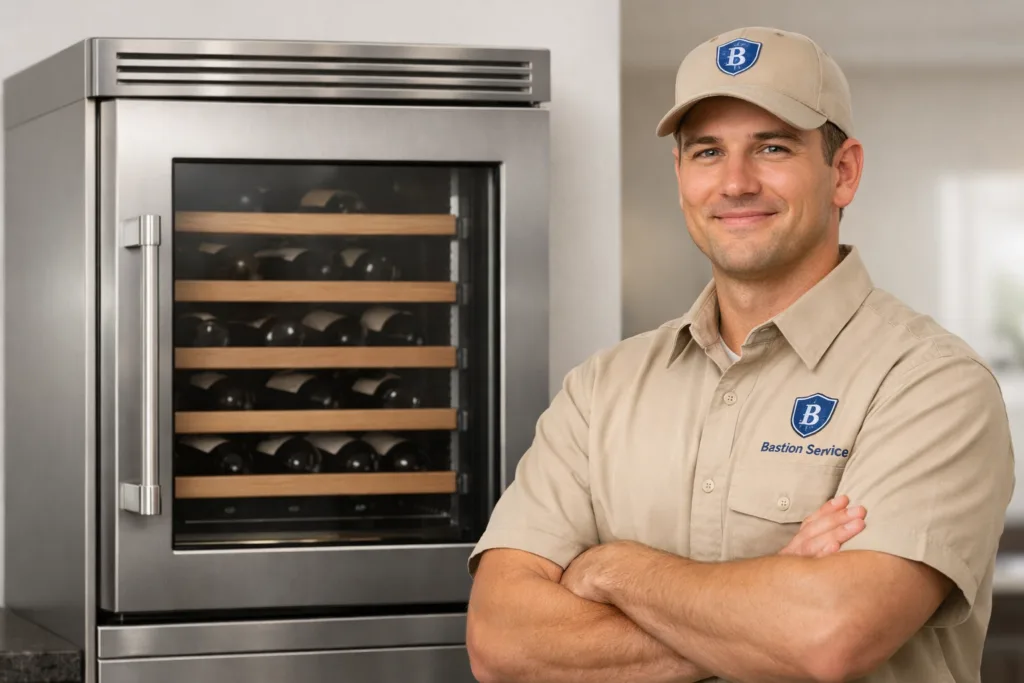
A Viking wine cooler that runs warm, develops moisture, or starts making new noises can affect both storage conditions and day-to-day confidence in the appliance. Because these units rely on stable airflow, accurate sensing, and consistent cooling performance, the most useful approach is to match the repair path to the symptom instead of guessing at parts.
What different symptoms usually point to
Many wine cooler complaints sound similar at first, but the underlying cause can be very different. A cabinet that feels warm may have an airflow problem, a sensor issue, a control fault, or a sealed-system concern. A noisy unit may still be cooling correctly, but a worn fan motor or vibration issue can signal that another part is under strain. Looking at the exact pattern of behavior helps narrow the problem quickly.
Wine cooler not cooling enough
If bottles are coming out warmer than expected or the interior never seems to reach the set temperature, the problem may involve restricted condenser airflow, a weak evaporator fan, a faulty thermistor, a control issue, or trouble in the refrigeration circuit. In Fairfax homes, this often shows up gradually at first, with the display appearing normal while the cabinet temperature drifts upward.
Warning signs include longer run times, slow recovery after the door is opened, and warmer upper or lower sections inside the cabinet. If the unit cannot maintain stable storage conditions, service should not be delayed.
Temperature swings or overcooling
A Viking wine cooler that alternates between too warm and too cold can be just as frustrating as one that stops cooling altogether. Fluctuations often point to sensor readings that are no longer accurate, inconsistent fan circulation, or control response problems. If one shelf feels much colder than another, or if the displayed setting does not match what you are noticing inside, the issue is usually more than normal variation.
Overcooling matters because wine storage depends on consistency. Freezing risk is uncommon but possible in some areas of the cabinet when airflow or control logic is off.
Constant running or unusual noise
It is normal for a wine cooler to cycle on and off, but nonstop operation usually means the unit is struggling to satisfy the temperature setting. Dirty condenser sections, poor ventilation, door gasket leaks, or a weakening compressor can all cause extended run times. In built-in installations, even a modest airflow restriction can push the unit to run longer than it should.
Noise complaints often come from one of a few places:
- Evaporator or condenser fan motors wearing out
- Compressor vibration changing under load
- Panels or trim rattling during operation
- Ice or frost interfering with fan movement
A sudden change in sound is often more meaningful than a low background hum that has always been there.
Condensation, leaks, or frost buildup
Moisture around the appliance can come from several sources, including a clogged drain path, a door that is not sealing evenly, heavy condensation caused by warm air intrusion, or frost buildup that disrupts normal circulation. Water under the unit should never be ignored, especially when the cooler is installed near finished flooring or cabinetry.
Condensation on the glass can sometimes be related to room conditions, but repeated moisture inside the cabinet or frost collecting in one area usually suggests a service issue. Left alone, that moisture can lead to reduced cooling performance and additional wear on fans and controls.
Display or control panel problems
If the display is blank, flashes unexpectedly, changes settings on its own, or becomes unresponsive, the issue may involve the interface, wiring, control board, or power supply to the unit. These problems can appear cosmetic at first, but they often affect compressor and fan operation behind the scenes.
When the controls stop behaving predictably, it is best not to rely on the displayed temperature alone. The cabinet may not be holding the storage conditions the panel suggests.
Common causes behind Viking wine cooler performance issues
Most residential repair calls come down to a few systems that work together. When one begins to fail, the symptom may seem simple even though the cause is not.
- Airflow problems: Dirty condenser areas, blocked circulation, or fan failure can cause warm temperatures and longer cycles.
- Sensor and thermostat faults: If temperature feedback is inaccurate, the cooler may overcool, undercool, or cycle irregularly.
- Door seal issues: A weak gasket lets in warm, humid air, which can lead to condensation, frost, and constant running.
- Drainage problems: Blocked drains or moisture mismanagement can create leaks or persistent internal dampness.
- Control failures: Electronic faults can affect lights, display behavior, fan operation, and compressor timing.
- Sealed-system concerns: Compressor, refrigerant, or related cooling-component problems typically show up as persistent temperature loss.
When to stop using the cooler and schedule service
Some problems can worsen if the appliance keeps running. If the cabinet is clearly warming, the compressor clicks without starting, the fan is making grinding or intermittent noise, or water is collecting under the unit, continued operation may increase damage or lead to a complete cooling failure.
It also makes sense to act quickly when the unit becomes unpredictable. Intermittent symptoms are often early signs of a component failing under load. A fan motor that works only part of the time, for example, may still cool the cabinet some days and fail completely the next.
Repair or replacement: what usually makes sense
For many Fairfax homeowners, the choice depends on the confirmed fault and the overall condition of the appliance. Repair is often worthwhile when the problem is isolated to a fan, sensor, control component, gasket, or drainage issue and the cabinet itself remains in good shape.
Replacement becomes more likely when the wine cooler has multiple overlapping failures, significant age-related wear, repeated repair history, or a major sealed-system issue that is disproportionate to the condition and value of the unit. The best decision usually comes from identifying the actual failed system first rather than reacting only to the symptom.
Helpful notes to gather before service
A few observations can make troubleshooting faster and more accurate. Before the visit, it helps to note:
- The current set temperature and any recent changes
- Whether the display appears normal or behaves erratically
- If the problem is constant or comes and goes
- Any recent increase in noise or vibration
- Whether moisture appears inside the cabinet, on the glass, or under the unit
- If the door seems loose, misaligned, or slow to seal
Those details often help distinguish between an airflow issue, a control problem, and a deeper cooling fault.
Focused help for Viking wine coolers in Fairfax
Viking wine coolers are designed for stable storage, so even small changes in temperature control, airflow, or sealing performance deserve attention. For homeowners in Fairfax, the goal is straightforward: determine why the unit is no longer maintaining proper conditions and choose the repair that fits the actual failure, the condition of the appliance, and the long-term value of keeping it in service.