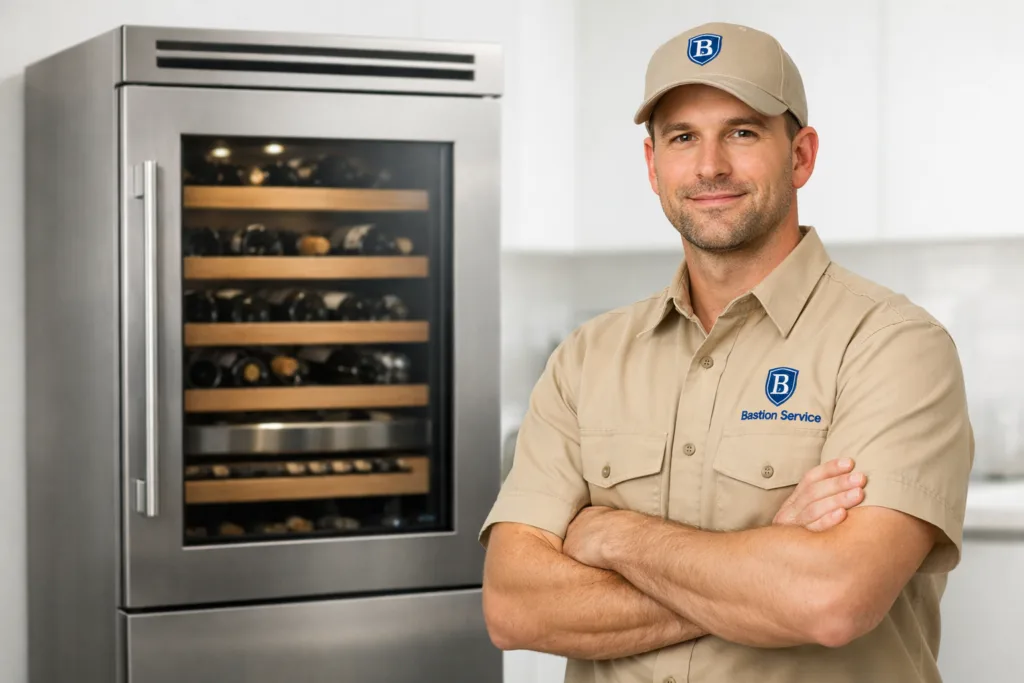
Stable wine storage depends on consistent cabinet conditions, not just whether the unit still powers on. When a Sub-Zero wine cooler starts drifting warm, collecting moisture, or making new noises, the same symptom can come from very different causes. That is why the best next step is to evaluate the pattern of the problem instead of guessing at a single failed part.
Common Sub-Zero Wine Cooler Problems in Fairfax Homes
Many wine cooler issues build slowly. A unit may seem mostly functional for days or weeks before the problem becomes obvious. In Fairfax homes, the most common complaints usually fall into a few symptom groups.
Temperature swings or a cabinet that runs too warm
If bottles feel warmer than expected or the display does not match actual cabinet conditions, the problem may involve airflow, a temperature sensor, a fan motor, the door gasket, or the cooling system itself. A cooler that works intermittently can be especially misleading because partial cooling often hides a problem that is getting worse.
Warning signs include:
- The cabinet reaches the set temperature only sometimes
- Temperatures rise after the door has been closed for a while
- Upper and lower sections feel noticeably different
- The display appears normal while the contents do not feel properly chilled
Unit running constantly or cycling longer than usual
A Sub-Zero wine cooler that rarely seems to rest may be trying to compensate for warm air entering the cabinet, restricted airflow, a faulty control, or reduced cooling performance. Long run times do not always mean a major failure, but they do mean the appliance is working harder than it should.
Left unresolved, constant operation can add wear to fans, controls, and the compressor. If the cooler has clearly changed its running pattern, that change is worth checking.
Condensation, interior fogging, or water buildup
Moisture inside or around a wine cooler is more than a cosmetic issue. It can point to a sealing problem, drainage issue, uneven temperatures, or air leaks around the door. If labels are getting damp, shelves are collecting water, or you keep seeing fogging on the glass, the unit is not maintaining conditions the way it should.
Common moisture-related signs include:
- Water droplets on shelves or interior walls
- Fogging that returns soon after wiping the glass
- Damp labels or packaging
- Condensation around the door opening
Fan noise, buzzing, rattling, or clicking
Some operating sound is normal, but a noticeable change in noise usually means something has shifted. Fan blades can become obstructed, mounting points can loosen, and internal components can start vibrating in ways they did not before. A louder-than-normal unit may still be cooling, but the sound change itself is useful diagnostic information.
If the noise appears during startup, while the door is closed, or only during certain parts of the cooling cycle, that pattern helps narrow down where the problem is coming from.
Control panel, display, or lighting problems
When controls respond inconsistently, temperatures display incorrectly, or interior lights behave erratically, the issue may be tied to sensors, electrical components, or the control system. These problems matter because they can affect actual cooling performance, not just convenience.
Why Similar Symptoms Can Mean Different Repairs
A warm cabinet does not automatically point to a compressor issue, and condensation does not automatically mean the door was left open. Premium refrigeration products often show overlapping symptoms. For example, a weak evaporator fan, a sensor problem, and a sealing issue can all lead to unstable temperatures.
That is why symptom-based troubleshooting matters. The repair path should come from what the cooler is actually doing over time: how it cycles, whether airflow is consistent, whether the door seals properly, and whether the displayed temperature matches the cabinet condition. Replacing parts based on assumption can increase cost without fixing the real problem.
What Fairfax Homeowners Can Check Before Scheduling Service
There are a few basic things worth checking before service is scheduled. These steps will not solve every issue, but they can rule out simple causes and help describe the problem more clearly.
- Make sure the door closes fully and is not blocked by shelves or bottle placement
- Check for visible gasket gaps, debris, or signs that the seal is not sitting evenly
- Note whether the issue started after a heavy restock or a recent temperature adjustment
- Listen for when unusual noises occur and whether they repeat in the same part of the cycle
- Look for recurring moisture, not just a one-time fogging event after the door was opened
If the problem continues after these basics are checked, further trial-and-error usually does more harm than good. Repeated warm temperatures, nonstop running, and recurring moisture are signs that the unit needs direct diagnosis.
When Repair Makes Sense
Many Sub-Zero wine cooler problems are worth repairing, especially when the cabinet, shelves, and overall condition of the appliance are still solid. Issues involving fan motors, sensors, controls, door gaskets, drainage, and certain electrical components are often practical to address when identified early.
Repair is usually more favorable when:
- The issue is isolated to one system or component group
- The cabinet and interior are otherwise in good shape
- The unit has been performing well until a recent change in behavior
- The problem can be traced to a serviceable part rather than broad overall decline
When Replacement May Be the Better Option
Replacement becomes more relevant when a wine cooler has multiple major failures, repeated cooling problems that keep returning, or repair costs that no longer make sense for its age and condition. The question is not whether the unit can be made to run again, but whether the repair path is reasonable and likely to provide dependable operation afterward.
Signs that replacement may need to be considered include:
- Multiple systems failing at the same time
- Longstanding cooling instability with a history of repeated service
- Severe wear combined with a major refrigeration problem
- Repair cost approaching the value of replacing the unit
Why Early Attention Helps Protect the Appliance
A wine cooler rarely improves on its own. A struggling fan can eventually affect temperature balance. A poor door seal can force longer run times. A control problem can cause the appliance to overrun or undercool without making the cause obvious from the display alone. Addressing the issue while the symptom is still limited often helps prevent added stress on surrounding components.
For homeowners in Fairfax, the practical advantage of early service is simple: it is easier to address one clear failure than a chain of related ones caused by continued operation under strain.
Sub-Zero Wine Cooler Repair Focused on the Actual Symptom
The most useful approach is to start with what the cooler is doing now: running warm, cycling too long, building condensation, showing control issues, or making unusual noise. From there, the repair decision should be based on confirmed cause, appliance condition, and whether the solution is likely to restore stable wine storage without unnecessary parts replacement.
For residential Sub-Zero wine cooler repair in Fairfax, that kind of targeted evaluation helps homeowners make a better decision about the next step, whether the issue turns out to be a manageable component repair or a sign of broader system decline.