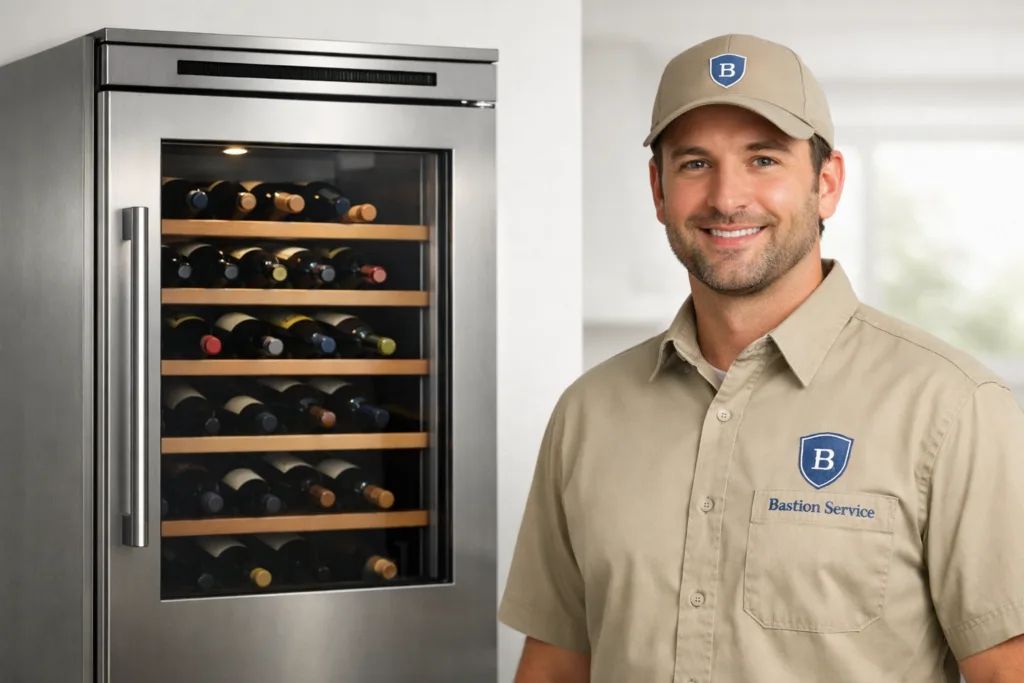
A True wine cooler that starts drifting out of range, collecting moisture, or making new noises can affect more than convenience. Wine storage depends on steady conditions, so even a small change in cooling performance can be worth attention before it turns into a larger failure.
Start with the symptom pattern
The most useful way to approach a wine cooler problem is to look at exactly what the unit is doing. A cabinet that is a few degrees warm, a display that seems inaccurate, and a unit that runs longer than usual may all seem related, but they can come from very different causes. Temperature sensors, control boards, fans, door gaskets, airflow restrictions, drainage issues, and sealed-system problems can overlap in ways that make guessing unreliable.
In Fairfax homes, symptom details often tell the story. Whether the cooler is still running, whether the light works, whether condensation appears near the door, and whether the sound profile has changed all help narrow down the likely repair path.
Common True wine cooler problems in Fairfax homes
Not cooling enough
If bottles feel warmer than expected or the cabinet struggles to hold its set temperature, the issue may involve restricted airflow, a weak fan, sensor trouble, dirty condenser components, or a refrigeration-system fault. Some units cool intermittently, which can make the problem easy to overlook at first. If the temperature slowly creeps upward over several days, that usually points to a problem that is developing rather than a one-time fluctuation.
Temperature swings
A cooler that moves between too warm and too cold can be especially frustrating because it may appear to recover and then drift again. This symptom can be tied to thermostat or sensor issues, control problems, poor air circulation, or a door that is not sealing consistently. Repeated fluctuation is a sign that the unit is no longer maintaining the stable environment it was designed to provide.
Fan noise, buzzing, or rattling
True wine coolers are not silent, but their normal operating sounds are usually predictable. A new rattle, clicking sound, louder hum, or noticeable fan noise often means something has changed inside the cabinet or behind it. A fan blade may be obstructed, mounting hardware may have loosened, or the unit may be working harder because heat is not being removed efficiently. Noise by itself does not confirm a major failure, but it should not be ignored when it appears alongside cooling changes.
Condensation, water, or frost
Moisture problems can show up in several ways: water under the unit, droplets on shelves, dampness around the door, or frost where it should not be forming. A worn gasket can pull humid air into the cabinet. A blocked drain path can keep water from exiting properly. Frost buildup may also point to airflow or defrost-related trouble. These issues often start small, then become more obvious as cooling performance declines.
Controls or display problems
Sometimes the cooler appears to be on, but the displayed temperature does not match the real cabinet temperature. In other cases, settings do not respond correctly, interior lighting works while cooling does not, or the unit powers on and off unpredictably. Control and sensor faults can mimic more serious refrigeration issues, which is why testing matters before replacing parts.
Signs it is time to schedule service
Homeowners in Fairfax often decide to have a wine cooler checked when they notice one or more of these changes:
- The cabinet no longer feels as cool as the setting indicates
- The unit runs almost constantly or starts short cycling
- There is water inside the cabinet or on the floor nearby
- The door does not close or seal as firmly as it used to
- Frost or heavy condensation keeps returning
- The cooler makes new buzzing, clicking, or rattling sounds
- The controls seem erratic or the display appears inaccurate
These symptoms do not all lead to the same repair. One unit may need a gasket or fan-related fix, while another with similar symptoms may have a more involved cooling-system issue.
Why continued use can make the problem worse
A wine cooler that is running outside its normal pattern often puts extra stress on its components. If the compressor runs too long because warm air is entering through a poor seal, wear increases. If water is collecting where it should not, nearby cabinetry or flooring can be affected. If airflow is restricted, the unit may keep trying to compensate without ever reaching the correct temperature.
That does not mean every issue is severe, but it does mean delay can change the repair from straightforward to more expensive. A minor sealing, fan, or drainage problem is usually easier to deal with before it leads to broader cooling trouble.
Repair or replacement depends on the failure
Not every malfunction calls for replacing the appliance. Many True wine cooler problems are practical to repair when the cabinet is otherwise in solid condition. Sensor issues, fan motor failures, gasket wear, drainage problems, and some control-related faults are often worth addressing. On the other hand, replacement becomes a more realistic discussion when there is major sealed-system trouble, repeated breakdown history, or a repair cost that does not make sense for the unit’s age and overall condition.
The key is to evaluate the actual failed component rather than deciding based on the symptom alone. A cooler that seems “not cooling” may have a manageable fault, while another with the same complaint may be nearing the end of its useful life.
What a focused service visit should clarify
For residential service, the goal is not just to confirm that the cooler is malfunctioning. It is to identify whether the issue is electrical, mechanical, airflow-related, or part of the refrigeration system, and then determine whether repair is practical. That gives homeowners a clearer next step instead of relying on trial-and-error part replacement.
If your True wine cooler in Fairfax is showing temperature swings, not cooling properly, developing condensation, or making new sounds, the best next move is to have the symptom pattern evaluated before storage conditions worsen further.