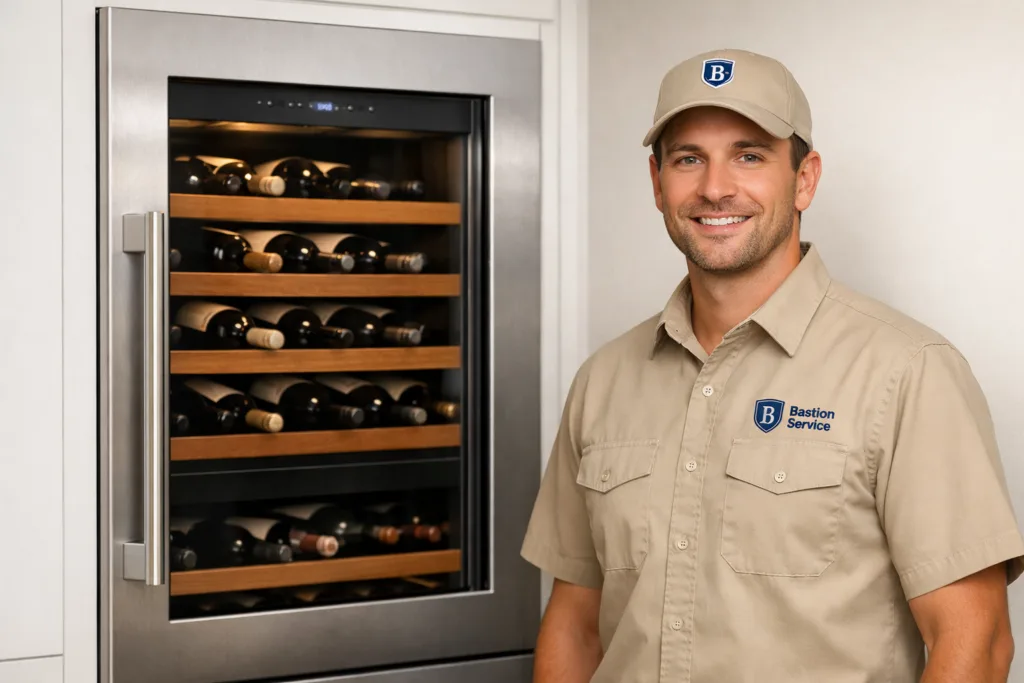
Stable storage conditions matter more in a wine cooler than in many other household appliances, so small changes in temperature, airflow, or humidity should not be ignored for long. On a Viking unit, symptoms that look simple from the outside can come from several different failure points, including sensors, fans, controls, door sealing problems, or compressor-related trouble. The most useful next step is identifying the source of the problem before deciding whether the repair is minor, urgent, or no longer cost-effective.
Common Viking wine cooler symptoms and what they may mean
Wine coolers are designed to maintain a narrow temperature range. When that stability disappears, the pattern of the problem often tells you a lot about where to look first.
Not cooling enough
If the cabinet feels warmer than the setting suggests, possible causes include restricted condenser airflow, a weak evaporator fan, sensor or thermostat issues, or trouble in the sealed cooling system. A unit that is only a few degrees off may have a very different repair path than one that has stopped cooling almost completely.
Temperature swings during the day
Fluctuating temperatures can point to an inaccurate thermistor, a control board problem, poor door sealing, or an intermittent fan or compressor issue. In some cases, the cooler reaches the set point briefly and then drifts because it is not reading cabinet conditions correctly.
Running all the time
When a Viking wine cooler runs nearly nonstop in a Mid-City home, it may be struggling to remove heat efficiently. Dirty coils, blocked ventilation, warm air leaking past the gasket, or a control fault can all keep the unit working longer than it should. Constant operation is more than a nuisance because it can increase wear on major components.
Shutting off too soon
If the cooler cycles off before the cabinet is actually cold enough, the issue may involve temperature sensing, electronic controls, or inconsistent fan operation. Short run times paired with warmer shelves often suggest the unit is getting the wrong information about internal temperature.
Condensation or moisture buildup
Moisture around the frame, on glass, or inside the cabinet usually means warm air is entering or the internal climate is not being controlled properly. A worn gasket is one possibility, but door alignment, drainage issues, and cooling performance should also be checked together.
New or louder noises
Buzzing, clicking, rattling, or persistent fan noise can each mean something different. Some sounds come from loose shelving, cabinet vibration, or normal cycling. Others suggest a failing fan motor, an overworked compressor, or start components that are struggling to keep the system operating normally.
Symptom-based causes technicians often find
Many Viking wine cooler repairs fall into a handful of categories, but these categories can overlap. That is why symptom-based testing matters more than guessing at a single part.
- Airflow problems: clogged coils, blocked vents, or weak condenser and evaporator fan performance
- Door sealing issues: torn gaskets, poor alignment, or doors that do not close fully
- Control and sensor faults: inaccurate temperature readings, thermostat problems, display irregularities, or board failures
- Compressor and start issues: hard starting, overheating, short cycling, or reduced cooling output
- Moisture and drainage concerns: excess condensation, water collection, or internal humidity problems
For example, a cooler that seems to have a bad fan may actually be overheating because airflow is restricted elsewhere. A unit that appears to have a gasket problem may be producing condensation because it is no longer maintaining consistent cabinet temperature. Looking at the full symptom pattern prevents unnecessary parts replacement.
When waiting can make the problem worse
Some wine cooler issues can safely be monitored for a short period, but others should be addressed sooner. If bottles are warming, the display no longer matches actual cabinet conditions, or the unit is leaking or making repeated unusual noises, delaying service can increase strain on the cooling system and lead to more expensive repairs.
Intermittent problems are also worth attention. A cooler that works normally for a day and then loses temperature again often has an electrical or control-related fault that may become more consistent over time.
Signs service should be scheduled soon
- The cabinet is warming even though the unit is running
- The compressor feels excessively hot
- The cooler starts and stops repeatedly
- Condensation is increasing around the door or on shelves
- Noise has changed from occasional to frequent
- The control panel is unresponsive or inaccurate
How homeowners usually decide between repair and replacement
Not every Viking wine cooler problem leads to the same answer. Repairs are often worthwhile when the fault is limited to a fan motor, sensor, gasket, control component, or another serviceable part. Replacement becomes more likely when diagnosis points to major sealed-system failure, repeated compressor trouble, or several problems in the same aging unit.
Most Mid-City homeowners weigh a few practical questions before moving forward:
- What specific part or system has failed?
- Is the rest of the cooler in solid condition?
- Does the repair cost make sense compared with replacement?
- Are the required parts available?
- Is the cooler likely to operate reliably after the repair?
Answering those questions gives a clearer path than relying on the symptom alone. A warm cabinet, for instance, can lead to a modest repair in one case and a major cooling-system decision in another.
What to expect from a focused service visit
A useful service call should do more than confirm that the appliance is not performing normally. It should identify how the unit is behaving, what components are involved, and whether continued operation risks additional damage. For homeowners in Mid-City, that kind of practical repair guidance helps turn a vague cooling complaint into a real next step.
On a Viking wine cooler, that evaluation typically includes checking temperature behavior, airflow, fan operation, door sealing, moisture patterns, and control response. Once those basics are tested together, it becomes easier to tell whether the problem is a straightforward repair, an issue that should be handled quickly, or a larger failure that changes the repair decision altogether.