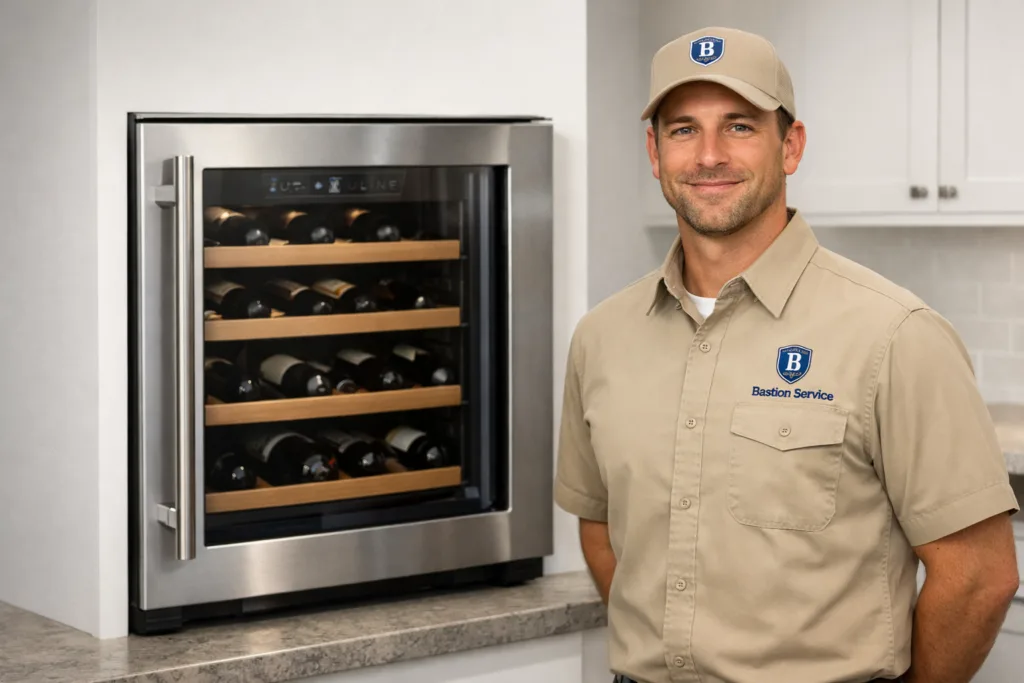
Wine coolers are less forgiving than standard kitchen refrigeration. A small airflow problem, a weak fan, or a drifting sensor can lead to noticeable temperature swings that affect storage conditions long before the unit fully stops cooling. When a U-Line wine cooler starts behaving differently in a Playa Vista home, the symptom pattern usually tells a lot about where the problem is developing.
How U-Line wine cooler problems usually show up
Most failures do not begin with a complete shutdown. More often, homeowners notice a gradual change in how the cooler runs. The cabinet may feel slightly warmer, the compressor may run longer than usual, or condensation may begin forming around the door. Those early signs matter because they often point to repairable issues before strain spreads to other components.
Useful diagnosis starts by separating similar-looking problems. For example, a cooler that is not cold enough could be dealing with restricted airflow, a bad fan motor, a control issue, a door seal leak, or a sealed-system problem. The symptom may look the same from the outside, but the repair path is very different.
Common symptoms and what they can mean
Not cooling enough
If bottles are not reaching the expected temperature, the issue may be related to weak air circulation, a faulty temperature sensor, control trouble, condenser buildup, or declining cooling performance. Sometimes the unit still sounds active and appears to run normally, but the interior never stabilizes where it should. That often means the cooler is working harder without delivering proper results.
Signs to watch for include:
- The display shows the set temperature, but the cabinet feels warmer
- The compressor runs for long stretches
- Cooling improves briefly and then slips again
- Different shelves feel noticeably different in temperature
Running constantly or cycling too often
A U-Line wine cooler that rarely shuts off may be trying to overcome warm air infiltration, poor ventilation, dirty condenser components, or reduced cooling efficiency. Frequent on-and-off cycling can point to sensor errors, control board issues, startup trouble, or overheating protection.
Neither pattern should be ignored. Constant operation increases wear, while short cycling can make temperature stability worse and place extra stress on electrical components.
Fan noise, buzzing, clicking, or rattling
Noise matters most when it is new, louder than before, or paired with poor cooling. Interior fan noise may suggest a failing fan motor, blade interference, or frost buildup affecting airflow. Buzzing and repeated clicking can indicate compressor start trouble. Rattling may be something simple like vibration against a panel, but it can also show up when internal components are under strain.
The timing of the sound is often helpful. A noise that appears only during startup is different from one that continues throughout the cooling cycle.
Condensation or water inside the cooler
Moisture inside the cabinet or around the door is commonly linked to warm air entering through a weak gasket, repeated door openings, drainage issues, or a unit that is struggling to regulate temperature correctly. If condensation is left unchecked, it can lead to odor, shelf damage, and added stress on fans and controls.
Look for patterns such as:
- Water collecting near the bottom of the cabinet
- Moisture beads around the door opening
- Fogging that returns shortly after wiping surfaces dry
- Condensation appearing with temperature inconsistency
Display or control problems
If the display is blank, flashing, inaccurate, or not responding to settings, the problem may involve the user interface, main control, wiring, or temperature sensing components. When the displayed reading no longer matches actual cabinet conditions, homeowners can end up adjusting settings repeatedly without solving the real problem.
What can cause temperature swings in a wine cooler
Temperature fluctuation is one of the most common complaints because several different faults can produce it. In a U-Line wine cooler, swings may be caused by sensor drift, intermittent fan operation, unstable compressor performance, ventilation problems, or door sealing issues. Even small variations become important when the appliance is meant for steady wine storage rather than broad food-safe refrigeration ranges.
If the cabinet seems fine one day and warm the next, that inconsistency often points to a component that is failing intermittently rather than one that has stopped outright. Those are the cases where symptom-based testing is especially useful.
When waiting makes the repair harder
Some homeowners keep using the unit as long as it is cooling at least a little. The problem is that partial cooling can hide a worsening fault. A struggling fan, overworked compressor, or leaking gasket may not stop operation immediately, but continued use can increase wear and make the final repair more expensive.
It makes sense to schedule service sooner when you notice any of the following:
- The cooler runs but does not hold the set temperature
- Condensation keeps returning
- Noise is getting louder or more frequent
- The cabinet is warm even though the controls appear normal
- The unit is cycling oddly or running nonstop
Repair or replace: what usually makes sense
Many wine cooler problems are worth repairing when the issue is limited to fans, controls, sensors, gaskets, drains, or other serviceable components and the cabinet remains in otherwise solid condition. Repair becomes less attractive when the unit has major sealed-system failure, repeated breakdowns, or long-term cooling instability tied to age and high-cost parts.
A practical repair decision depends on more than whether the unit technically turns on. It should consider:
- How well the appliance has been holding temperature recently
- Whether the fault is isolated or part of broader deterioration
- The condition of the cabinet, seals, and interior components
- The likelihood that repair will restore reliable storage conditions
What a service visit should help clarify
For homeowners in Playa Vista, the goal is not just to identify a failed part. The visit should clarify why the wine cooler lost performance, whether continuing to run it risks further damage, and which repair path makes the most sense for that specific U-Line model. That includes checking cooling behavior, airflow, controls, fan operation, seals, drainage, and overall appliance condition.
When those findings line up with the symptoms you have been seeing at home, it becomes much easier to decide on the next step with confidence. In many cases, that means a straightforward repair. In others, it means recognizing early that replacement is the smarter long-term choice.