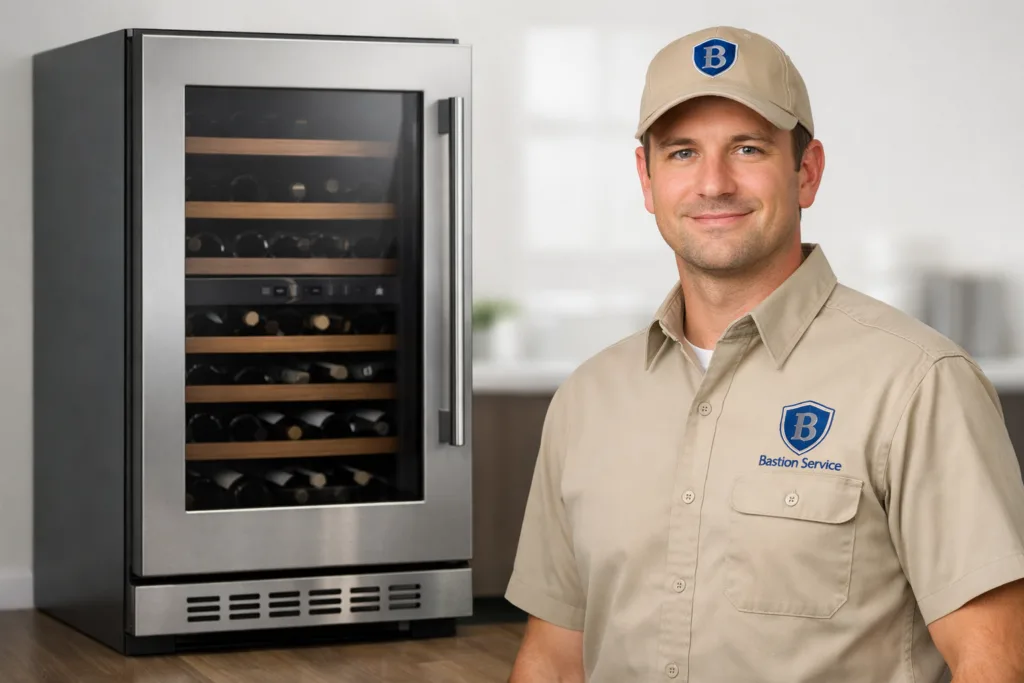
Small temperature changes inside a wine cooler can affect storage quality long before the problem becomes obvious. If a KitchenAid unit starts running warm, develops condensation, makes new fan noise, or cycles in a way that seems unusual, the main goal is to identify whether the issue is airflow-related, electrical, control-based, or tied to the refrigeration system itself.
How symptom patterns help narrow down the problem
Wine coolers often fail in ways that look similar from the outside. A cabinet that no longer holds a steady temperature might have dirty condenser coils, blocked ventilation, a weak fan motor, a faulty thermistor, a control board issue, or a compressor-related problem. Because several different faults can create the same end result, symptom-based testing is more useful than replacing parts based on guesswork.
In Playa Vista homes, installation conditions can also affect performance. Built-in and under-counter KitchenAid wine coolers need enough airflow around the cabinet, unobstructed vents, and a door gasket that closes evenly. Even when the display appears normal, trapped heat or humid room air entering through a poor seal can lead to unstable temperatures and moisture inside the unit.
Common KitchenAid wine cooler issues
Not cooling enough
If bottles are no longer staying at the selected temperature, the cause may be as simple as restricted airflow or as serious as a sealed-system failure. Common possibilities include:
- Dust or debris on condenser coils
- Condenser or evaporator fan problems
- A temperature sensor reading incorrectly
- Control board or thermostat faults
- Start device, compressor, or refrigerant system issues
A unit that runs for long periods without recovering temperature usually needs attention sooner rather than later, since extended run time can increase wear on cooling components.
Overcooling or freezing bottles
When a KitchenAid wine cooler starts driving temperatures too low, the issue is often related to sensing or control rather than basic airflow. A faulty thermistor, thermostat, or control board can cause the system to cool past the set point. If contents are beginning to freeze, it is best not to keep relying on the current setting, since the unit may no longer be responding accurately.
Water, condensation, or excess humidity
Moisture inside the cabinet can point to several different conditions. A worn or misaligned door gasket may allow humid air to enter. Frost may form and later melt into water at the bottom of the cabinet. In some units, a drain or defrost-related issue can also contribute. Condensation on shelves, labels, or the interior walls is more than a cosmetic problem, especially if it happens repeatedly.
Buzzing, rattling, or fan noise
Some operating sound is normal, but a new or louder sound usually deserves a closer look. Rattling can come from cabinet vibration or loose panels. Buzzing may be related to the compressor or fan assembly. Clicking can sometimes indicate a start issue or repeated attempts to begin a cooling cycle. If noise appears together with weak cooling, that combination usually points to a mechanical or electrical fault rather than a minor annoyance.
Lights and display work, but the cabinet is warm
This is one of the more misleading symptom patterns. Interior lighting and an active display only confirm that the unit has some electrical power. They do not confirm that the fans, start components, controls, or sealed system are operating correctly. A wine cooler can appear powered on while still failing to cool.
What can affect performance in a residential kitchen or bar area
KitchenAid wine coolers installed under counters or in enclosed cabinetry are especially sensitive to airflow. If heat cannot escape properly, the unit may run longer, cool less effectively, and develop excess wear over time. Homeowners in Playa Vista also sometimes notice performance changes after cabinetry shifts slightly, shelves are overloaded, or the door begins closing unevenly.
Basic conditions worth checking include:
- Whether vents are blocked by trim, items, or dust buildup
- Whether the door gasket is making full contact
- Whether bottles or shelves are restricting internal air circulation
- Whether the unit is running constantly without reaching the set temperature
- Whether frost or moisture is forming in one area repeatedly
Signs it is time to schedule service
Service is usually a good idea when the wine cooler shows a consistent pattern rather than a one-time fluctuation. That includes temperature swings that last more than a short period, repeated condensation, new frost buildup, persistent mechanical noise, or a cabinet that seems to run almost nonstop.
It also makes sense to have the unit checked if:
- The displayed temperature does not match actual cabinet conditions
- The cooler starts cycling on and off abnormally
- The door alarm or controls behave unpredictably
- Cooling has become noticeably slower than before
- Water appears inside the cabinet more than once
When a cooling problem is left alone, a minor fan, sensor, or sealing issue can sometimes lead to added strain on larger components.
Repair versus replacement
Many KitchenAid wine cooler problems are still worth repairing, especially when the fault involves fans, temperature sensors, controls, door sealing, or other accessible components. In those cases, restoring normal operation may be straightforward once the failed part is confirmed.
Replacement becomes a more serious consideration when the unit has major sealed-system trouble, repeated cooling breakdowns, or repair costs that no longer make sense compared with the age and condition of the appliance. For homeowners in Playa Vista, the deciding factor is usually not the symptom alone but the underlying cause, the condition of the cabinet, and the expected reliability after repair.
What a diagnosis should confirm
A thorough inspection should establish whether the problem is coming from temperature sensing, restricted airflow, a fan motor, control failure, starting components, door sealing, or a larger refrigeration issue. That distinction matters because each category leads to a very different repair path and cost range.
For a household wine cooler, steady operation matters more than occasional short-term cooling. If your KitchenAid unit is no longer holding temperature, is developing moisture, or is making unusual sounds, a diagnosis-led service visit can clarify whether the problem is manageable and what the most sensible next step looks like.