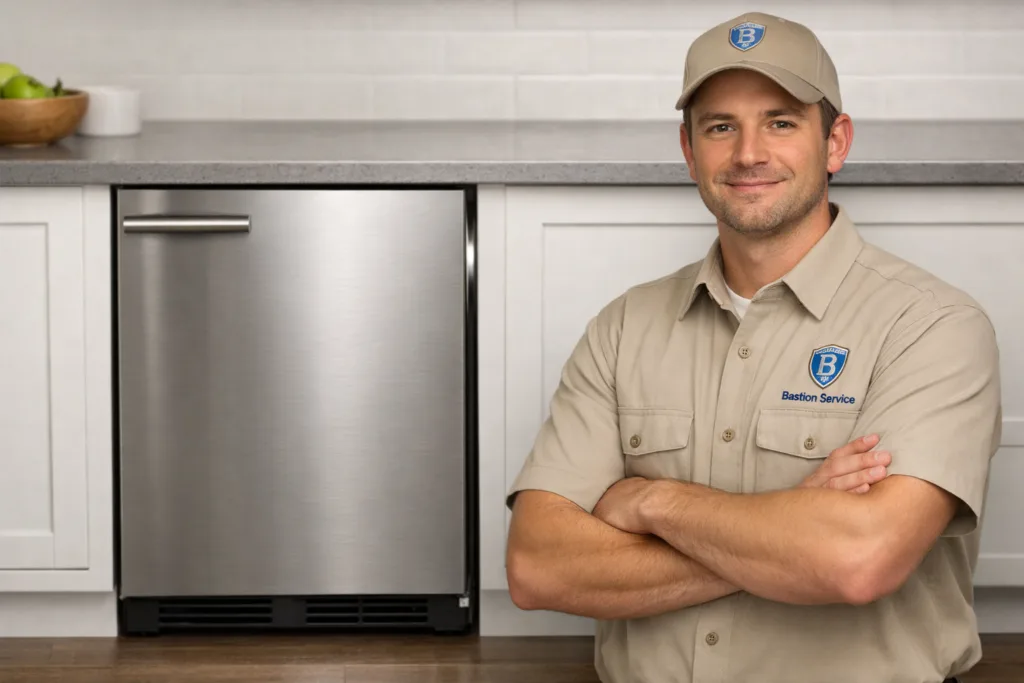
Temperature trouble in a U-Line refrigerator rarely has just one obvious cause. A unit that seems warm one day and overly cold the next may be dealing with an airflow restriction, a sensor problem, a fan issue, poor door sealing, or a fault in the cooling system itself. Looking at the full symptom pattern usually tells more than any single sign on its own.
In Playa Vista homes, refrigerator problems also tend to show up in practical ways first: food spoils faster, drinks are not as cold, shelves feel uneven in temperature, frost starts appearing where it did not before, or water begins collecting under the unit. Those changes are worth attention early, before they lead to food loss or added strain on major components.
What symptom patterns often mean
U-Line refrigerators are designed for steady, controlled cooling, so a noticeable change in performance usually points to a real operating problem rather than normal variation. The most useful starting point is to match the symptom to the likely system involved.
Refrigerator is running warm
If the cabinet is not reaching a safe temperature, possible causes include dirty condenser coils, restricted airflow, evaporator fan problems, condenser fan failure, sensor or thermostat issues, or a sealed system problem. Warm operation should be taken seriously because the refrigerator may keep running without actually preserving food properly.
Homeowners sometimes notice that the unit sounds active and assume it is still cooling normally, but a refrigerator can run for long periods while still falling behind on temperature. When that happens, the issue is often not whether it turns on, but whether the cooling system is moving and regulating cold air correctly.
Food is freezing in the refrigerator section
Unexpected freezing can point to a temperature control fault, a bad sensor reading, an airflow imbalance, or a problem with how cold air is being directed inside the cabinet. This is especially common when some shelves seem normal while others are much colder than expected.
Although freezing may seem less urgent than warming, it still indicates that the refrigerator is no longer controlling temperature accurately. That can lead to wasted groceries and can signal a broader control issue that may get worse over time.
Frost is building up
Frost buildup often means moisture is entering where it should not or that the unit is not clearing frost as intended. Common causes include a worn door gasket, poor door closure, repeated warm-air intrusion, airflow blockage, or a defrost-related fault.
When frost spreads behind interior panels, airflow can become restricted enough to affect cooling throughout the cabinet. In many cases, homeowners first notice the refrigerator running longer or sounding different before the temperature problem becomes obvious.
Water is leaking inside or onto the floor
Leaks usually trace back to drainage problems, condensation issues, leveling concerns, or door-seal trouble. A blocked drain can allow water to collect inside and eventually spill outward, while excess condensation may suggest warm air is getting into the cabinet more often than it should.
Water around a refrigerator should not be ignored. Even a small leak can damage flooring, encourage odor buildup, or create repeated moisture issues around the appliance.
New or unusual noises
Buzzing, clicking, rattling, humming, or fan noise may come from normal operation, but a change in sound often helps narrow down the problem. Fan blades can become obstructed by ice, mounting points can loosen, and components under load can begin sounding louder than usual.
If the sound change happens at the same time as cooling problems, frost, or frequent cycling, it becomes more meaningful as a diagnostic clue. The noise itself may not be the only problem; it may be the result of another failure developing inside the unit.
Unit runs constantly or starts and stops too often
A refrigerator that rarely shuts off may be struggling to reach its target temperature. A unit that short cycles may be dealing with a control, sensor, compressor, or airflow issue. Either pattern usually means the appliance is no longer operating in a stable, efficient rhythm.
Long run times can also increase wear on the system, especially if the root cause is forcing the refrigerator to work harder than normal just to maintain basic cooling.
Why similar symptoms can have different causes
One of the more frustrating parts of refrigerator repair is that the same symptom can come from very different failures. Poor cooling might be caused by a fan problem, dirty coils, a faulty control, restricted airflow, or a sealed system issue. Frost buildup may come from a simple door-seal problem or from a deeper defrost failure.
That is why replacing a part based only on the most obvious symptom can lead to unnecessary cost and lost time. The goal is to identify which system is failing and whether that failure is isolated or part of a larger condition affecting the appliance.
When service is worth scheduling
Service usually makes sense when the refrigerator is not holding temperature, begins freezing food unexpectedly, leaks water, develops repeated frost, starts making new noises, or shows inconsistent cooling from day to day. Even if the unit still appears to be working part of the time, unstable performance often means the problem is advancing.
- Drinks are no longer staying cold enough
- Fresh food spoils sooner than expected
- Items near vents freeze while other areas feel warm
- Condensation or water appears repeatedly
- The compressor seems to run almost nonstop
- Frost returns shortly after being cleared
These are the kinds of signs that often point to more than simple adjustment needs. In many cases, waiting turns a manageable repair into a bigger cooling or moisture problem.
When continued use can make things worse
Some refrigerator problems do not stay contained for long. Heavy frost can choke off airflow, a blocked drain can keep leaking, and a fan under strain can fail completely. If the compressor is running continuously because the unit cannot reach temperature, continued operation may add stress to an already overworked system.
If food temperatures are no longer reliable, it is smart to avoid treating the refrigerator as if it is operating normally. Protecting perishables and addressing the cause early is often the safer and less disruptive choice.
Repair or replace?
Many U-Line refrigerator problems are repairable when the issue is limited to components such as fans, controls, sensors, gaskets, or drainage parts and the cabinet itself is still in good condition. Repair becomes less attractive when the appliance has major sealed system trouble, multiple age-related failures, or a history of repeated breakdowns.
The right decision usually depends on the exact failure, the condition of the unit overall, and whether the repair path restores stable performance rather than offering only a temporary improvement. For homeowners in Playa Vista, that practical comparison matters more than guessing based on age alone.
What to pay attention to before the visit
A few observations can make the problem easier to pinpoint. It helps to note whether the refrigerator is warm all the time or only at certain times of day, whether frost is visible in one area or across multiple surfaces, whether the leak appears after door openings or overnight, and whether unusual sounds happen during startup, shutdown, or constant operation.
It is also useful to check whether the door closes fully, whether shelves or bins are blocking closure, and whether the problem appeared gradually or all at once. Small details often help separate a control issue from an airflow issue or a drainage problem from a cooling-system fault.
Residential help for U-Line cooling equipment
Some households in Playa Vista have more than one U-Line cooling product in use, especially in kitchens, entertainment spaces, or built-in storage areas. In addition to refrigerator issues, similar symptom-based troubleshooting may be helpful for a freezer, ice maker, or wine cooler when the problem involves temperature swings, frost, leaks, or unusual cycling behavior.
Bastion Service helps homeowners evaluate U-Line refrigerator problems based on how the unit is actually behaving, so the next step is guided by the symptom, appliance condition, and repair path rather than assumption.