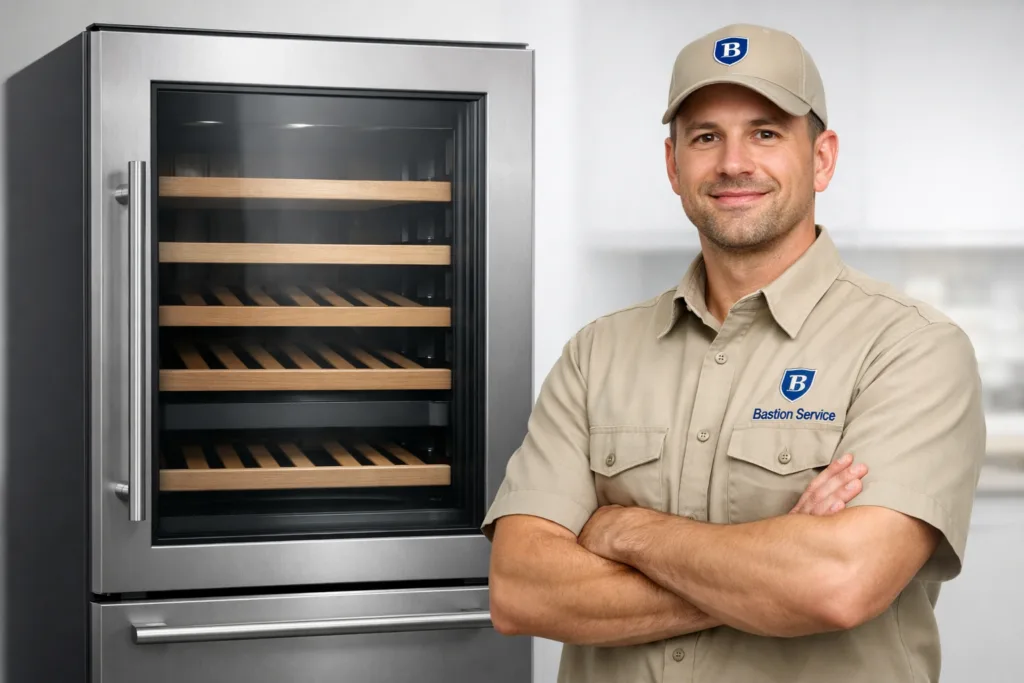
A True wine cooler that runs warm, cycles too often, or starts collecting moisture can put your collection at risk surprisingly quickly. Similar symptoms can come from very different problems, including restricted airflow, sensor drift, control faults, door seal wear, drainage issues, or more serious refrigeration trouble. That is why the most useful next step is to evaluate the actual pattern of failure instead of assuming every cooling issue means the same repair.
Start with what the cooler is doing day to day
Wine storage depends on consistency. When a cabinet begins running a few degrees high, cooling unevenly, or changing behavior from one day to the next, those changes usually show up before the unit stops working completely. Paying attention to the symptom pattern can help narrow down where the problem is starting.
- Running warm all the time may point to airflow restrictions, fan trouble, dirty condenser components, or a failing control input.
- Temperature swings often suggest sensor issues, intermittent fan operation, thermostat or board problems, or a door that is not sealing well.
- Condensation on glass or shelving can be tied to gasket wear, unstable cooling, blocked drainage, or excessive run time.
- Buzzing, clicking, humming, or vibration may come from fans, compressor stress, mounting or leveling issues, or components working harder than normal.
Even when the cooler still appears partly functional, these symptoms matter because wine coolers are designed for stable holding conditions rather than wide temperature variation.
Common True wine cooler problems in Del Rey homes
Not cooling enough
If the cabinet no longer reaches the selected setting, the cause may be as simple as poor airflow through the ventilation path or as complex as a sealed-system problem. A weak evaporator fan, heat buildup around the condenser area, inaccurate temperature feedback, or electronic control trouble can all leave the unit running without maintaining proper storage conditions.
This is one of the most important issues to address early. When the cooler keeps trying to recover but never reaches the target temperature, components can stay under strain for long periods.
Temperature swings from shelf to shelf
Uneven temperatures inside the cabinet are often overlooked because the unit still feels cold in some areas. In practice, this can mean air is not circulating correctly, the fan is slowing down, a sensor is misreading cabinet conditions, or the control system is cycling at the wrong times. If one section feels noticeably warmer than another, the problem is usually more than ordinary variation.
Condensation, fogging, or water inside
Moisture on the glass, damp labels, or water collecting under shelving usually points to a condition that should not be ignored. A worn gasket can allow humid room air into the cabinet. A blocked drain can keep water from clearing properly. Short cycling or unstable cooling can also create repeated condensation that never fully dries out. If moisture is showing up regularly, it is worth checking before it leads to odor, staining, or added stress on internal parts.
Fan noise, vibration, or constant running
A noticeable change in sound is often one of the earliest clues that something is wrong. Rattling can come from loose panels or mounting. A louder hum may indicate a compressor working harder than it should. Clicking, uneven airflow noise, or vibration can point to fan issues or an installation problem affecting normal operation. When unusual noise appears together with weak cooling, that combination deserves attention sooner rather than later.
Signs the issue may be getting worse
Some problems stay relatively stable for a short time, while others tend to escalate quickly. Continued use can make the repair more involved if the cooler is:
- running almost nonstop
- warming despite the door staying closed
- building moisture repeatedly
- showing frost where it normally does not
- making new noises during cooling cycles
- leaking under or inside the cabinet
In Del Rey households, it is common to wait a few days to see whether the problem clears up on its own. With wine coolers, that usually does not help much. Ongoing temperature instability and airflow problems rarely resolve without service, and delay can increase wear on major components.
Repair or replacement depends on the failed system
Many True wine cooler issues are repairable when the failure is isolated to parts such as fans, sensors, controls, switches, lighting components, or door seal items. In those cases, restoring proper operation can be a sensible path if the cabinet and refrigeration system are otherwise in good condition.
Replacement becomes a more serious consideration when the unit has major sealed-system trouble, repeated breakdowns, or repair costs that start approaching the value of the appliance. Age alone does not decide the answer. What matters more is which system has failed, whether parts access is reasonable, and whether the repair is likely to return the cooler to stable performance.
What to check before service
You do not need to diagnose the problem yourself, but a few observations can make service more efficient:
- Note the current displayed temperature and whether it matches actual cabinet conditions.
- Pay attention to whether the issue is constant or comes and goes.
- Listen for changes in fan noise, clicking, humming, or vibration.
- Look for condensation on the glass, damp shelving, or water under the unit.
- Check whether the door closes fully and the gasket sits evenly all the way around.
- For a built-in installation, keep the front ventilation area unobstructed.
If the cooler is still operating, avoid overloading it and try to limit unnecessary door openings until it can be checked.
Why symptom-based diagnosis matters for a wine cooler
With refrigeration appliances, the same visible complaint can have several causes. “Not cooling” might actually be a fan problem, a sensor issue, a blocked airflow path, an electronic control fault, or a more serious refrigerant-related condition. “Leaking” might be drainage, condensation, or a door seal problem rather than a plumbing issue. Looking at the exact symptoms first helps avoid replacing the wrong part and gives a better sense of whether repair is practical.
Focused help for True wine cooler repair in Del Rey
For homeowners in Del Rey, the goal is to protect both the appliance and the bottles stored inside it. Whether the cooler is running warm, showing moisture, making new noise, or behaving unpredictably, the best next step is a clear diagnosis tied to the way the unit is actually failing in everyday use. From there, it becomes much easier to decide whether a targeted repair is the right move.