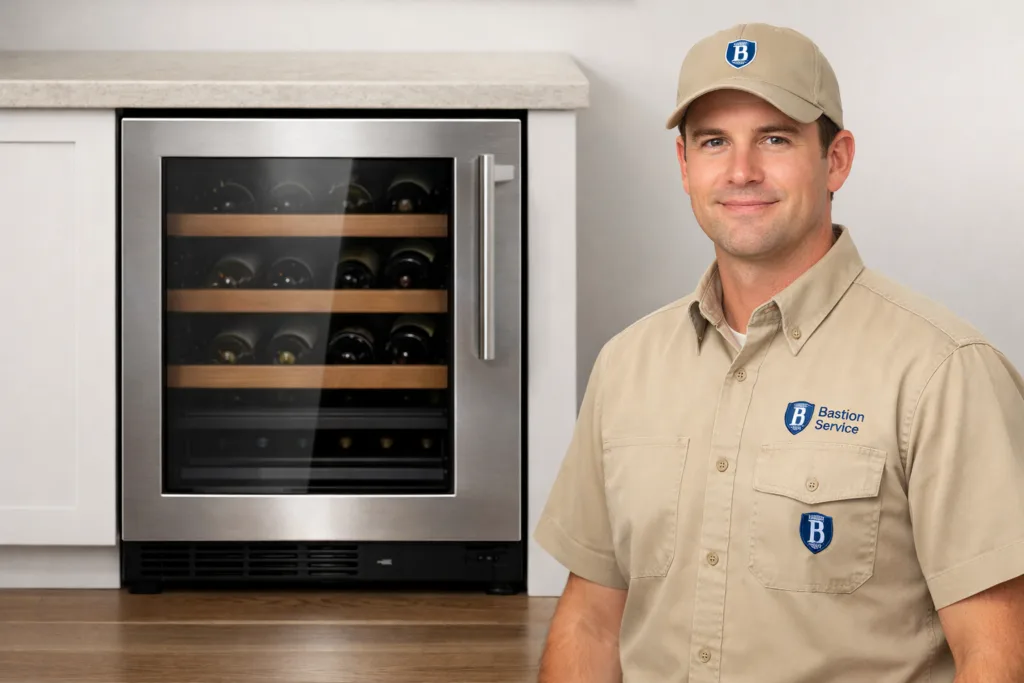
Wine coolers protect more than convenience. They help preserve flavor, balance, and long-term storage conditions that can be affected quickly when temperature, airflow, or humidity drift out of range. With U-Line units, the same outward symptom can come from several different faults, so the best repair decisions usually start with identifying what the cooler is actually doing from cycle to cycle.
Common U-Line wine cooler symptoms and what they may mean
Not cooling enough
If bottles feel warmer than expected or the cabinet never seems to reach the selected setting, the problem may involve weak airflow, a failing evaporator fan, dirty condenser components, a control issue, or a sealed-system problem. In some homes, the cooler may still produce some cooling but not enough to hold a stable storage temperature, which can make the issue seem intermittent even when it is steadily getting worse.
When a unit is cooling unevenly, diagnosis should look at whether the problem is being caused by heat exchange, circulation, sensing, or compressor performance rather than assuming the thermostat is the only culprit.
Temperature swings
A cabinet that cools, then warms, then cools again may point to a sensor reading problem, control board behavior, fan interruption, or restricted ventilation. Temperature swings are especially important with wine storage because repeated fluctuation is often more damaging than a single brief change.
If you notice that one section feels cooler than another, or that the display and the actual cabinet condition do not match, that often suggests the issue is not simply user settings. It usually means one part of the cooling process is no longer responding as it should.
Running constantly or cycling too often
A U-Line wine cooler that seems to run almost nonstop is often working harder than normal to overcome warm air intrusion, poor heat release, dirty coils, or reduced cooling efficiency. If it starts and stops too frequently instead, the cause may be related to controls, sensors, or electrical components that are not managing the cooling cycle properly.
Either pattern adds wear. A unit that never rests can strain major components, while short cycling can prevent proper temperature pull-down and create unstable storage conditions inside the cabinet.
Condensation or water inside the cabinet
Moisture inside a wine cooler may come from a door gasket that is no longer sealing tightly, a blocked drain path, excess humidity entering the cabinet, or a leveling issue that affects how water moves during normal operation. If water is reaching shelves, labels, or the area around the base, it is worth addressing before the problem spreads to nearby cabinetry or flooring.
Repeated condensation also matters because it can be a clue that warm outside air is getting in more often than it should, which usually means the cooler is dealing with both a moisture issue and a temperature-control issue at the same time.
Fan noise, rattling, or louder humming
Some operational sound is normal, especially when the unit starts a cooling cycle. What should stand out is a new sound, a louder than usual hum, rattling against surrounding surfaces, clicking that repeats abnormally, or a fan noise that changes pitch. These symptoms may point to a fan motor problem, loose internal components, vibration from installation shifts, or a compressor that is under added stress.
Noise changes are often one of the earliest signs that a repair is needed. Even if cooling has not fully failed yet, a mechanical sound that was not present before usually deserves attention.
Why symptom patterns matter
One reason wine cooler repairs can be misjudged is that different failures can look similar from the outside. A warm cabinet might be caused by weak airflow rather than a major sealed-system defect. Water inside the unit might be drainage-related rather than a cooling failure. A cooler that seems dead may actually have a control or power issue instead of a failed compressor.
Looking at the full symptom pattern helps narrow the repair path. Useful clues include whether the display is working, whether the fan can be heard, whether the temperature problem is constant or occasional, whether moisture appears after door openings or even when the unit stays closed, and whether unusual sounds happen at startup, during running, or at shutdown.
Problems that should not be ignored
Scheduling service makes sense sooner rather than later when the cabinet is no longer holding a safe storage temperature, the cooler is running almost all the time, fan noise has become obvious, or condensation keeps returning after basic cleaning and door checks. These are the kinds of symptoms that often worsen with delay.
- Bottles no longer feel consistently cool
- The displayed temperature does not match cabinet conditions
- Water collects inside or around the base
- The door does not close or seal firmly
- New buzzing, rattling, or clicking develops
- The unit cycles in an unusual pattern day after day
In built-in installations, waiting can be harder on the appliance because trapped heat and tight clearances may amplify existing airflow or cooling problems.
Repair issues often found with U-Line wine coolers
On residential units, many service calls come down to a smaller group of faults than homeowners expect. Controls, thermistors or sensors, evaporator or condenser fan motors, door gaskets, drain issues, and condenser cleaning needs are all common places to start. Some cases do lead to compressor or refrigerant-side concerns, but not every cooling complaint points there.
That distinction matters because repair value can look very different depending on the failed component. Replacing an accessible control or gasket is a different decision from addressing a major cooling-system failure in an older appliance.
How to decide between repair and replacement
For many Del Rey homeowners, the question is less about whether the unit can be repaired and more about whether repair is the sensible investment. A good candidate for repair usually has a solid cabinet, a door that still aligns properly, and an issue limited to a specific serviceable part. Repair becomes less attractive when the cooler has a history of recurring cooling loss, significant sealed-system trouble, or age-related wear in multiple areas at once.
It also helps to consider how the appliance is used. If the cooler remains the right size and configuration for the household, a focused repair may extend its useful life without changing the kitchen or bar setup. If the unit has been struggling repeatedly and performance has been inconsistent for a while, replacement may offer a better long-term outcome.
What homeowners can check before service
Before arranging U-Line wine cooler repair in Del Rey, a few basic observations can help make the problem easier to pinpoint:
- Confirm the cooler has adequate space for ventilation and is not packed tightly against surrounding surfaces.
- Check whether the door closes evenly and the gasket makes full contact.
- Look for visible condensation, standing water, or frost where it should not be.
- Listen for whether the fan and compressor sounds are normal, absent, or unusually loud.
- Notice whether the issue is constant or appears at certain times of day.
These checks do not replace service, but they can help separate a simple use or airflow issue from a component problem that needs repair.
A focused approach for Del Rey homes
In Del Rey, residential wine cooler service is most useful when it stays centered on the actual symptom, the condition of the appliance, and the likely repair path. That helps homeowners avoid guessing, protects the wine stored inside, and makes it easier to decide whether the next step should be repair now or replacement instead of further spending on a declining unit.
For U-Line wine coolers, the most important thing is not to assume that every warm cabinet, noise complaint, or moisture issue means the same failure. Once the source of the problem is identified, the repair decision becomes much more straightforward.