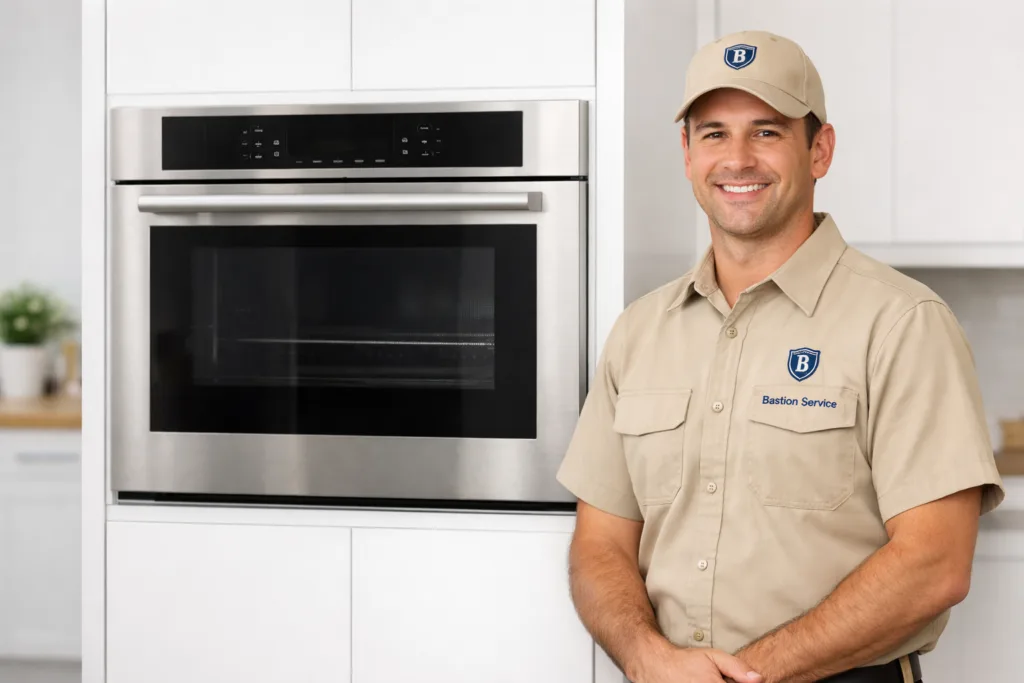
Built-in wall ovens tend to fail in ways that look similar at first but come from very different causes. A Thermador unit that bakes unevenly may have a sensor issue, an airflow problem, a weak heating circuit, or a control fault. That is why the most useful first step is to match the exact symptom to the likely system involved instead of guessing based on one bad cooking result.
How Thermador wall oven symptoms usually show up
Many Rancho Park homeowners first notice a wall oven problem through food results rather than a complete shutdown. Cookies brown too fast on one side, casseroles need extra time, or preheat drags on much longer than before. In other cases, the change is more obvious: the display flashes an error, the oven turns off during a cycle, or one cavity in a double oven stops working while the other still runs.
Those details matter because symptom patterns often point in different directions:
- No heat at all: possible power supply, element, thermal cutoff, wiring, or control issue
- Slow preheat: possible weak element, sensor drift, relay problem, or incomplete heating cycle
- Temperature swings: possible sensor, calibration, control, or cycling problem
- Uneven baking: possible convection fan, airflow, rack-position sensitivity, or partial heat loss
- Error codes or random shutoffs: possible electronic control, communication, latch, or temperature-safety fault
Not heating or not reaching the set temperature
If the oven powers on but never gets hot enough, the issue is not always the same as a unit that stays completely cold. Some Thermador wall ovens will still light the display and appear normal even when a heating component is failing. Others may begin heating, then fall short of the selected temperature and leave food undercooked.
Common causes can include:
- Failed or weakened bake or broil element
- Faulty temperature sensor
- Relay or control board failure
- Damaged wiring or connection points
- Power supply problems affecting proper voltage delivery
In a double wall oven, one cavity failing while the other still works can help narrow down the fault. If both sections show the same problem, the diagnosis may lean more toward shared controls or power-related issues.
Why preheat takes too long
Long preheat is one of the most common complaints because the oven still seems usable, just frustratingly slow. A healthy oven should rise to temperature in a reasonably consistent way. If preheat time has steadily increased, that often suggests a heating component is weakening or the control system is not reading temperature accurately.
Slow preheat may also show up with these related signs:
- The oven eventually reaches temperature but cannot hold it
- Preheat finishes, but food still cooks too slowly
- The broil function seems stronger than the bake function
- The oven performs worse on higher temperature settings
This is the kind of problem that can linger for weeks before becoming severe, especially in homes where cooking schedules vary day to day.
Uneven baking, hot spots, and unreliable cooking results
When the oven is technically heating but meals come out inconsistent, the problem often involves how heat is being distributed rather than whether heat is present at all. Thermador wall ovens with convection features depend on proper fan operation and airflow. If that system is interrupted, one rack position may cook much faster than another, or the rear of the oven may brown differently than the front.
Homeowners often describe this issue as:
- Burned edges with undercooked centers
- One side of a baking sheet browning faster
- Recipes suddenly needing adjustment
- Roasting results changing from one use to the next
Uneven results can also come from sensor inaccuracies or from a heating element that cycles inconsistently. Because the oven still appears to run, this type of fault is easy to tolerate longer than it should be.
Temperature swings and overheating concerns
All ovens cycle heat on and off to maintain temperature, but large swings are a different matter. If the cavity gets much hotter than the setting, scorches food unexpectedly, or seems to cool off too much between heating cycles, the oven may not be regulating properly.
This can point to:
- A sensor reading the cavity temperature incorrectly
- Control board problems affecting heat cycling
- Calibration drift that has moved beyond a small adjustment
- Stuck relay behavior causing overheating
Overheating deserves prompt attention, especially if the exterior becomes unusually hot, the oven shuts itself down, or cooking results change sharply without any recipe difference.
Error codes, beeping, and control panel issues
Electronic problems can be straightforward or intermittent. A Thermador wall oven may show an error once and continue working, or it may repeat the same code until the oven becomes unusable. A keypad that stops responding, a display that flickers, or settings that reset on their own can all indicate control-related trouble.
Recurring faults often involve:
- Temperature sensor circuits
- Door latch or lock systems
- Main control or user interface failures
- Communication issues between components
- Heat-related stress on electronic boards
If power cycling temporarily clears the problem but it returns during the next bake cycle, that usually suggests the underlying fault is still active.
Door, latch, and self-clean problems
Door problems affect more than convenience. If the door does not close tightly, heat can escape and cause long cook times, uneven baking, or temperature instability. A damaged hinge, worn seal, latch issue, or alignment problem may all show up as cooking performance complaints before the door problem becomes obvious.
Self-clean cycles can also bring out existing weaknesses because of the high heat involved. After self-cleaning, some ovens develop latch faults, display problems, or temperature-related errors that were not noticeable before. A door that remains locked, will not unlock fully, or closes poorly afterward should be evaluated before continued use.
When it makes sense to stop using the oven
Some symptoms are frustrating but low-risk for a short period. Others are signs that continued use could lead to a larger failure. It is smart to stop using the oven and arrange service if you notice:
- Breaker trips during operation
- Burning electrical smell
- Visible scorching, sparking, or damaged wiring signs
- Repeated overheating
- Display failure combined with unstable oven behavior
- Door lock problems that prevent safe operation
On a built-in appliance, early attention can prevent a limited repair from turning into additional damage to controls, wiring, or surrounding components.
Repair or replacement for a Thermador wall oven
Many wall oven issues are repairable when the appliance structure is still sound and the failure is limited to serviceable parts such as elements, sensors, fans, latches, switches, or certain electronic components. Replacement becomes more likely when there are repeated major failures, severe internal wear, extensive control damage, or key parts that are no longer practical to source.
For most Rancho Park households, the decision comes down to a few simple questions:
- What part or system has failed?
- Is the rest of the oven in solid condition?
- Is the problem isolated or part of broader deterioration?
- Will the repair restore reliable everyday use?
A practical repair plan is usually easier to make once the fault has been narrowed down to the actual heating, control, or mechanical issue.
What homeowners should pay attention to before service
If possible, it helps to note exactly how the oven is misbehaving. Useful details include whether the problem affects bake, broil, convection, or all modes; whether it happens in one cavity or both; whether an error code appears; and whether the symptom started suddenly or gradually. Even small observations can help separate a heating fault from a control or sensor issue.
It is also helpful to notice whether the oven fails the same way every time or only during longer cooking cycles. A unit that starts normally and then shuts down may point to a different repair path than one that never heats from the beginning.
Focused help for Thermador wall oven problems in Rancho Park
Thermador wall oven repair in Rancho Park is most effective when the visit is centered on the exact complaint, not just the assumption that the oven is “acting up.” Whether the issue is no heat, uneven baking, slow preheat, temperature instability, or control trouble, careful symptom-based troubleshooting is what leads to the right next step for the appliance and the household using it.