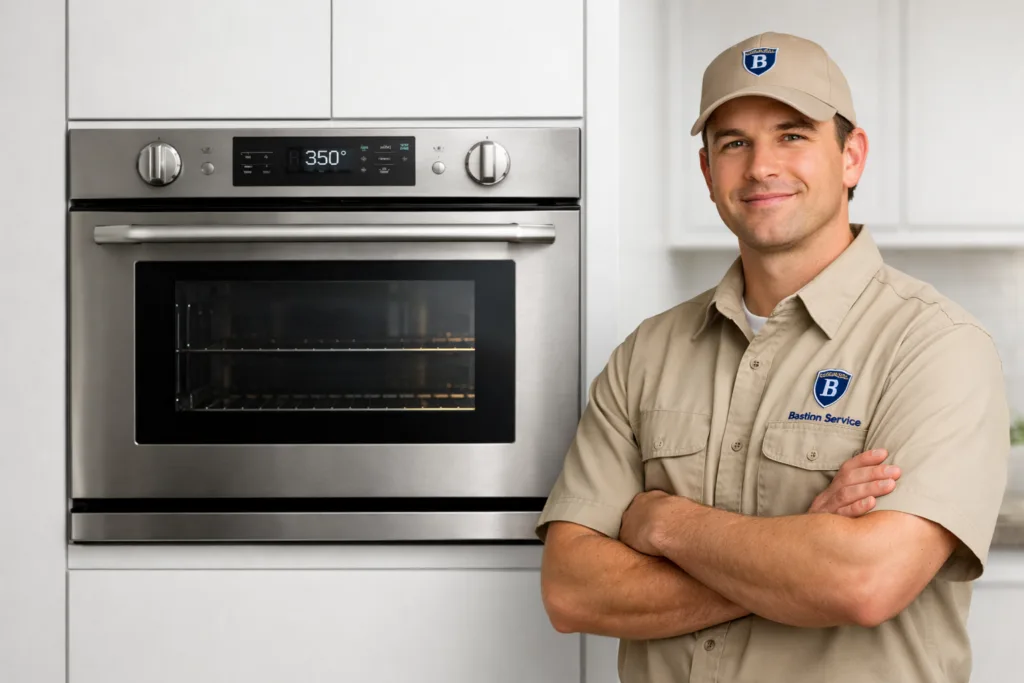
When a wall oven starts missing temperatures, shutting down mid-cycle, or refusing to respond, the symptom you see is only part of the story. In many Summit units, similar behavior can come from very different causes, including a weak heating element, a drifting temperature sensor, loose wiring, a failing relay, or a control issue. Sorting that out first helps avoid unnecessary part changes and gives homeowners a realistic sense of what the repair involves.
Common Summit wall oven problems seen in Rancho Park homes
Wall ovens tend to fail in recognizable patterns. Paying attention to how the problem shows up can make the next step more straightforward and help determine whether the issue points to heat production, temperature regulation, door sealing, or electronics.
Not heating or only partially heating
If the oven turns on but never gets hot enough, or heats only weakly, the problem may involve the bake element, broil element, sensor circuit, control board, or incoming power path. Some ovens still appear to operate normally on the display while one heating circuit is no longer working correctly. That often leads to long cook times, poor browning, and meals that come out inconsistent from front to back or rack to rack.
Homeowners sometimes notice this first during preheat. The oven may seem to take far longer than usual, or it may signal that preheat is complete before the cavity is actually ready. That kind of symptom usually needs testing rather than guesswork, especially when the oven still produces some heat but not the right amount.
Uneven baking and temperature swings
When cookies brown more on one side, casseroles stay cold in the center, or roasted food cooks unpredictably, temperature regulation is often the bigger issue than total heat loss. A Summit wall oven with this pattern may have a sensor reading out of range, a control not cycling heat correctly, or a door seal problem allowing heat to escape.
Temperature swings can also become more obvious over time. At first, the oven may only seem “a little off.” Later, recipes that used to work without trouble start coming out undercooked or overcooked. If the oven has become unreliable for everyday meals, that is usually a sign the problem is no longer minor.
Slow preheat
Slow preheating is one of the most common complaints because it affects nearly every use of the appliance. A delayed warm-up can happen when one heating function is weak, when the sensor is reporting temperature inaccurately, or when the control is not sending proper power through the heating circuit. In some cases, the oven does eventually reach the set temperature, but only after an unusually long wait that makes normal cooking impractical.
If slow preheat is paired with uneven baking, the issue is often broader than simple calibration. That combination usually points to a component fault that should be checked before continued use causes more strain on connected parts.
Control panel or display problems
Unresponsive buttons, flickering numbers, random beeping, error messages, and settings that change on their own usually indicate an electronic problem rather than a heating-only failure. On a built-in wall oven, the user interface and main control often need to be evaluated together because one can affect the behavior of the other.
If the display goes blank intermittently, restarts during cooking, or fails to accept commands, the oven may not be safe to trust for unattended cooking. Even if the unit still heats sometimes, unstable controls can turn a small annoyance into a larger repair later.
Door, latch, and sealing issues
A wall oven door that does not close tightly can cause heat loss, uneven cooking, and longer preheat times. Worn hinges, a damaged gasket, or alignment issues may all contribute. In models with a door lock system, homeowners may also run into a latch that stays engaged or a lock that does not release properly after a cleaning cycle.
These problems are not just about convenience. When the door does not seal as intended, the oven can struggle to hold temperature, and nearby components may be exposed to more heat than they should be.
Signs the problem should be checked sooner
Some wall oven problems can wait a short time if the unit is still usable, but others should be addressed promptly. It is smart to stop using the oven and schedule service if you notice:
- A burning smell that does not fade quickly
- Sparking or visible damage on a heating element
- Repeated shutdowns during baking or roasting
- A breaker that trips when the oven is used
- Error codes that keep returning after reset attempts
- A door lock that fails during operation or remains stuck
These symptoms can point to electrical or heat-related faults that may worsen with continued use. In a built-in appliance, waiting too long can also allow a single failed part to affect wiring, controls, or adjacent components.
Why symptom-based testing matters
Two ovens can appear to have the same issue while needing completely different repairs. An oven that “is not heating” may actually have one failed element, an inaccurate sensor, a control relay issue, or a power supply problem. An oven that “runs too hot” may not need recalibration at all if the underlying problem is a faulty sensor circuit or poor control response.
That is why the most useful service approach starts with the exact complaint: whether the oven is slow to preheat, bakes unevenly, goes dead mid-cycle, or shows control errors. From there, the technician can test the related systems instead of replacing parts based on assumptions. For Rancho Park homeowners, that usually leads to a clearer repair decision and fewer surprises.
Repair or replacement: what usually influences the decision
Most households do not decide based on age alone. The bigger factors are the specific failed part, the overall condition of the oven, and whether the appliance has developed repeated major issues. If the repair is limited to a targeted component and the cavity, door, and controls are otherwise in solid shape, repair is often reasonable.
Replacement becomes easier to justify when the oven has multiple problem areas, recurring electronic faults, significant door or hinge wear, or signs of heat damage beyond a single part failure. What helps most is understanding whether the issue is isolated or part of a broader decline in reliability.
What to expect from a service visit
A productive wall oven service visit should focus on the behavior you are actually seeing in your kitchen. That may include checking heating performance, verifying temperature readings, evaluating element operation, inspecting wiring connections, testing sensor values, and reviewing control response. If the complaint involves the door or latch, those mechanical points should be checked as closely as the electronics.
Once the fault is identified, the next step is usually straightforward: proceed with repair, pause use until parts can be replaced, or consider replacement if the overall condition no longer supports a sensible fix. For homeowners in Rancho Park, the goal is not just to get the oven running again, but to know whether it will return to stable, predictable cooking.
Helpful details to note before scheduling
If possible, keep track of when the problem happens and what the oven does. A few details can make diagnosis easier, such as whether the issue appears only during preheat, whether the broiler still works, whether the display stays on when heat stops, or whether the problem began after a self-clean cycle. Error codes, odd noises, and repeated breaker trips are also worth mentioning.
Those observations can help narrow the likely cause and speed up the path to a repair plan. When a Summit wall oven starts behaving inconsistently, specific symptom details are often more useful than a general description that it is “acting up.”