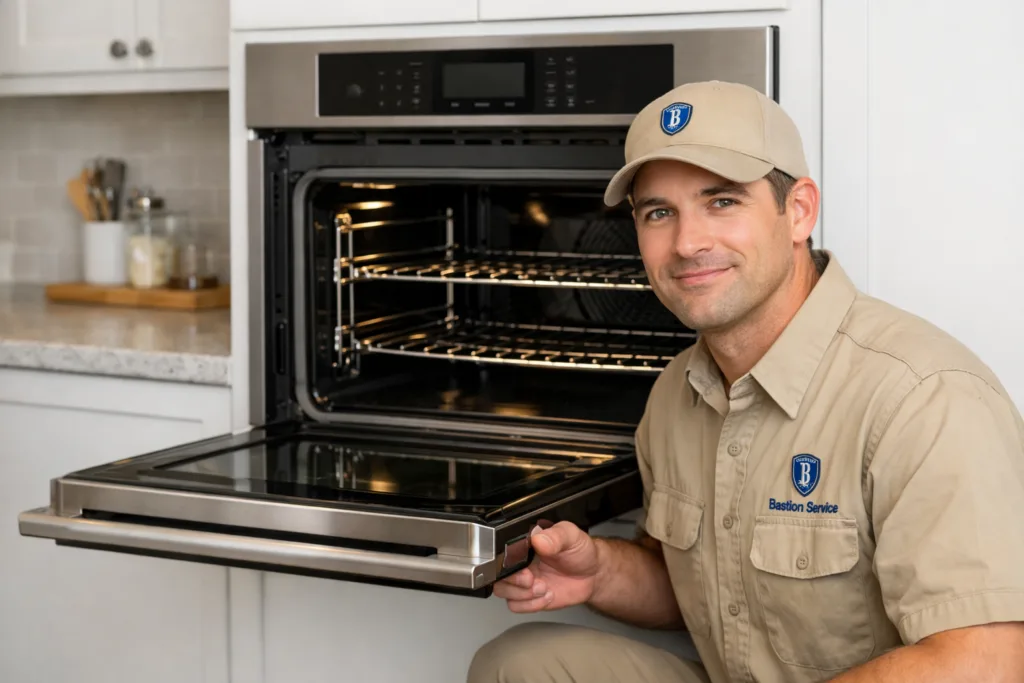
Wall ovens tend to fail in ways that disrupt the whole kitchen routine. One day the oven seems a little slow, and the next it is undercooking casseroles, shutting off during baking, or refusing to start at all. With Dacor units, the symptom matters because similar complaints can point to very different causes inside the heating, sensing, latch, or control system.
Start with the symptom you are seeing
The fastest way to make sense of a wall oven problem is to match the behavior to the most likely system involved. That helps narrow down whether the issue is mainly electrical, temperature-related, mechanical, or tied to the controls.
Oven will not heat
If the display comes on but the cavity stays cold, the problem may involve a failed bake element, a broil element that is not assisting preheat, a blown thermal protection part, a sensor problem, or a control board that is not sending power where it should. In some cases, the oven appears to start normally but never actually begins a proper heating cycle.
Homeowners often notice this first when preheating seems endless or food remains pale long after the usual cook time. If both the upper and lower heating functions seem affected, the control side of the system becomes more likely.
Slow preheat and weak cooking performance
A Dacor wall oven that eventually heats but takes much longer than normal can be harder to diagnose than a complete no-heat failure. One weak heating circuit can still allow the oven to warm up, just very slowly. A drifting temperature sensor can also tell the control that the oven is hotter than it really is, causing early cycling and poor cooking results.
- Preheat takes noticeably longer than before
- Roasting is sluggish and baking times keep stretching
- The oven reaches temperature on the display, but food still cooks slowly
- Broil performance seems weak or inconsistent
Uneven baking and temperature swings
When one tray browns too fast while another lags behind, the issue may not be the recipe. Uneven baking can come from inconsistent element operation, sensor inaccuracies, door seal leakage, or a convection-related problem on models equipped with fan-assisted cooking. Temperature swings are especially frustrating because they can look random from one meal to the next.
If cookies are burning on the bottom, casseroles are finishing only at the edges, or baked goods are collapsing despite familiar settings, the oven may not be maintaining the temperature you selected.
Display, keypad, and control issues
Some wall oven calls are not really about heat at first. A blank display, beeping, unresponsive touch controls, error codes, or a clock that resets can indicate a fault in the interface, main board, wiring harness, or power supply path. Intermittent issues are common in this category. The oven may work for a few cycles, then stop responding or cancel a cooking program unexpectedly.
Because electronic symptoms can overlap, it helps to note exactly what happens before the failure. For example, whether the display dims during preheat, the keypad responds only sometimes, or the unit loses power after the door is opened can all help point to the right repair path.
Door, latch, and self-clean problems
A wall oven door that will not close fully can affect both performance and safety. Heat loss through a bad seal or misaligned hinge changes cooking results and can make nearby surfaces warmer than they should be. If the door stays locked after self-clean, the latch motor, switch, control logic, or related linkage may be involved.
Many owners first notice this after a self-clean cycle, when the oven does not return to normal operation. If the latch is sticking or the door must be forced, it is best to stop using that feature until the problem is resolved.
Signs the problem is getting more serious
Some oven issues stay annoying but stable for a while. Others tend to escalate. It is smart to stop and reassess if you notice any of the following:
- The oven trips a breaker repeatedly
- There is a burning smell that seems electrical rather than food-related
- The oven overheats or scorches food at normal settings
- The unit shuts off during cooking
- The door locks unexpectedly
- Error codes keep returning after power is reset
These symptoms suggest more than a simple calibration issue. Continued use can place extra stress on relays, wiring, sensors, or other components that are already operating outside normal range.
When to stop using the oven
It is usually best to stop using the appliance if the oven will not turn off, smells hot in an abnormal way, sparks, trips power protection devices, or shows obvious signs of overheating. The same applies if the door will not unlock properly or the controls behave unpredictably enough that you cannot trust the selected mode.
For less urgent issues such as slow preheat or mild temperature inconsistency, the oven may still operate, but repeated use can make the eventual repair larger. A weak component often affects neighboring parts over time, especially in high-heat appliances.
Repair versus replacement for a Dacor wall oven
Many Rancho Park homeowners want to know whether a repair still makes sense before they commit to service. In a lot of cases, it does. A wall oven is often worth repairing when the fault is limited to a sensor, heating element, latch assembly, switch, fuse, fan motor, or a specific electronic component and the rest of the appliance is in good condition.
Replacement deserves a closer look when there are multiple major failures at once, severe heat damage to wiring, repeated board problems, or signs that the unit has been operating with unresolved electrical stress for too long. The age and overall condition of the oven matter, but the real deciding factor is usually how isolated the failure is and whether the repair restores normal performance with a reasonable scope of work.
What homeowners in Rancho Park can check first
Before service, a few basic observations can make the symptom clearer:
- Confirm whether the display powers on normally
- Check whether bake and broil both attempt to heat
- Notice whether the oven fails immediately or only after warming up
- Watch for recurring error codes
- Pay attention to whether the door closes and seals evenly
- Compare actual cooking results to the set temperature
These checks are useful because they describe the failure pattern without trying to guess the failed part. For built-in electric cooking appliances, internal testing and part diagnosis are better left to a qualified technician.
What a service visit should clarify
A productive visit should identify whether the problem is coming from heat generation, temperature sensing, airflow, latching, controls, or incoming power to the oven. It should also answer three practical questions: is the unit safe to use, what component or circuit has failed, and is the repair a sensible investment for this appliance?
For Dacor Wall Oven Repair in Rancho Park, that kind of symptom-based evaluation is what helps turn a frustrating kitchen disruption into a repair decision that actually makes sense.