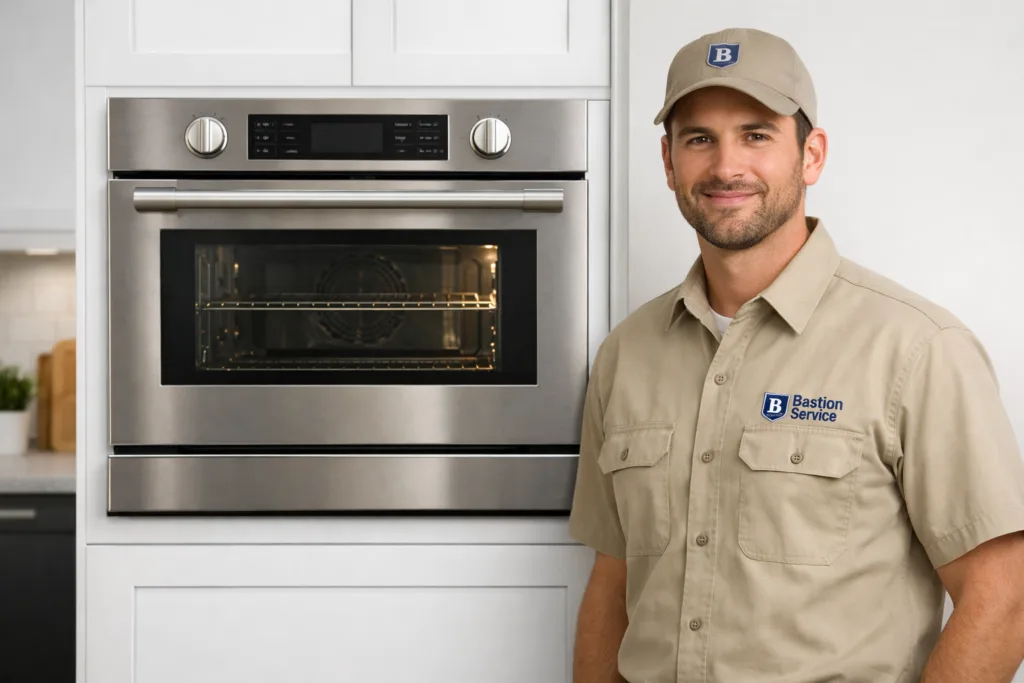
Cooking problems usually show up before a Thermador oven fails completely. A roast that finishes late, a tray of cookies that browns unevenly, or a preheat cycle that seems to drag on can all point to a part that is weakening rather than working properly. Catching those patterns early can help prevent a small heating or control issue from turning into a bigger repair.
What common Thermador oven symptoms usually mean
Different symptoms often trace back to different systems inside the oven. That is why the most useful starting point is the exact way the problem appears during normal use. In Rancho Park homes, the most common complaints tend to involve slow preheat, poor temperature control, no-heat conditions, and electronic control problems.
Oven is not heating
If the oven will not heat at all, the cause may depend on whether the unit is gas or electric. Gas models may have a weak or failed igniter that no longer draws enough current to open the gas valve correctly. Electric models may have a failed bake or broil element, a wiring issue, or a control problem that prevents power from reaching the heating circuit. In some cases, the display may still light up even though the oven cannot actually begin heating.
This type of symptom is usually more than an inconvenience. Repeatedly trying to start an oven that will not heat can put extra strain on related components and make the original failure harder to isolate.
Preheat is much slower than normal
When preheat takes far longer than it used to, the oven may still appear to work, but not correctly. A weak igniter, a partially failed element, a temperature sensor reading incorrectly, or a control board issue can all create long preheat times. Homeowners often notice this first when meals run behind schedule or when the oven says it is ready but food still cooks as if the cavity never fully reached temperature.
Slow preheat matters because it often signals a component that is deteriorating rather than completely dead. Addressing it sooner can help avoid a total no-heat failure later.
Uneven baking or temperature swings
If one side of a dish cooks faster than the other, or recipes that used to be reliable suddenly become inconsistent, the issue may involve the temperature sensor, convection fan, calibration drift, door sealing problems, or a heating element that is no longer performing evenly. These problems can be subtle at first, especially with baked goods, but they usually become more noticeable over time.
Thermador ovens are typically chosen for precise cooking performance, so uneven results are often a sign that service is worth considering even if the appliance still turns on and completes a cycle.
Controls respond poorly or the oven will not start
A blank display, unresponsive touch controls, intermittent startup, or a unit that powers on but will not run a bake cycle can point to electronic control faults, latch issues, wiring problems, or incoming power trouble. These symptoms can be frustrating because they may come and go before the oven stops working consistently.
Intermittent behavior is especially important to note. If the oven sometimes starts and sometimes does not, that pattern can help narrow down whether the problem is control-related, power-related, or tied to a specific safety circuit.
Error codes, unusual fan noise, or door issues
Error codes are often tied to sensor faults, overheating conditions, communication errors, or door latch problems. A loud or unusual fan sound may come from a worn convection fan motor, a cooling fan issue, or an obstruction affecting airflow. If the door does not close tightly, heat can escape and lead to poor cooking results, long preheat times, and extra stress on the oven as it tries to maintain temperature.
Signs the problem is getting worse
Some ovens show a steady pattern of decline before they stop working well enough for daily use. Watching for these changes can help Rancho Park homeowners decide when to stop troubleshooting and schedule service.
- Preheat times keep getting longer from week to week
- The oven reaches temperature, then drops heat unexpectedly
- Broil still works, but bake does not perform normally
- Error codes return soon after being cleared
- The breaker trips during use
- The cavity light and display work, but cooking performance does not
- The door feels loose, misaligned, or fails to seal well
These symptoms often suggest that the appliance is still partially functional, but not operating the way it should. That middle stage is usually when a targeted repair is most straightforward.
When to stop using the oven
There are times when continued use is not worth the risk. If the oven gives off a persistent burning smell, shows visible sparking, shuts off mid-cycle, overheats, or trips the breaker repeatedly, it is best to stop using it until the cause is identified. The same is true if wiring appears damaged or if the control panel behaves unpredictably during cooking.
For gas models, a strong or ongoing gas odor should always be treated as a safety issue first. In that situation, use should stop immediately while the source of the problem is addressed.
Repair or replace?
Many Thermador oven issues are repairable, especially when the fault is isolated to one system such as the igniter, temperature sensor, heating element, fan motor, switch, or electronic control component. Repair usually makes sense when the oven is otherwise in good shape, the problem has a defined cause, and there is not a long history of repeated failures.
Replacement becomes more likely when several major issues are present at the same time, when there is significant internal wear, or when the unit has developed recurring electrical or control faults that make long-term reliability harder to restore. Age, condition, prior repair history, and part availability all factor into that decision.
For most households, the goal is simple: restore normal cooking performance without putting more money into the appliance than the outcome justifies.
What helps speed up diagnosis
If service is needed, a few details can make the problem easier to pinpoint. It helps to note whether the issue happens in bake, broil, convection, or all modes; whether the oven eventually heats or never heats at all; whether the display shows an error code; and whether the problem is constant or intermittent. Even details like a door not closing firmly or a fan running louder than usual can be relevant.
That kind of symptom history is often more useful than a reset attempt or a guess about which part failed. It gives the repair path more direction from the start.
What Rancho Park homeowners usually want to know
Most people are trying to answer three practical questions: is the oven safe to use, what is actually causing the problem, and is the repair worth doing? Good service should answer those questions clearly, not bury them under vague explanations. Whether the issue is no heat, uneven baking, slow preheat, or control failure, the next step should be based on how the oven is behaving in real use and what it will take to restore reliable performance in the home.
If your Thermador oven has started showing inconsistent temperatures, delayed heating, repeated fault codes, or a complete failure to start, a symptom-based inspection is usually the fastest way to decide on the right repair path.