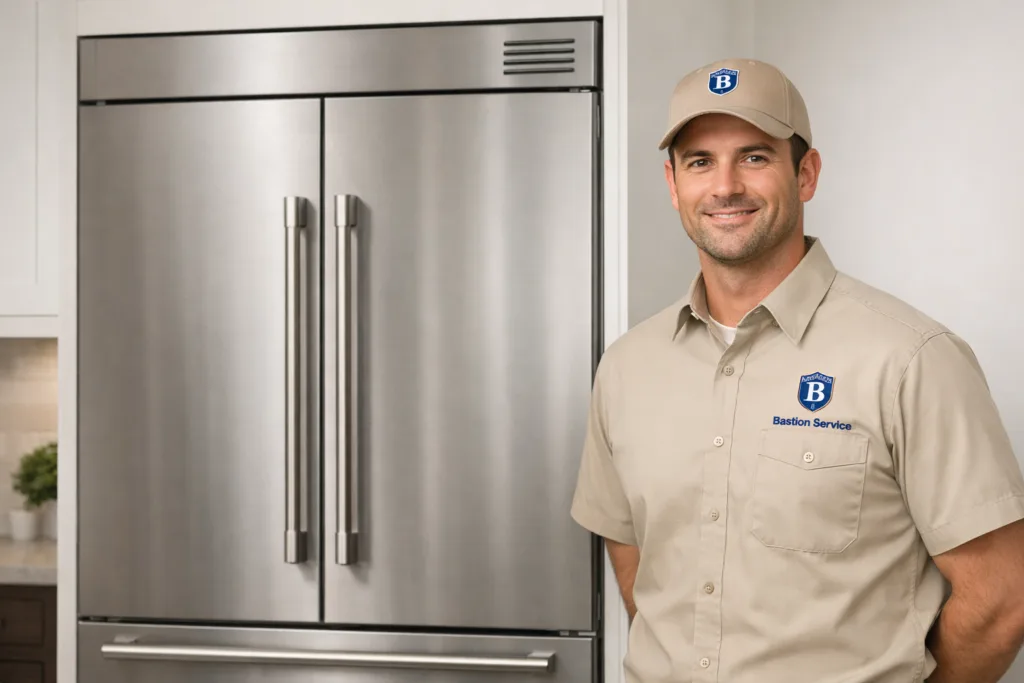
Thermador refrigerators are built to hold tight temperatures, so even small changes in cooling, airflow, or moisture control tend to show up quickly in everyday use. A refrigerator that seems only slightly off can lead to spoiled groceries, frozen produce, water on the floor, or constant compressor run time. The most useful way to approach the problem is by matching the symptom pattern to the system most likely involved.
Common Thermador refrigerator symptoms and what they can mean
One symptom does not always equal one failed part. A warm refrigerator compartment, for example, can be caused by restricted airflow, a failing evaporator fan, sensor problems, a defrost issue, or a sealed system fault. Looking at how the unit behaves over time usually tells more than a single temperature reading.
Fresh food section is warm but the freezer seems cold
This is one of the more common complaint patterns. In many cases, the freezer is producing enough cold air, but that air is not moving properly into the refrigerator section. Possible causes include a frosted evaporator cover, fan failure, air damper problems, or a control issue that is no longer regulating airflow correctly.
Homeowners often notice milk warming first, soft foods losing their chill, or items near the door becoming less cold than items at the back. If the freezer is also starting to soften, the issue may be moving beyond airflow and into a broader cooling problem.
Food freezes in the refrigerator compartment
If vegetables are icing over, drinks are too cold, or food near the rear wall freezes, the refrigerator may be overcooling in the fresh food section. This can happen when a sensor reads inaccurately, the damper stays open too long, or control logic is not responding the way it should.
Repeated freezing is worth addressing early. Besides ruining food, it can be a sign that temperatures are swinging more than they should, which can affect overall refrigerator performance.
Frost buildup inside the freezer or around vents
Heavy frost usually points to either warm air entering where it should not or a defrost system that is not clearing moisture properly. Door gasket gaps, a door that is not closing fully, defrost heater problems, and thermostat or control faults can all contribute.
As frost builds, airflow drops. That often leads to uneven temperatures, louder fan noise, and poor cooling in the refrigerator section even though the actual root cause started in the freezer.
Water leaks under or inside the refrigerator
Water under a Thermador refrigerator can come from a blocked defrost drain, a supply line issue, ice maker fill problems, or excess condensation from sealing problems. Moisture inside drawers or under shelves may point to a different issue than a leak reaching the floor, so the exact location matters.
Leaks should not be ignored. Even minor water spread can damage flooring, cabinet edges, and nearby surfaces if it continues over time.
Refrigerator runs all the time
A unit that rarely cycles off may be struggling to reach the set temperature. Dirty condenser areas, airflow restrictions, gasket leaks, control issues, and compressor-related problems can all lead to extended run time. In hot weather or after frequent door openings, longer cycles can be normal, but constant operation with weak cooling usually is not.
If the refrigerator is running hard and food still is not staying cold enough, continued operation can place more stress on important components.
Clicking, buzzing, rattling, or fan noise
Noise complaints often become easier to identify when the timing is clear. Clicking at startup can point to a compressor start issue. A scraping or whirring sound may mean fan blades are hitting ice. Rattling can come from vibration, loose panels, or items stored too close to moving components.
With premium built-in refrigeration, sound changes are often one of the first signs that something mechanical or airflow-related has shifted.
Why symptom patterns matter on Thermador refrigeration
Thermador refrigerators can show the same outward problem for several different reasons. That is why guessing from one symptom alone often leads to wasted time and unnecessary parts replacement. A unit that is warm after defrost may have a fan issue. A unit that is warm after a power interruption may have a control or startup problem. A unit that cools at night but not during the day may be dealing with restricted heat exchange or unstable component performance.
Built-in models also add another layer of complexity. Ventilation, fit, panel alignment, and access can all affect how the problem presents itself. In a household setting, the goal is not just to get the refrigerator running again for a day or two, but to restore stable food storage without recurring temperature trouble.
Signs the problem may be getting worse
- Temperatures drift even after settings are adjusted
- Cooling returns briefly, then fails again
- Frost keeps coming back after being cleared
- Water leaks spread beyond the front edge of the unit
- The compressor seems hot and runs for long periods
- Fresh food spoils early while the freezer still appears normal
- Noises become louder, more frequent, or happen at the same point in each cycle
Intermittent performance is especially important to address. A refrigerator that works normally for a short period and then slips out of range can be harder to live with and harder to monitor because it creates the impression that the issue has resolved when it has not.
When repair is often worthwhile
Many Thermador refrigerator problems are still sensible to repair when the fault is isolated and the cabinet, liner, and major cooling system components are otherwise in good shape. Fan motors, sensors, drain blockages, door gasket problems, some ice maker faults, and certain electronic control issues often fall into that category.
Repair decisions become more complicated when a unit has a major sealed system failure, repeated expensive breakdowns, or multiple overlapping issues that affect reliability. Age matters, but condition matters more. A well-kept refrigerator with one defined fault is different from a unit showing several signs of decline at once.
What homeowners can note before service
A few observations can make diagnosis faster and more accurate. Helpful details include:
- Whether the freezer is still keeping food solid
- Whether the interior lights and display respond normally
- Where frost is collecting
- Whether the leak appears after defrost cycles or ice maker use
- Whether the noise happens at startup, during cooling, or at shutoff
- How long the problem has been happening
- Whether the issue started after a power outage, filter change, or door closure problem
These details help separate airflow, control, drainage, and cooling-system issues that can otherwise look similar at first glance.
Household impact in Palos Verdes Estates
In Palos Verdes Estates homes, refrigerator trouble usually shows up first as a daily routine problem rather than a dramatic breakdown. Groceries do not stay fresh as long, ice production drops, drinks are not cold enough, or moisture begins collecting where it should not. By the time food loss becomes obvious, the refrigerator may have been operating inefficiently for some time.
For that reason, unusual temperature swings, repeated frost, and new operating noises are worth taking seriously even if the unit is still partially cooling. Early service can prevent a smaller issue from turning into a broader loss of performance.
Choosing the right next step
The best next step depends on what the refrigerator is doing right now, not on a generic assumption about age or brand alone. If the problem is isolated, repair is often the more practical option. If cooling is unstable, the unit is leaking repeatedly, or multiple symptoms are appearing together, a professional evaluation gives a better basis for deciding what makes sense.
For homeowners in Palos Verdes Estates, Thermador refrigerator repair is most helpful when it focuses on the actual failure pattern, the condition of the appliance, and the repair path most likely to restore normal kitchen use.