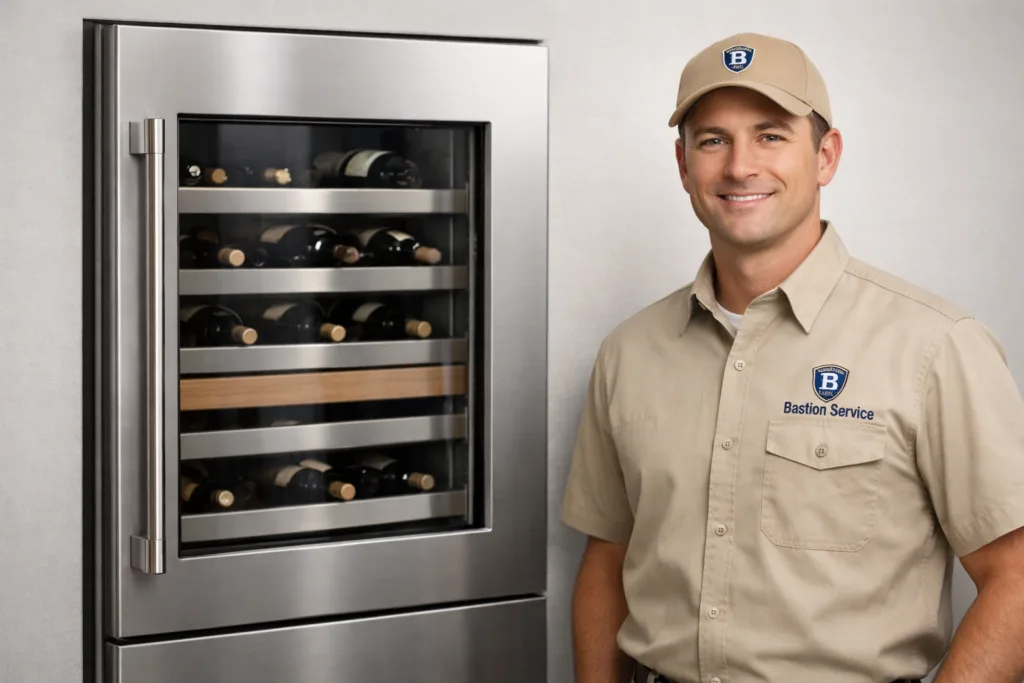
Wine coolers protect more than temperature alone. They help maintain a stable environment for bottles that can be affected by repeated warming, excess moisture, vibration, and poor airflow. When a Monogram unit begins acting differently, the most useful approach is to look at the exact symptom pattern rather than assume every cooling problem has the same cause.
Common Monogram wine cooler problems homeowners notice first
Most service calls start with one of a few recognizable changes in operation. Some are obvious right away, while others build slowly over days or weeks.
Not cooling enough
If the cabinet feels warm, the display temperature does not match actual conditions, or bottles never seem to reach the selected setting, the issue may involve restricted airflow, fan trouble, a temperature sensor problem, dirty condenser components, control failure, or a refrigeration-system fault. Because these causes can overlap, a unit that is no longer holding temperature should be checked before extended run time puts extra strain on the system.
Temperature swings or uneven cooling
A wine cooler should hold a narrow range more consistently than a standard kitchen refrigerator. If temperatures rise and fall throughout the day, one zone drifts off setting, or the cabinet seems cold at one time and warm later, that usually points to a problem with sensing, air circulation, control response, or cooling performance. These symptoms matter because repeated fluctuation can affect long-term storage conditions even when the unit is still running.
Fan noise, buzzing, or vibration
A low operating hum can be normal, but new clicking, rattling, buzzing, or stronger vibration is worth attention. A loose internal component, evaporator fan issue, condenser fan problem, compressor strain, or installation imbalance can all change how the cooler sounds. Noise becomes more concerning when it appears together with warming, frost, or constant cycling.
Condensation, water, or frost inside
Moisture buildup can come from warm air leaking past the door gasket, a drain issue, restricted airflow, or a cooling pattern that is no longer stable. Frost can reduce circulation and make temperature control less reliable. If you keep wiping out water or see recurring condensation on shelves or walls, the cause should be diagnosed instead of treated as a simple cleanup issue.
Controls, display, or alarm problems
If the panel is unresponsive, the display is inaccurate, settings do not hold, or alerts appear without an obvious reason, the fault may be tied to sensors, wiring, user interface components, or the main control system. Electrical and control issues can sometimes mimic cooling failures, which is why symptom-based testing is important before parts are replaced.
Why symptom patterns matter
Two wine coolers can look like they have the same problem while needing completely different repairs. A cabinet running warm might have a simple airflow problem, or it could be dealing with a deeper sealed-system issue. A noisy unit could have a fan obstruction, or the sound could be related to compressor stress. Looking at how the cooler behaves over time helps separate minor faults from issues that change the repair outlook.
This is especially important with built-in and premium refrigeration products, where part replacement without confirming the cause can add cost without solving the problem. A careful diagnosis helps determine whether the repair is straightforward, whether continued operation risks more damage, and whether the appliance is still a good repair candidate.
What you can check before scheduling service
There are a few basic checks that can help rule out simple causes before professional service is arranged:
- Make sure the door is closing fully and not being pushed open by bottle placement.
- Check the temperature setting to confirm it was not changed accidentally.
- Look for blocked interior vents that could interfere with circulation.
- Inspect the door gasket for gaps, warping, or debris that prevents a good seal.
- Clear visible dust from accessible exterior ventilation areas if your installation allows it.
- Notice whether the problem affects both zones or only one, if your cooler is dual-zone.
If the issue remains after those checks, deeper testing is usually needed. Repeatedly unplugging and restarting the unit or lowering the setting to extremes typically does not fix the underlying fault and can make the symptom pattern harder to interpret.
Signs the problem may be getting worse
Some issues begin small and become more expensive if ignored. Homeowners in Westwood often call when they notice the cooler still works, but no longer works normally. That early stage is often the best time to evaluate the unit.
- The cooler runs almost constantly but temperatures still drift.
- It starts and stops more often than before.
- Condensation keeps returning after the interior is dried.
- One section stays off-temperature while another seems normal.
- Noise is becoming more frequent or more pronounced.
- The display shows irregular readings or settings do not stay saved.
These patterns suggest more than a temporary fluctuation. Waiting too long can lead to added wear on fans, controls, or the compressor, while also exposing stored bottles to unstable conditions.
Repair or replace?
Many Monogram wine cooler problems are repairable, especially when the issue involves fans, sensors, controls, switches, door sealing components, or other accessible electrical and mechanical parts. In those cases, repair can restore normal storage performance without replacing the entire unit.
Replacement becomes a more serious consideration when the cooler has a major sealed-system problem, repeated breakdown history, extensive internal deterioration, or a repair cost that no longer makes sense for the appliance’s age and condition. The right choice depends on the actual fault, how the unit has been performing overall, and whether the repair is likely to return it to stable, reliable operation.
When service is the right next step
Professional service is usually warranted when the wine cooler cannot maintain the selected setting, develops recurring moisture or frost, shows control problems, or changes its run pattern and sound at the same time. Those combinations often point to faults that need testing beyond basic homeowner checks.
For residential Monogram wine cooler repair in Westwood, the goal is not simply to make the unit turn back on. It is to identify the source of the problem, protect the appliance from unnecessary strain, and determine whether repair will realistically restore consistent cooling for the household.