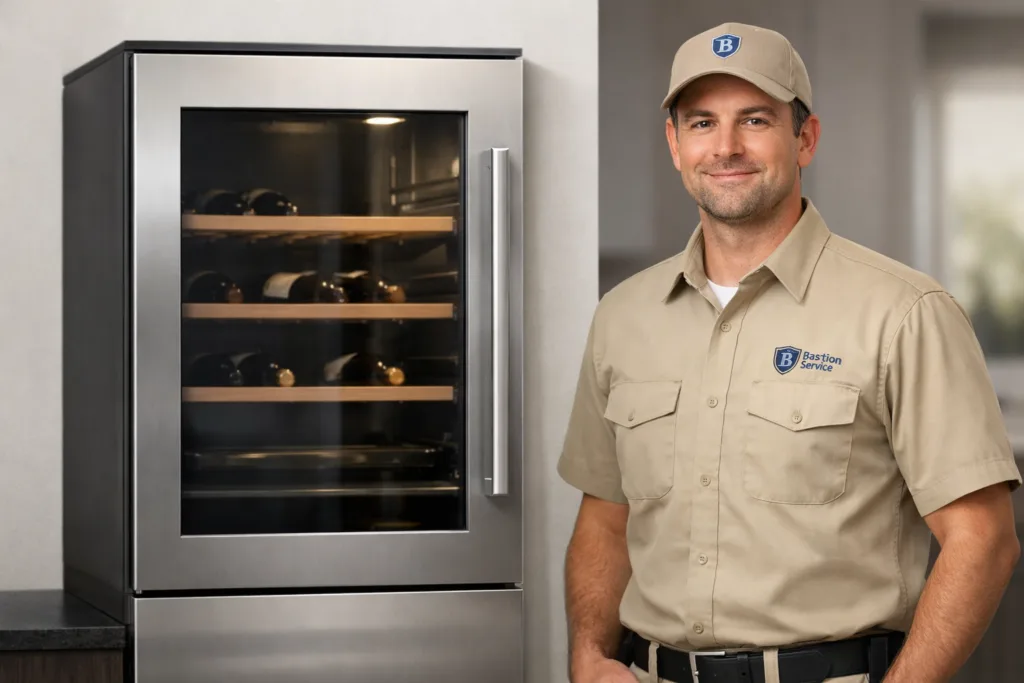
Temperature drift, recurring condensation, and unusual noise in a Miele wine cooler usually come from a small group of causes, but the symptoms can overlap. What looks like a simple thermostat problem may actually be poor airflow, a door seal issue, sensor inaccuracy, or a fan that is no longer moving air correctly through the cabinet.
Because wine storage depends on consistency more than just “cold enough,” even a mild performance change is worth paying attention to. A cooler that still turns on and cools somewhat can still expose bottles to repeated swings that affect storage conditions over time.
Common Miele wine cooler problems in Westwood homes
In Westwood homes, the most frequent service calls for Miele wine coolers tend to involve one or more of these issues:
- Cabinet not cooling to the set temperature
- Temperature fluctuating throughout the day
- One area cooling differently than another
- Condensation on shelves, glass, or around the door
- Water collecting inside the unit
- Buzzing, clicking, rattling, or fan-related noise
- Display, touch panel, or control response problems
- Unit running too often or seeming to never shut off
These symptoms do not all point to the same repair. A warm cabinet may involve circulation, controls, sensing, or a cooling-system fault. Moisture may come from repeated warm-air entry, drainage trouble, or a gasket that is no longer sealing evenly. Noise can be as minor as vibration or as significant as a fan or compressor working under strain.
What different symptom patterns can mean
Running warm or failing to hold temperature
If the cabinet never reaches the selected setting, the problem may involve restricted airflow, fan failure, inaccurate sensing, control issues, or a more serious refrigeration fault. If the temperature rises slowly over several days, homeowners sometimes assume the appliance just needs an adjustment, but gradual warming is often how component problems first appear.
Another clue is recovery time. If the cooler takes much longer than normal to return to temperature after the door is opened, that may suggest weak airflow or a cooling issue rather than simple household use.
Uneven cooling inside the cabinet
When one section feels colder than another, the issue is often related to air circulation or sensor feedback. In a wine cooler, uneven performance matters because bottles stored in different zones may not be seeing the same conditions. This can happen even when the display appears normal.
Condensation, water, or excess moisture
Moisture is one of the most common signs that something is off. Condensation on interior surfaces, water near the bottom of the cabinet, or dampness around the door can indicate:
- A worn or misaligned door gasket
- Frequent warm-air intrusion
- Drainage or defrost-related problems
- A door that is not closing fully
Left alone, excess moisture can contribute to odor, label damage, and unstable humidity conditions inside the cooler.
New or worsening noise
Miele wine coolers normally produce some operating sound, but a noticeable change usually means something should be checked. Fan scraping, repeated clicking, vibration, or a constant louder hum can point to loose components, fan motor trouble, airflow restriction, or compressor stress.
Noise is often an early warning symptom. The unit may still cool for a while, but continued operation can increase wear if a moving component is struggling.
Display or control issues
If the touch panel stops responding, the display shows incorrect readings, or settings change unpredictably, the problem may be electrical or control-related rather than a direct cooling failure. In some cases, a sensor or control problem can make the appliance cool poorly even though the sealed system is still functioning.
Signs the issue is getting worse
Some wine cooler problems stay mild for a short time, then accelerate. It is a good idea to schedule service if you notice any of the following:
- The cabinet temperature is drifting more often
- The compressor seems to run constantly
- Condensation returns soon after being wiped away
- Noise is becoming louder or more frequent
- The display is inconsistent or no longer matches actual conditions
- The door needs extra force to close or does not seal evenly
When these signs are ignored, the appliance may continue operating under strain and create a larger repair than the original fault.
When continued use can cause more damage
It is usually not ideal to keep using the unit normally if it is running nonstop, building moisture, or making obvious fan or vibration noise. A cooler that cannot regulate itself may place added stress on the compressor and electrical components. If the door seal is compromised, repeated warm-air entry can also worsen frost and condensation patterns.
For collections meant for longer storage, waiting too long can be costly even before the appliance fully fails. Stable conditions are the goal, and partial cooling is not the same as proper storage performance.
How a proper diagnosis should approach the problem
A useful service visit should do more than confirm that the appliance feels warm. Diagnosis should include measured cabinet temperature, control response, airflow behavior, fan operation, gasket condition, door closure, drainage condition, and compressor cycling. That process helps separate a sensor or control fault from a mechanical cooling problem.
This is especially important on premium refrigeration products, where replacing the wrong part can waste time and still leave the original symptom unresolved.
Repair versus replacement for a Miele wine cooler
Repair is often a sensible choice when the unit is otherwise in good shape and the fault is limited to a serviceable part such as a fan, sensor, control component, switch, or seal. If the cabinet structure, shelves, door, and general cooling system condition remain solid, targeted repair can restore stable operation without turning into an ongoing project.
Replacement becomes a more serious consideration when there are multiple overlapping failures, a history of repeated breakdowns, or major cooling-system concerns that do not make sense relative to the unit’s age and condition. The best decision depends on the exact failure pattern, not just on whether the cooler is technically still running.
What Westwood homeowners should watch before the appointment
If service is needed, it helps to note a few details in advance:
- Whether the unit is warm all the time or only intermittently
- If the display temperature matches how the cabinet actually feels
- Where condensation or water is appearing
- Whether noise occurs constantly or only during certain cycles
- If the door has become harder to close or reopen
- How long the issue has been present
Those observations can make symptom-based troubleshooting faster and help identify whether the problem is tied to cooling, controls, airflow, or sealing.
Choosing the right next step
For many households, the best next step is not guessing at settings or waiting for a complete shutdown. When a Miele wine cooler in Westwood begins showing repeated cooling, moisture, noise, or control symptoms, an inspection based on the full symptom pattern gives the clearest path forward. That makes it easier to decide whether repair is practical and whether the unit can be returned to the stable storage conditions it was designed to provide.