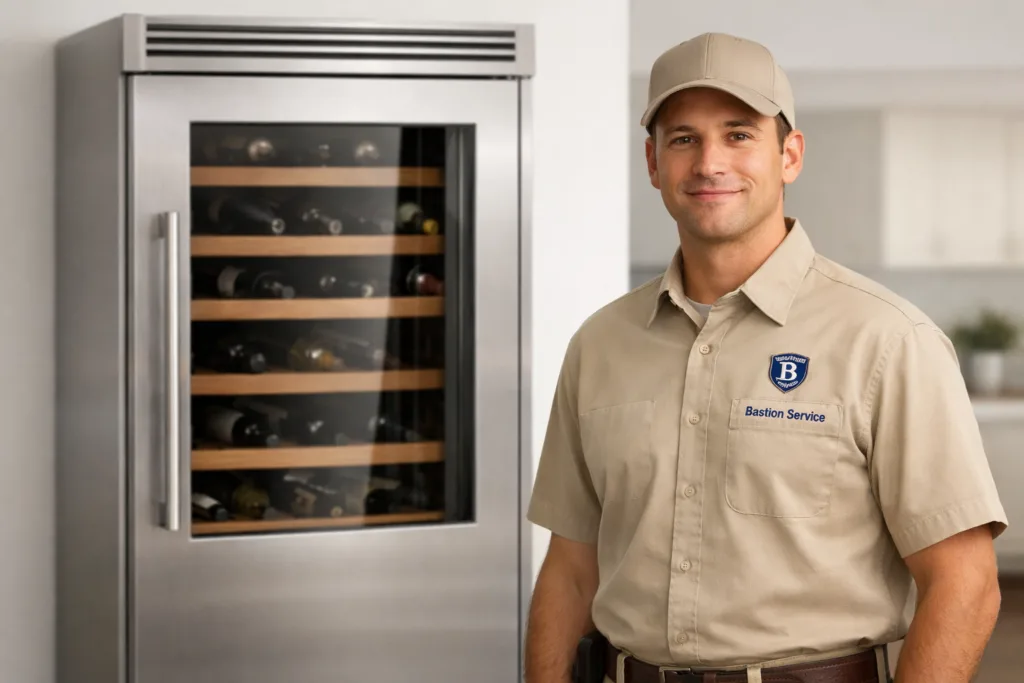
Common signs your Sub-Zero wine cooler needs attention

Wine coolers rarely fail all at once. More often, the first warning is a gradual change in performance: bottles no longer feel as cool as expected, the cabinet runs longer than usual, or moisture starts appearing around the door or on the shelves. In a home setting, these issues can be easy to overlook at first, especially if the unit still seems to be cooling somewhat.
With a Sub-Zero wine cooler, small changes matter. Consistent temperature and controlled humidity are part of proper storage, so a cooler that is only slightly off can still create a real problem over time. Addressing the symptom early can help prevent added strain on fans, controls, or refrigeration components.
Symptom-based Sub-Zero wine cooler repair in Westwood
Not cooling enough
If the cabinet is warmer than the set temperature, the cause may be airflow restriction, a failing fan motor, control trouble, sensor inaccuracy, or a sealed-system issue. In some cases, poor heat removal at the condenser can also reduce cooling performance and make the cooler run harder than it should.
A unit that is somewhat cool but not truly stable can be especially deceptive. Homeowners may think the cooler is still working normally, while internal temperatures continue drifting outside the ideal range.
Temperature swings
When the temperature rises and falls without an obvious reason, the problem may involve the control board, thermistor, door sealing, or internal air circulation. Uneven cooling from top to bottom can also point to airflow issues inside the cabinet.
These swings are important to correct because wine storage depends on consistency, not just whether the cooler eventually gets cold again.
Condensation or water buildup
Water droplets on shelves, moisture around the door frame, or dampness below the unit can signal a worn gasket, a drainage problem, warm air intrusion, or imbalance in cooling conditions. Moisture should not be treated as a cosmetic issue alone. It can affect cabinetry, create odors, and point to a larger performance problem.
Fan noise, buzzing, or rattling
New sounds often mean something has changed mechanically. A louder fan may indicate wear in the motor or blade interference. Buzzing can come from vibration, electrical components, or compressor strain. Rattling may be as simple as a loose panel, but it can also be the first sign that the unit is working harder than normal.
Any noise that is new, persistent, or getting worse is worth checking before it develops into a bigger repair.
Running constantly or cycling too often
A Sub-Zero wine cooler that rarely seems to shut off may be compensating for heat gain, restricted airflow, dirty condenser conditions, weak cooling performance, or a control problem. Short cycling, where the unit starts and stops too frequently, can point to electrical or sensor-related issues.
Both patterns increase wear. Even if the cabinet still feels cool, the operating pattern itself can be a sign that service is needed.
Why symptom overlap makes diagnosis important
One of the biggest challenges with wine cooler repair is that different failures can look similar at first. A warmer cabinet might be caused by a fan issue, a sensor reading problem, poor condenser performance, or a more serious refrigeration fault. Condensation might come from a door seal issue, or it might be tied to unstable cabinet temperature.
That is why the best repair path starts with identifying the actual source of the symptom rather than replacing parts based on guesswork. A targeted diagnosis helps determine whether the problem is minor, moderate, or part of a larger component failure.
What homeowners can check before scheduling service
- Make sure the door closes fully and the gasket is not twisted, cracked, or loose.
- Check for items blocking interior airflow.
- Confirm the temperature setting has not been changed accidentally.
- Listen for changes in fan or compressor sound during operation.
- Look for recurring moisture near the door, shelves, or floor area around the unit.
If these basic checks do not explain the problem, or the symptom returns quickly, the issue is likely beyond a simple adjustment.
When to stop relying on the cooler and arrange repair
It is a good idea to schedule service when the cabinet no longer holds a steady temperature, bottles are clearly warmer than they should be, moisture keeps returning, or the cooler begins making persistent unfamiliar sounds. Display irregularities, constant running, and repeated recovery problems after a reset are also signs that the unit needs professional attention.
In Westwood homes, built-in wine coolers are often installed in finished kitchen or bar areas, so ignoring leaks or condensation can affect more than the appliance itself. Prompt service can help limit both appliance damage and surrounding moisture issues.
When repair usually makes sense
Many Sub-Zero wine cooler problems are repairable, especially when the issue is tied to fans, controls, sensors, drainage, door sealing, or other isolated components. Repair is often the better choice when the cabinet is otherwise in good condition and the failure has a defined solution.
For residential units that have performed well until a recent symptom appeared, repair is often the most practical next step.
When replacement may be worth discussing
Replacement becomes more likely when the cooler has major sealed-system trouble, repeated high-cost failures, or multiple aging components failing at the same time. The decision depends on the age of the appliance, the condition of the cabinet, the nature of the repair, and whether the work is likely to restore reliable long-term temperature control.
A good service evaluation should help clarify whether the problem is a focused repair or part of a larger pattern of decline.
A straightforward repair approach for Westwood homeowners
The most effective service process is simple: verify the symptom, test the systems most likely involved, confirm the cause, and then decide whether the repair is sensible for the condition of the unit. That approach keeps the focus on restoring proper storage performance instead of chasing symptoms one part at a time.
If your Sub-Zero wine cooler in Westwood is running warm, collecting condensation, making more noise than usual, or cycling oddly, addressing the issue early gives you the best chance of preserving both the appliance and the wine stored inside.