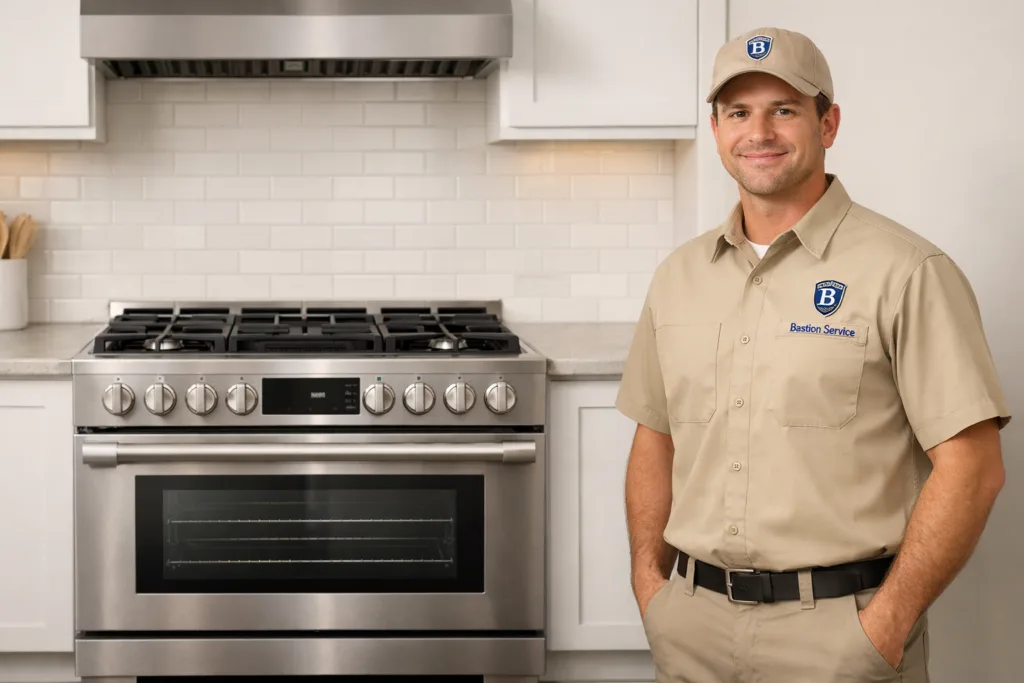
Range problems usually show up in the middle of normal routines: a burner that clicks through breakfast, an oven that falls behind during dinner, or temperatures that no longer match the setting on the display. On a Monogram range, those symptoms can come from ignition parts, heating components, sensors, controls, or wiring, so it helps to evaluate the exact pattern before deciding on a repair.
How symptom-based range diagnosis helps
Two ranges can appear to have the same problem while needing completely different repairs. An oven that will not heat may have an igniter issue on one model and a sensor or control fault on another. A burner that will not light may be dealing with moisture and buildup, or it may have a failing spark system. Starting with the symptom pattern helps narrow the cause faster and avoids replacing parts that were not actually responsible.
In Mid-Wilshire homes, the most useful service visit is one that checks how the range behaves under real operating conditions. That includes whether the failure is constant or intermittent, whether it affects one burner or all of them, and whether the oven is missing temperature by a little or by a lot.
Common Monogram range problems in daily use
Burner keeps clicking
Continuous clicking is one of the most common complaints on a gas range. Sometimes the burner still lights, and sometimes it does not. This can point to a wet or misaligned burner cap, debris around the ignition area, a faulty switch, wiring trouble, or a spark module problem. If the clicking continues after the flame is lit, the system may not be recognizing ignition correctly.
Because repeated clicking can wear on ignition components, it is best not to ignore it if it keeps returning.
Burner will not ignite or lights slowly
When a burner does not light promptly, the issue may involve the igniter, burner head, gas flow, or related electrical components. Homeowners often notice a delayed flame, several clicks before ignition, or one burner that behaves differently from the others. If the problem is limited to a single burner, that often helps isolate the repair path.
Oven not heating properly
If the oven stays cold, heats weakly, or takes much longer than normal to preheat, the cause may be an igniter, bake element, broil element, temperature sensor, relay, or electronic control issue. On some ranges, the oven may appear to start normally but never build enough heat for reliable baking or roasting.
This symptom often becomes obvious when food needs extra time, browns unevenly, or repeatedly comes out underdone in the center.
Uneven baking or drifting temperature
Temperature inconsistency can be frustrating because the oven still runs, but results are no longer predictable. One rack may cook faster than another, the back of the oven may brown more aggressively, or recipes that once worked well may suddenly require adjustments. Possible causes include a weak heating component, calibration problems, a faulty sensor, or convection-related issues on models equipped with convection features.
Display, keypad, or control problems
When settings do not respond, error codes appear, or the display behaves intermittently, the problem may be tied to the user interface, control board, wiring, or incoming power. These issues can affect oven heating, timer functions, and operating reliability in ways that are not always obvious from the front panel alone.
Signs the range should not keep being used
Some performance issues are inconvenient but manageable for a short time. Others should be treated as a stop-use condition until the appliance is checked. It is wise to stop using the range if:
- the oven overheats or will not regulate temperature
- a burner ignites unpredictably or flames look abnormal
- the appliance trips power repeatedly
- the control panel behaves erratically during operation
- you notice scorching, sparking, or a burning electrical smell
If there is a strong or persistent gas smell, do not continue troubleshooting the appliance yourself. Leave the area if necessary and contact the gas utility or emergency service first.
What homeowners should notice before service
A few simple observations can make diagnosis easier. Try to note whether the issue affects the cooktop, the oven, or both. Check whether the problem is present every time or only occasionally. Pay attention to recent changes, such as slower preheating, longer clicking, dim displays, or temperature results that have gradually drifted off.
It also helps to know whether the problem started suddenly after a spill, cleaning, power interruption, or heavy holiday cooking. Those details can point toward moisture-related ignition issues, sensor shifts, or component stress from prolonged use.
Repair or replace: what usually matters most
For many Mid-Wilshire homeowners, the decision is less about age by itself and more about the condition of the appliance as a whole. A Monogram range with one clear failure, such as an igniter, sensor, switch, or heating component, is often worth repairing if the rest of the unit is performing well. Replacement becomes more likely when multiple systems are failing, control problems keep returning, or the cost of repair starts approaching the value of keeping the current range in service.
A good evaluation should explain not just what failed, but whether that failure appears isolated or part of a broader wear pattern.
What a focused service visit should accomplish
Homeowners usually need more than a general guess. A helpful appointment should identify the likely failed component, verify whether related parts were affected, and explain whether the repair is straightforward or more involved. It should also clarify whether the range can be used safely in the meantime or whether one or more functions should stay off until corrected.
That kind of practical repair guidance is especially useful with premium cooking appliances, where performance matters as much as basic operation. The goal is not just to make the range turn on again, but to restore consistent, predictable cooking.
Why prompt repair can prevent bigger problems
Small range issues do not always stay small. A weak igniter can turn into a no-heat oven. Repeated burner clicking can place added stress on ignition parts. Temperature regulation problems can become more noticeable over time and make everyday cooking unreliable. Addressing the symptom early often reduces the chance of added wear on connected components.
When a Monogram range begins showing unusual behavior in a Mid-Wilshire home, the most efficient next step is to match the repair plan to the actual symptom rather than assume every heating or ignition issue has the same cause.