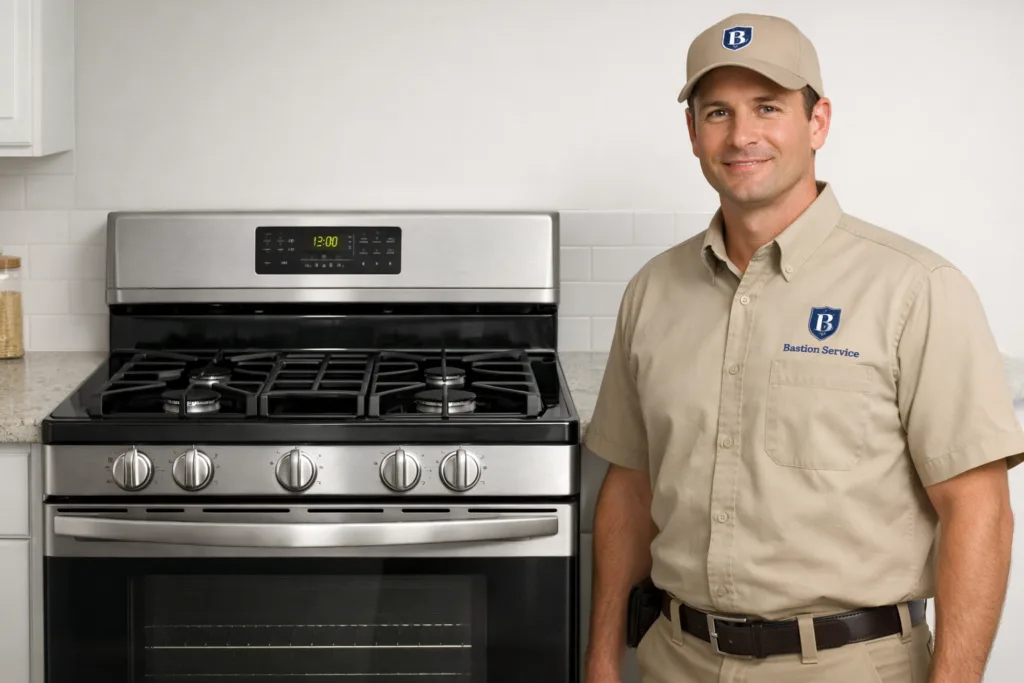
Range problems tend to interrupt the parts of the day that are hardest to postpone, whether that means getting breakfast started, making dinner on time, or baking with heat you can actually trust. On Kenmore ranges, the same basic complaint can come from several different parts, so the most useful approach is to match the repair path to the exact behavior of the appliance rather than replacing parts by guesswork.
Common Kenmore range problems in Mid-Wilshire homes
Most service calls fall into a few symptom groups. Some affect the cooktop, others affect the oven cavity, and some involve ignition or electronic controls. Paying attention to what the range does consistently, and when it fails, helps narrow down what is likely going wrong.
Surface burners that do not heat properly
On electric Kenmore ranges, a burner that stays cold, heats only partway, or works on one setting but not another may point to a failed element, a worn receptacle, a bad infinite switch, or damaged wiring below the cooktop. In some cases, the burner itself is not the root cause at all.
On gas models, burner trouble often shows up as clicking without ignition, delayed flame, weak flame, or uneven flame around the burner head. That can happen because of blocked ports, a misaligned cap, ignition component wear, or a spark-related fault. If one burner acts differently from the others, that pattern often helps isolate the issue more quickly.
Oven not heating or taking too long to preheat
If the oven never reaches the selected temperature, takes much longer than usual to preheat, or leaves food undercooked, likely causes include a weak igniter, failing bake element, sensor problem, thermal issue, or control failure. Homeowners often first notice this through meals that need extra cook time or baked goods that no longer turn out the same way.
With gas ovens, a weak igniter is a common reason the oven seems to start but never truly develops proper heat. With electric ovens, one failed heating element can make the oven appear to work while still producing poor baking results.
Oven running too hot or baking unevenly
An oven that scorches food, overshoots the set temperature, or produces inconsistent results from one rack to another may have a sensor issue, relay problem, calibration problem, or control board fault. Temperature complaints can also be tied to a heating component that cycles incorrectly.
When this starts happening regularly, many households begin compensating by lowering the set temperature or rotating dishes more often. That may get dinner through the night, but it usually does not solve the underlying problem.
Clicking, delayed ignition, or ignition failure
Persistent clicking is one of the most recognizable range symptoms. Sometimes it follows a spill or cleaning moisture around the burner area. In other cases, it points to a worn electrode, spark module problem, or issue in the ignition path. Delayed ignition should not be treated as normal, even if the burner eventually lights.
If there is a strong or lingering gas smell, stop using the appliance and address safety first. If there is no active gas odor but ignition remains unreliable, service is still worth scheduling before the problem becomes more disruptive.
Display, keypad, and control problems
Kenmore ranges can also develop issues that appear electronic rather than heat-related. A blank display, unresponsive keypad, intermittent error code, oven that shuts off during use, or controls that stop accepting input may involve the user interface, control board, wiring, or incoming power problem.
These symptoms can overlap, which is why testing matters. A control complaint is not always a failed board, and replacing the most expensive part first is rarely the best starting point.
What your symptom pattern can reveal
A few small details can make a big difference in diagnosing a range. For example, an oven that fails every time at preheat points in a different direction than an oven that heats well for twenty minutes and then loses temperature. A burner that clicks continuously even when turned off suggests a different issue than a burner that clicks only when you try to light it.
Useful observations include:
- Whether the problem affects one burner or several
- Whether the oven heats at all or just heats poorly
- Whether the issue is constant or intermittent
- Whether error codes appear during use or only after preheating
- Whether the problem started after a spill, cleaning, power interruption, or heavy oven use
Those details help separate a contained part failure from a larger electrical or control-related issue.
When to stop using the range and schedule service
Some problems are inconvenient but manageable for a short time. Others should move to the front of the list because continued use can stress additional parts or create avoidable safety concerns.
It is smart to schedule service promptly when:
- The oven will not heat at all
- Preheat times have become dramatically longer
- A burner lights late, clicks constantly, or fails regularly
- The oven overheats or burns food unexpectedly
- The display goes blank, resets, or shows recurring errors
- The range trips power or shuts off during cooking
If the appliance has shifted from an occasional annoyance to a repeatable pattern, the problem is usually not resolving on its own.
How continued use can make a repair worse
Range components often affect one another. A weak igniter can lead to poor heating performance and repeated ignition attempts. A damaged burner receptacle can worsen as the burner is used over and over. An overheating oven can place extra stress on sensors, relays, and adjacent internal parts.
That does not mean every symptom requires emergency action, but it does mean persistent heat and ignition problems are worth addressing before they spread into a larger repair. For households in Mid-Wilshire that rely on the range daily, waiting too long often turns a straightforward fix into a broader service call.
Repair or replace: what usually makes sense
Many Kenmore range problems are still practical to repair when the issue is limited to a specific component and the appliance is otherwise in solid condition. Parts such as igniters, elements, sensors, switches, burner components, and some control-related items are often the kinds of failures that support repair rather than replacement.
Replacement becomes more reasonable when the range has multiple major problems at once, recurring control failures, significant wear across both oven and cooktop functions, or a repair estimate that no longer matches the overall condition of the appliance.
A good service decision usually comes down to three things:
- What part actually failed
- Whether the problem is isolated or part of a wider pattern
- Whether the rest of the range is in shape to justify the repair
What homeowners can check before an appointment
Without disassembling the appliance, there are a few basic observations that can help make service more efficient. Confirm whether the issue affects bake, broil, or both. Notice whether all surface burners behave the same way. If a gas burner is not lighting properly, check whether the cap appears seated correctly and whether visible food debris is interfering with the flame path.
For electric models, note whether a burner works differently on high than on lower settings. For oven temperature complaints, keep track of whether the problem is slow preheat, low heat, or overheating. These details are often more helpful than a general statement that the range is “not working right.”
Focused help for Kenmore range issues in Mid-Wilshire
When a Kenmore range starts missing temperatures, misfiring at the burner, or acting unpredictably through the controls, the next step should be based on the exact symptom rather than assumption. In Mid-Wilshire homes, that often means looking closely at whether the fault is isolated to ignition, surface heat, oven heat, or electronic control behavior and then deciding whether the repair is practical from there.
The goal is simple: restore normal cooking when the problem is repairable and give homeowners a realistic answer when it is not. That keeps the process useful, efficient, and centered on what the range is actually doing in everyday use.