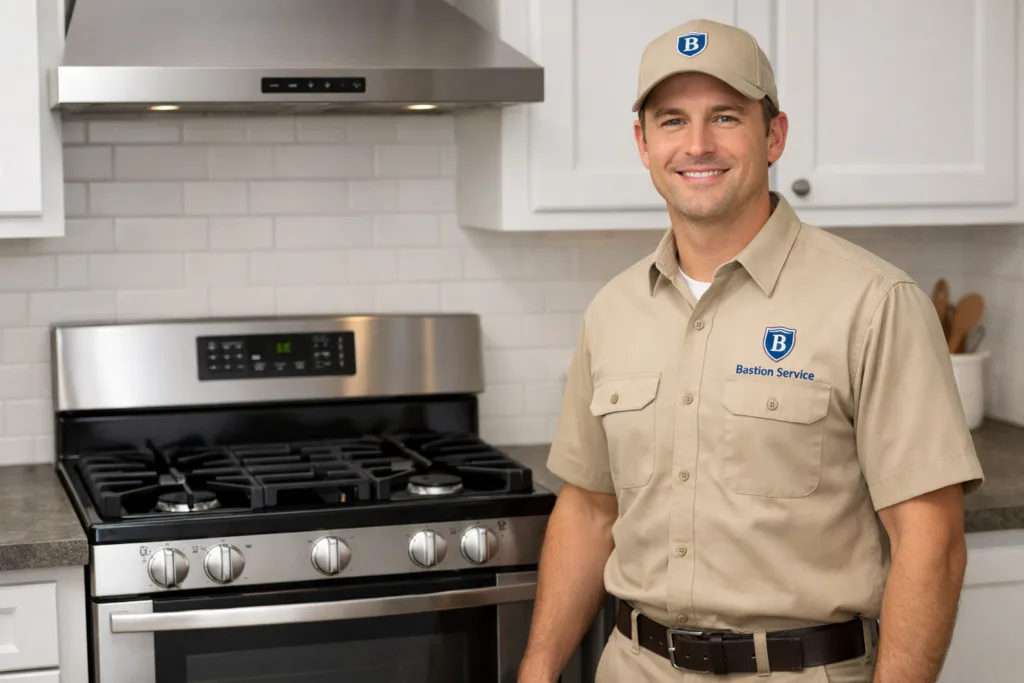
Range problems tend to show up in the middle of normal cooking: a burner that clicks but does not light, an oven that takes much longer to preheat, or temperatures that seem different from what the display says. With a GE range, those symptoms can come from several different sources, so the best next step is to match the repair plan to the way the problem appears in daily use.
How GE range problems usually show up at home
Many Mid-Wilshire homeowners first notice trouble through cooking results rather than a complete shutdown. Food may brown unevenly, water may take longer to boil, or the oven may seem fine one day and off the next. That pattern matters because intermittent issues often point to parts that are weakening, not just dirty surfaces or normal appliance variation.
On GE ranges, common causes include worn igniters, burner assembly issues, failing temperature sensors, damaged heating elements, loose wiring, switch problems, or electronic control faults. Because similar symptoms can overlap, replacing parts by guesswork often wastes time and money.
Common symptoms and what they can mean
Burner keeps clicking or will not ignite
If a gas burner clicks repeatedly, lights slowly, or only ignites after several attempts, the issue may involve the igniter, spark module, burner cap alignment, moisture, or residue affecting flame transfer. In some cases, the burner works inconsistently because one part of the ignition path is weak rather than fully failed.
If you notice a strong or persistent gas odor, stop using the appliance and address safety first. If there is no active gas smell but ignition is unreliable, the range should still be checked before the problem becomes more disruptive.
Oven not reaching temperature
An oven that stays cool, heats too slowly, or never seems to reach the selected setting may have a weak igniter, failing bake element, sensor problem, relay fault, or control issue. On some GE models, the oven can appear to heat normally at first while still falling short during longer baking cycles.
This often shows up as undercooked centers, extended cook times, or recipes that suddenly need adjustments even though nothing else in the kitchen has changed.
Oven temperature is off or cooking is uneven
When one rack browns faster than another or meals come out overdone on one side, the cause may be sensor drift, poor heat circulation, convection fan trouble on equipped models, or a worn door seal letting heat escape. Repeated uneven results across different pans and recipes usually suggest an appliance issue rather than cookware alone.
Electric surface element not heating correctly
On electric GE ranges, a surface element that stays too cool, cycles oddly, or fails to heat at all may point to a bad element, receptacle damage, a faulty infinite switch, or wiring trouble. Sometimes the burner turns on but cannot maintain stable heat, which makes simmering or consistent stovetop cooking difficult.
Display, keypad, or control problems
A dim display, unresponsive touchpad, flashing codes, or settings that change unexpectedly can indicate a failing control board, interface problem, or electrical fault inside the unit. Because modern ranges route several functions through the control system, a display issue may affect both oven and cooktop performance.
Signs the problem is getting worse
Small changes in performance often come before a full failure. It is worth scheduling service when you notice symptoms such as:
- Preheat times getting longer week by week
- Burners lighting only after repeated attempts
- Temperature results changing from one use to the next
- Error codes appearing intermittently
- Knobs, switches, or touch controls responding inconsistently
- The range shutting off unexpectedly during use
These issues rarely improve on their own. A weak igniter can become a no-heat call, and unstable temperature regulation can put added strain on other components.
Repair decisions for Mid-Wilshire households
In many homes, repair makes sense when the problem is limited to a specific part such as an igniter, element, sensor, switch, burner component, or a single control-related fault. If the rest of the GE range is in good condition and the appliance still fits the kitchen well, targeted repair is often the more practical choice.
Replacement becomes more likely when the range has multiple active problems, ongoing electronic failures, visible wear across several systems, or repair costs that no longer match the appliance’s overall condition. The most useful recommendation comes from identifying exactly what has failed and whether that issue is isolated or part of a broader decline.
What to check before service
Before assuming the range needs a major repair, a few basic observations can help narrow the problem:
- Notice whether the issue affects one burner, all burners, the oven, or the full unit
- Pay attention to whether the failure is constant or intermittent
- Check whether the display shows an error code
- Look for obvious burner cap misalignment on gas models
- Note whether the appliance recently lost power or tripped a breaker
These details can make the diagnosis more efficient and help separate a localized component failure from a wider control or power issue.
Why symptom-based GE range repair matters
Ranges combine heat, ignition, controls, and safety systems in one appliance, so a single symptom does not always have a single cause. Repeated clicking can be a burner issue or an ignition system fault. Bad baking results can come from weak heating, poor sensing, or control drift. That is why symptom-based testing is usually the fastest way to decide what is actually wrong and whether repair is practical.
For homeowners in Mid-Wilshire, the goal is straightforward: restore safe, consistent cooking performance without guessing at parts or overlooking a problem that could spread to other functions of the range.