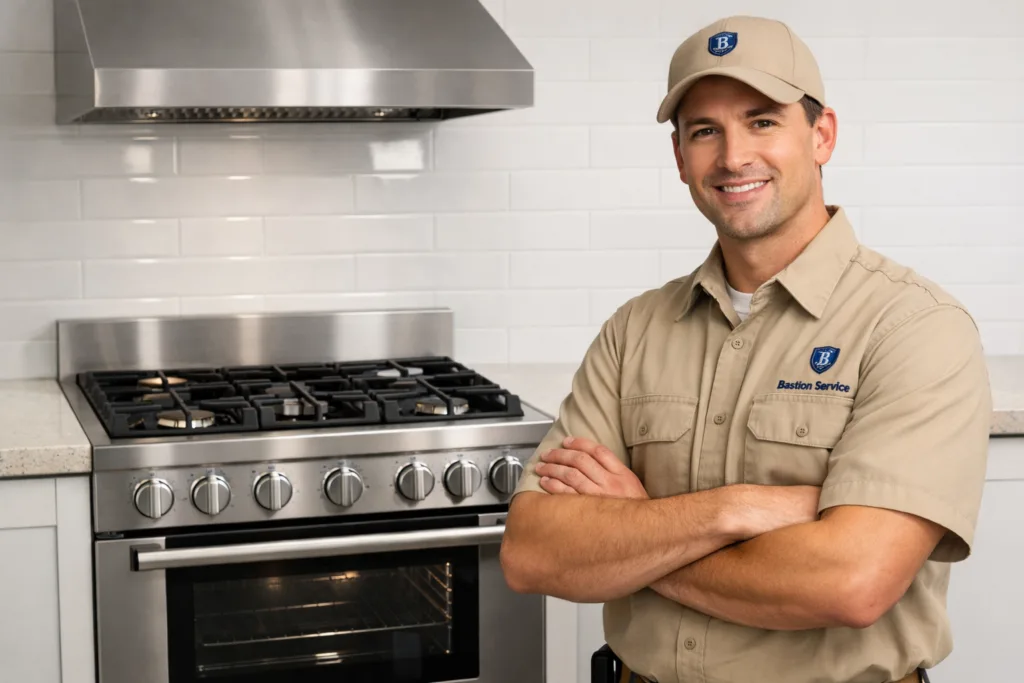
Cooking problems rarely stay isolated for long. A burner that starts clicking only once in a while can turn into a no-ignite issue, and an oven that runs a little cool can quickly affect baking, roasting, and everyday meals. With a Miele range, symptom details matter because the same complaint can come from very different failures.
For homeowners in Inglewood, the most useful service call is one that matches the repair plan to the way the appliance is actually failing. That means looking at ignition behavior, heat output, sensor feedback, controls, and any visible wear before deciding whether a part replacement makes sense.
Common Miele range problems seen in homes
Some range issues appear suddenly after the appliance worked normally the day before. Others develop slowly, with longer preheat times, uneven cooking, or burners that become less reliable over time. Paying attention to the pattern helps narrow down the likely cause.
Burners that click but do not light
If a surface burner clicks repeatedly without igniting, the issue may involve the igniter, burner cap positioning, moisture around the burner head, debris affecting spark performance, or a fault in the ignition circuit. In some cases the burner lights eventually but takes several tries, which often points to a developing problem rather than a one-time interruption.
Useful clues include:
- Clicking on one burner only versus all burners
- Ignition problems after cleaning or spillover
- A burner that sparks but will not hold a steady flame
- Clicking that continues even after flame appears
If you notice a strong or persistent gas odor, stop using the appliance until the safety issue is addressed.
Oven not reaching temperature
When the oven preheats slowly, never reaches the set temperature, or leaves food undercooked, the fault may involve the igniter on a gas model, a heating element on an electric configuration, the temperature sensor, a relay, or the electronic control. What looks like weak heat can also be a temperature-reading problem, where the oven is heating but not regulating correctly.
Homeowners often describe this as:
- Longer baking times than usual
- Roasts that cook unevenly
- Food browning too fast on top but staying underdone inside
- Temperature swings during longer cook cycles
Uneven baking or roasting
Uneven results do not always mean the entire range is failing. A worn door gasket, a convection fan problem, a sensor reading issue, or heat loss from a door that does not seal correctly can all affect performance. If one side of a tray browns faster than the other or cookies bake inconsistently from front to back, airflow and heat distribution should be checked along with the core heating system.
Control panel not responding properly
Miele ranges rely on electronic controls for temperature regulation, cooking modes, timers, and safety functions. When buttons stop responding, the display flashes errors, or settings reset unexpectedly, the problem may be tied to the interface, main control, wiring, or power delivery to the unit. Intermittent control problems are especially important to diagnose early because they can become complete no-start conditions later.
Door, hinge, and latch issues
A door that will not close fully can lead to heat loss, poor cooking results, and strain on surrounding parts. Hinges, springs, latches, and gaskets may wear gradually, so the first sign is often cooking inconsistency rather than a visibly broken part. If the door feels loose, misaligned, or difficult to shut, it is worth having the condition evaluated before it causes additional wear.
What specific symptoms can mean
Range symptoms often overlap, which is why part guessing tends to be expensive. A few examples show how important the pattern can be:
- Slow preheating: may point to a weak igniter, failing element, sensor problem, or relay issue.
- Repeated clicking: can come from a wet ignition area, misaligned burner parts, or a spark module problem.
- Oven overheating: may involve a sensor fault, control failure, or relay that is not cycling heat correctly.
- Dead display with no cooking functions: could indicate a power supply issue, wiring fault, fuse problem, or failed control.
- Intermittent operation: often suggests a connection issue, a component beginning to fail, or heat-related control trouble.
Because a single symptom can have several causes, the best repair path starts with confirming which system is actually responsible.
Signs the range should be serviced soon
It is usually better to schedule service before the appliance stops completely. Early symptoms can provide valuable diagnostic clues and may help limit added wear on controls, ignition parts, sensors, and heating components.
Common warning signs include:
- Burners that only ignite after several tries
- Oven temperatures that no longer match the setting
- Error codes that return after clearing
- Preheat times getting longer each week
- Controls that respond inconsistently
- Fans that sound louder than usual or do not seem to run properly
When to stop using the appliance
Some symptoms should not be ignored. Continued use can worsen the failure or create a safety concern.
- Persistent gas smell
- Burning odor from wiring or controls
- Visible sparking unrelated to normal ignition
- Tripping breakers when the range operates
- Oven overheating beyond the set temperature
- Display or controls acting unpredictably during active cooking
If the appliance is showing any of these behaviors, it is best to pause use until the cause is identified.
Repair or replace?
Many Miele range problems are repairable when the issue is limited to one system, such as ignition, heating, sensing, fan operation, door hardware, or a control-related component. Replacement becomes a more serious discussion when multiple major systems are failing at the same time, when the condition of the appliance is already poor, or when the total repair path no longer makes practical sense for the household.
A sensible decision usually depends on:
- The exact part or system that failed
- Whether there is secondary damage
- The overall condition of the range
- How reliably the appliance has been performing before this issue
That kind of diagnosis gives homeowners something concrete to work from instead of trying to judge the range by symptoms alone.
Why symptom-based diagnosis matters on a Miele range
Miele cooking appliances are designed with tightly integrated controls and performance systems, so the visible problem is not always the root cause. A burner issue may involve more than the burner itself. An oven complaint may start with heating but end up tracing back to sensing or control regulation. That is why a thorough inspection is more useful than replacing the first part that seems related.
For Miele range repair in Inglewood, the goal should be simple: identify the failing component accurately, explain how it is affecting cooking performance, and recommend the repair path that fits the actual condition of the appliance.