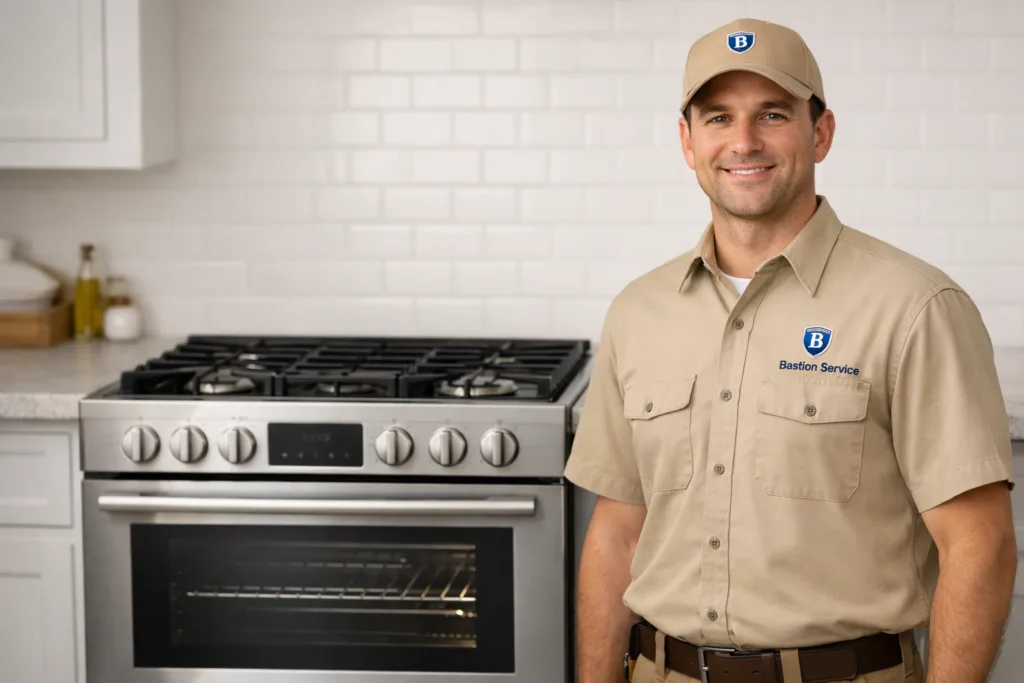
Small changes in how a range behaves usually show up before a full failure. A burner may take longer to light, the oven may need extra time to preheat, or the display may work one day and act erratic the next. With Bosch ranges, those symptoms can come from different systems, so the most useful approach is to match the repair plan to the exact behavior of the appliance.
Common Bosch range symptoms and what they may mean
A range combines surface cooking, oven heating, temperature regulation, and electronic controls. Because those functions overlap, one problem can mimic another. Symptom-based diagnosis helps narrow down whether the issue involves ignition parts, heating components, sensors, wiring, or the control system.
Burners that click but do not ignite properly
If a gas burner clicks repeatedly, lights late, or fails to light at all, the cause may be as simple as moisture or buildup around the burner head. It can also point to a misaligned cap, a faulty igniter switch, or a spark system problem. When the clicking continues after the burner area has been cleaned and fully dried, the issue usually needs closer testing.
If you notice a strong or ongoing gas smell, stop using the range and prioritize safety first before arranging service.
Oven not heating or heating inconsistently
When the oven stays cold, heats only partway, or cycles strangely, the failure may involve the bake element, igniter, sensor, relay, or wiring. Some Bosch ranges will appear to start normally but never reach the set temperature. Others heat unevenly, leaving one tray overdone while another remains undercooked.
Uneven baking is often treated like a simple calibration issue, but repeated hot and cold spots can signal a deeper heating or airflow problem. If the change in cooking results is new and consistent, it is worth having the range evaluated instead of adjusting cooking times around it.
Slow preheating
Long preheat times are easy to ignore because the oven may still get hot eventually. In practice, slow preheat can be an early sign of a weakened igniter, a struggling element, a sensor reading problem, or reduced power to part of the heating circuit. Continued use in that condition can lead to poorer temperature control and more wear on related components.
Temperature too high or too low
If the oven regularly burns food at normal settings or requires much longer cook times than expected, the temperature may not be tracking correctly. A drifting sensor, unstable control response, or intermittent heating component can all create that pattern. The important detail is whether the problem happens occasionally or on nearly every use, because repeatable symptoms are much easier to diagnose accurately.
Display, keypad, or control failures
A blank display, unresponsive keypad, flashing errors, or settings that change on their own can indicate power supply issues, a failing interface, or control board trouble. In some cases a power reset briefly restores normal operation, but if the fault comes back, the fix usually requires more than restarting the appliance.
Signs the range should not be put off
Some problems are less about convenience and more about preventing added damage or unsafe operation. Scheduling service is a smart next step when you notice:
- Burners that spark continuously or do not ignite reliably
- An oven that does not reach temperature
- Food suddenly cooking much faster or much slower than normal
- Repeated error codes or a dead control panel
- Preheat times that keep getting longer
- Intermittent power loss during cooking
Intermittent faults matter because they often spread stress to nearby parts. A range that works “sometimes” is not necessarily a minor issue, especially when heat output or ignition is involved.
What to check before booking service
A few simple observations can make the visit more efficient. Note whether the problem affects the oven, a single burner, all burners, or the controls. If the symptom appears only after the range has been on for a while, that pattern is worth mentioning. Error codes, unusual sounds, delayed ignition, and changes in cooking times are all useful details.
Basic cleaning around burner caps and making sure components are seated properly can help in some cases. Beyond that, repeated resets and guess-based part replacement rarely solve the problem for long. If the same symptom returns, professional diagnosis is usually the better move.
Repair or replace a Bosch range?
Many Bosch range issues are repairable when the failure is limited to one system and the rest of the appliance is in good condition. That is often the case with isolated ignition faults, certain heating problems, or a single failed sensor or control component.
Replacement becomes more worth considering when the range has several unrelated issues at once, has a history of recurring electronic faults, or would need multiple major parts in close succession. The better decision depends on the appliance’s overall condition, how severe the current symptoms are, and whether the repair restores normal function without stacking costs.
How service helps Inglewood homeowners make the right call
For households in Inglewood, range problems are usually most disruptive when they affect everyday cooking rather than causing a complete shutdown right away. That is why symptom-based evaluation matters. It helps identify whether the issue is a straightforward repair, whether continued use risks further damage, and whether the appliance still makes sense to keep.
When a Bosch range starts showing burner, oven, or control issues, the goal is not just to replace a part. It is to determine why the symptom is happening, what else should be checked, and whether the repair path is sensible for the appliance in your home.