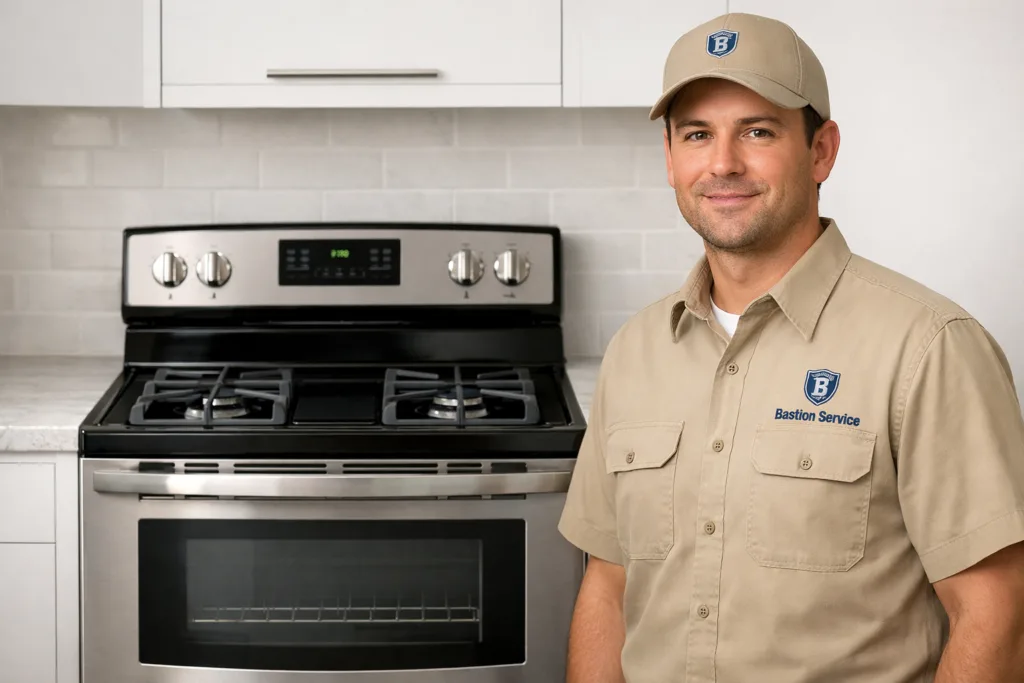
Range problems rarely stay neatly limited to one function. A burner that clicks but will not light can point to ignition parts, burner alignment, moisture, or a control issue, while an oven that seems to heat normally may still be cooking 25 to 50 degrees off. That is why symptom pattern matters so much before any part is replaced.
Everyday Amana range problems homeowners notice first
Most household range issues show up in routine cooking. In Inglewood homes, that often means dinner taking longer than expected, baked food browning unevenly, a surface burner refusing to start, or a control panel acting unpredictably. Some problems are constant, while others appear only after the appliance has been running for a while.
Common complaints include:
- Gas burners clicking repeatedly
- Burners lighting slowly or not at all
- Oven not reaching the selected temperature
- Food cooking unevenly from front to back
- Electric elements staying too cool or getting too hot
- Display errors, resets, or unresponsive touch controls
- Broiler not working even when bake still works
When one symptom starts affecting daily meals, it helps to look at the full behavior of the range instead of focusing on a single failed cycle.
What common symptoms can mean
Burner clicks but does not ignite
On a gas Amana range, steady clicking without ignition may come from a misaligned burner cap, clogged burner ports, moisture after cleaning, a weak spark, or a fault in the ignition system. If one burner is affected, the problem may be local to that burner assembly. If several burners act the same way, the issue may involve shared ignition components or the switch system.
If there is a strong or persistent gas odor, stop using the appliance until the situation is checked. A burner that does not light correctly is not just inconvenient; it can also create a safety concern.
Oven takes too long to preheat
Slow preheating can be caused by a weak bake element on electric models, a failing igniter on gas models, a sensor reading incorrectly, or a control issue that is not sending proper power at the right time. Some ovens eventually reach temperature but still struggle to maintain it, which leads to inconsistent baking and roasting.
Homeowners often first notice this when recipes that used to be reliable suddenly require extra time or come out undercooked in the center.
Oven temperature is off
If the oven runs hot, runs cold, or swings more than expected, the cause may be a temperature sensor problem, a partially failed heating component, poor cycling control, or an issue with the electronic board. In some cases, the oven cavity is heating, but not accurately enough for dependable cooking results.
Signs of temperature inaccuracy include:
- Cookies burning on the bottom before the tops finish
- Casseroles taking much longer than normal
- Food browning too quickly at the set temperature
- Different results on each rack during the same bake cycle
Electric surface element does not behave normally
On electric Amana ranges, a cooktop element that stays cold, cycles weakly, or overheats may involve the element itself, the receptacle, the switch, or wiring at the connection point. A damaged receptacle can sometimes create intermittent contact, which makes the burner seem to work only when the cookware is positioned a certain way.
An element that will not reduce heat properly should be checked promptly, especially if it continues glowing more intensely than expected after the setting is lowered.
Broiler works but bake does not, or the reverse
When one oven function works and another does not, that usually helps narrow the problem. On electric models, a failed bake or broil element is a common cause. On gas models, the issue may involve the igniter or the way the control is calling for that specific function. Because the oven can still appear partially operational, these failures are sometimes mistaken for a general temperature problem.
Control panel or display problems
If the display flickers, shows error codes, stops responding, or resets during use, the fault may involve the control board, keypad, power supply, or related wiring. Electronic issues can affect timing, temperature regulation, and oven function selection, so they are often more than a cosmetic nuisance.
Signs the problem may be getting worse
Some range issues stay mild for a while, then become more disruptive. Intermittent failures are especially important to watch because they often point to a part wearing out rather than a one-time glitch.
It is smart to stop putting off service when you notice:
- A burner that works only sometimes
- Repeated clicking after the flame should already be established
- The oven overshooting the selected temperature
- Long preheat times getting progressively worse
- Controls cutting in and out during cooking
- A breaker tripping when the range is used
Continued use in these conditions can add stress to switches, wiring, sensors, and controls, which may turn a smaller repair into a broader one.
Safety issues that should not be ignored
Cooking appliances combine heat, power, and in some homes gas supply, so certain symptoms deserve immediate attention. A range should not be used normally if it has a persistent gas smell, visible sparking where it should not, a burner that does not cycle down, or signs of overheating around knobs or the control area.
Other warning signs include:
- Scorching around an element or burner area
- Burn marks near wiring connections
- An oven door that will not close properly
- Control errors that prevent normal shutoff
When safe operation is uncertain, the next step should focus on testing and condition assessment rather than continued trial use.
Repair or replace an Amana range?
For many households in Inglewood, repair makes sense when the issue is limited to a single burner system, igniter, element, sensor, switch, or control-related component and the rest of the appliance is in solid shape. A targeted repair is often worthwhile when the cabinet, cooktop, oven cavity, and major functions have otherwise held up well.
Replacement may become the better option when multiple systems are failing at once, the range has ongoing electrical problems, or the appliance shows broader wear that makes future repairs likely. The age and overall condition of the unit matter, but so does the nature of the current failure. One isolated part failure is very different from repeated problems across the cooktop and oven together.
What a service visit should help clarify
A useful diagnosis should answer the questions homeowners actually need answered. Is the problem confined to one burner or affecting the full ignition system? Is the oven heating element weak, or is temperature feedback inaccurate? Is the control failing outright, or is another component feeding it the wrong information?
That process should also help clarify:
- Whether the range is safe to keep using
- Whether the issue is likely to worsen quickly
- Whether the failure is isolated or part of a larger pattern
- Whether repair is practical for the condition of the appliance
For homeowners in Inglewood, that kind of practical repair plan is usually the fastest way to decide what to do next without guessing.
Getting better results from symptom tracking
If your Amana range has been acting up, a few details can make the problem easier to pinpoint. Note whether the issue affects the oven, the cooktop, or both. Pay attention to whether it happens only after preheating, only on one setting, or only intermittently. Error codes, unusual sounds, delayed ignition, and abnormal heat levels are all useful clues.
Even simple observations, such as whether one burner fails while the others work normally, can help separate an isolated component issue from a broader control or power problem. That makes the next step more efficient and helps avoid unnecessary part swapping.