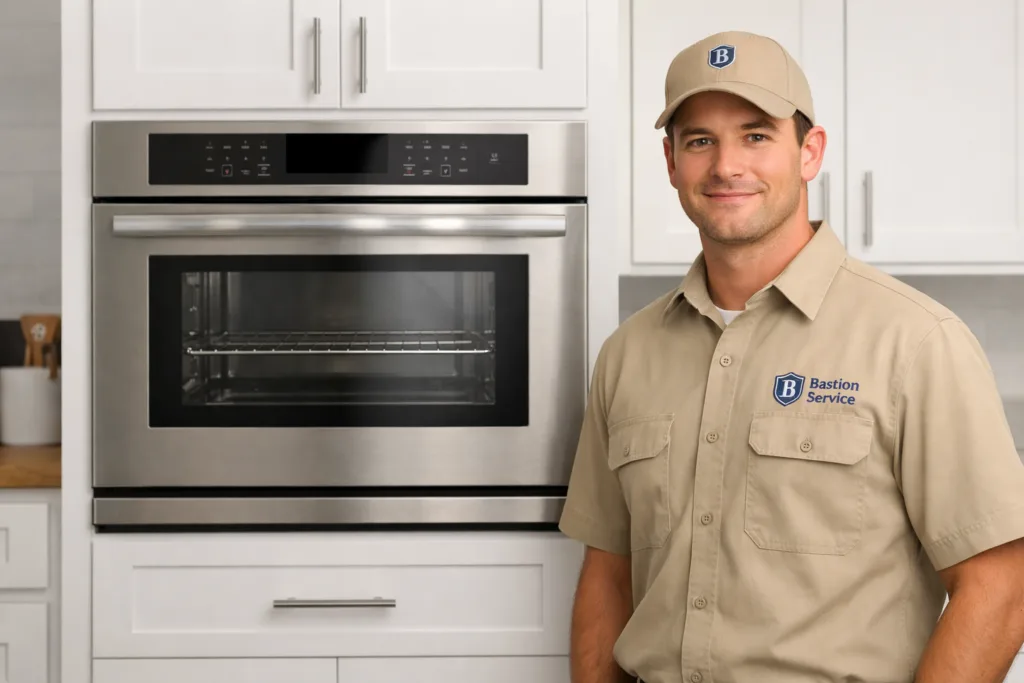
Common LG oven problems in Culver City homes

LG ovens often fail in ways that look similar at first, but the underlying cause can be very different. A unit that will not heat at all, one that heats slowly, and one that overshoots the set temperature may each point to a different repair path. Looking at the exact symptom pattern helps narrow the problem faster and avoids replacing parts that are still working.
Not heating or heating too slowly
If the oven powers on but the cavity stays cool, preheat drags on, or food comes out underdone, likely causes include a weak bake element, a failing broil element, a bad igniter on gas models, a temperature sensor problem, damaged wiring, or a control issue. In some cases, the display appears normal while the oven never produces enough heat to cook properly.
Slow preheat is especially easy to overlook because the oven seems functional. When preheat gets longer over time, that can signal a component that is still working intermittently but no longer performing under load.
Uneven baking and temperature swings
When casseroles are burnt around the edges and cool in the center, or one rack cooks much faster than another, the issue may involve uneven heat distribution, a partially failed element, a convection fan problem, a door seal issue, or a sensor that is not reading accurately. Temperature swings can also come from relay or control faults that cause the oven to cycle incorrectly.
These symptoms matter because many homeowners keep using the oven as long as it still turns on. The result is wasted food, unreliable cook times, and extra stress on parts that may already be weakening.
Oven will not start
An LG oven that is completely unresponsive may have a power supply problem, a blown fuse, a failed control board, damaged wiring, or a safety-related fault such as a door lock issue. If the display works but bake or broil will not engage, the failure may be limited to the heating circuit, command response, or a specific mode-related component.
Problems after the self-clean cycle
Self-clean can trigger service calls when the oven becomes locked, stops heating normally, or shows control problems right afterward. The extreme heat of that cycle can stress door lock parts, sensors, wiring, and electronic controls. If the timing lines up with self-clean, that detail is useful because it changes which components should be checked first.
How symptom-based diagnosis helps
Two ovens can show the same complaint and still need different repairs. “Not heating” might mean a failed element, an igniter that no longer draws proper current, a sensor that is reading incorrectly, or a control board that is not sending power where it should. The goal is to confirm the fault through testing rather than guessing from the symptom alone.
This is especially important with intermittent problems. If the oven sometimes reaches temperature and sometimes does not, the issue may be a component breaking down only after it warms up. That kind of pattern often points away from simple calibration and toward a part that is weakening in real use.
Signs the problem may be getting worse
Some issues stay limited to cooking performance, while others can lead to broader electrical or control damage if ignored. It is smart to stop using the oven and arrange service when you notice symptoms like these:
- Preheat is taking much longer than it used to
- The oven shuts off during cooking
- Food is repeatedly undercooked or overcooked at the same settings
- The display shows recurring error codes
- The door will not close, latch, or seal correctly
- The oven trips power or behaves erratically
- There is an unusual burning smell not explained by normal residue
If there are signs of overheating, electrical smell, visible wire damage, or repeated failure to start, continued use is not a good idea. Those symptoms can move beyond a routine repair and create additional part failures.
What may be causing the issue
LG oven repairs in Culver City commonly involve one or more of the following systems:
- Heating elements that have opened, weakened, or are only partially operating
- Igniters that glow but do not pull enough current to open the gas valve
- Temperature sensors that send inaccurate readings
- Control boards or relays that fail to cycle heat correctly
- Convection fans that are not circulating heat as intended
- Door gaskets and hinges that allow heat to escape
- Lock assemblies affected by self-clean or control faults
Because several of these failures can produce nearly identical cooking problems, good testing matters more than the error code alone.
Repair or replace?
For many homeowners, repair makes sense when the oven is otherwise in good condition and the problem is limited to a specific component such as an element, igniter, sensor, fan, latch, or control-related part. Replacement becomes a more serious consideration when the appliance has multiple active problems, a history of repeated breakdowns, or a major repair that does not fit the unit’s remaining service life.
The most helpful service visit is one that explains the fault clearly and gives you a realistic picture of what the repair would accomplish. In many cases, a single targeted fix restores normal baking and roasting. In others, the diagnosis shows that more than one system has started to fail, which changes the decision.
What to have ready before service
If you are scheduling LG oven repair in Culver City, a few details can make the visit more efficient:
- Whether the oven is gas or electric
- Whether the problem affects bake, broil, convection, or every mode
- Any error codes shown on the display
- Whether the issue started suddenly or gradually
- Whether the problem began after a self-clean cycle or power interruption
- Whether the oven heats a little, heats unevenly, or does not heat at all
Those details help narrow the likely failure before hands-on testing begins.
Why fast action can save time and frustration
An oven problem rarely shows up at a convenient moment. Once temperature control becomes unreliable, meal timing, baking results, and everyday kitchen routines all become harder to manage. Addressing the issue early can prevent the situation from turning into a larger control or wiring repair, especially when the first warning signs are slow preheat, inconsistent baking, or occasional shutdowns.
For Culver City households, the best outcome usually comes from matching the repair plan to the actual symptom pattern, the condition of the oven, and the likely life left in the appliance. That makes it easier to decide whether a focused repair is the right next step.