




Appliance problems are easier to solve when the symptoms are grouped by what the machine is failing to do. A refrigerator that is noisy and warm, a washer that fills but will not spin, and a dryer that heats but takes too long all point to different systems. Looking at the full pattern helps narrow the cause and prevents guesswork.
For specific LG appliance paths in Culver City, review LG Refrigerator Repair in Culver City, LG Freezer Repair in Culver City, and LG Washer Repair in Culver City.
For homeowners in Culver City, the most important first distinction is whether the appliance is simply underperforming or showing signs that continued use could cause food spoilage, water damage, or a safety issue. That difference often decides how quickly service should be scheduled.
Start with the symptom, not the part
Many LG appliances display a problem long before a component fully fails. You may notice intermittent cooling, occasional drainage trouble, longer cycle times, or controls that respond inconsistently. Those early signs matter because they often reveal whether the issue is tied to airflow, heating, drainage, sensors, door latching, ignition, or electronic controls.
A good repair decision usually comes from questions like these:
- Did the problem appear suddenly or get worse over time?
- Is the appliance completing the full cycle or stopping partway through?
- Is there leaking, overheating, frost buildup, or rising temperature?
- Are noises new, repetitive, or tied to a specific part of operation?
- Has the appliance shown error codes along with loss of function?
Those details help separate a limited repair from a broader condition problem.
Refrigerator and freezer symptoms that should not wait
LG refrigerators and freezers often show trouble through warming temperatures, inconsistent cooling, frost accumulation, leaking water, fan noise, or ice maker complaints. While these can look like separate issues, they may stem from the same underlying fault, such as blocked airflow, defrost problems, drain issues, door seal failure, sensor errors, or a cooling-system concern.
If food is softening, the compressor seems to run constantly, or temperatures swing from cold to warm, the appliance may be working harder without maintaining safe storage conditions. That is usually a sign to stop waiting for the problem to “settle down” on its own.
Freezers deserve special attention because a partial cooling problem can be easy to miss at first. Excess frost, packages that soften and refreeze, or unusual internal noise can all indicate that the unit is not holding conditions consistently.
Common refrigerator and freezer warning signs
- Fresh food compartment feels warm even though the freezer seems cold
- Frost builds up around vents or interior panels
- Water appears under drawers or on the floor
- Fan noise becomes louder, irregular, or constant
- Ice production slows or stops
- Compressor runs for long periods with poor cooling results
Washer problems that can lead to bigger damage
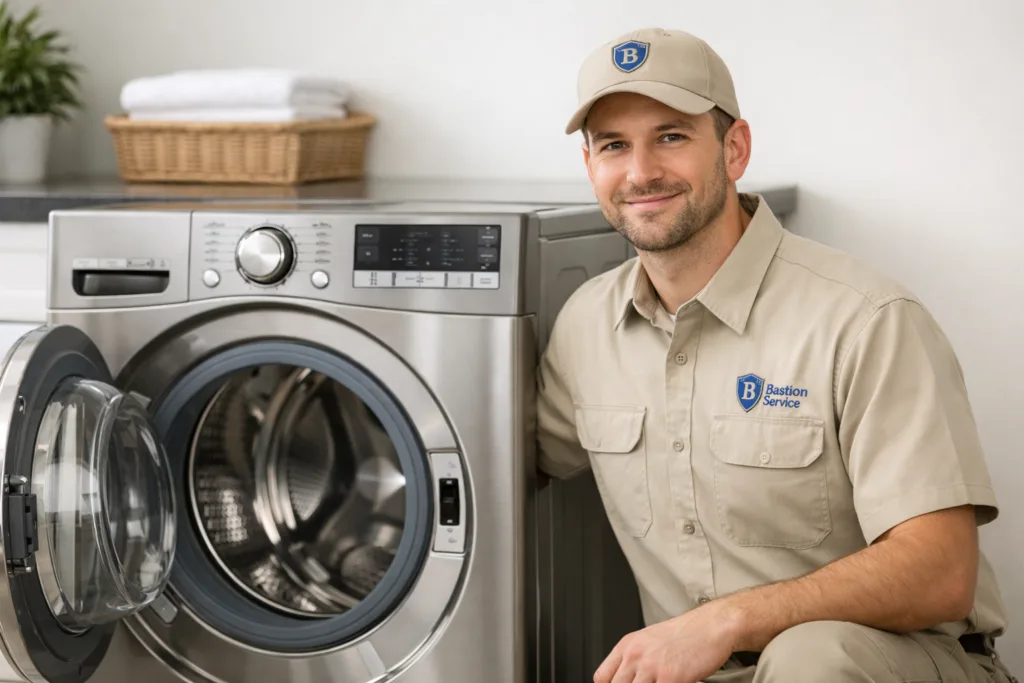
LG washers commonly develop issues with draining, spinning, filling, balancing, or door locking. Some are obvious, like standing water in the tub or a cycle that stops mid-program. Others start more subtly, such as repeated off-balance loads, small leaks, or louder spin noise.
Leaks and violent vibration deserve prompt attention because they can affect flooring, nearby cabinetry, and other parts of the machine. A washer that struggles to drain may also place extra strain on the pump and controls if the problem is ignored.
When evaluating washer symptoms, it helps to note whether the machine fails at the same stage every time. A unit that fills but does not agitate suggests a different repair path than one that washes normally but cannot complete the drain or spin cycle.
Washer symptoms homeowners often notice first
- Water remains in the drum after the cycle ends
- The washer stops before spin begins
- The door stays locked or will not latch properly
- The machine shakes hard or walks during spin
- There is leaking during fill, wash, or drain
- Clothes come out wetter than normal
Dryer issues are often about heat, airflow, or wear
An LG dryer can appear to be running normally while still failing to dry well. If the drum turns but clothes stay damp, the issue may involve heat production, airflow restriction, moisture sensing, or internal wear. On the other hand, a dryer that overheats, shuts off mid-cycle, or produces burning smells should be treated more urgently.
Long dry times are not just an inconvenience. They often indicate that the appliance is operating inefficiently and placing extra stress on heating and safety components. Noisy operation can also point to worn supports, rollers, or other moving parts that may worsen with continued use.
Dryer symptoms worth checking promptly
- Loads need multiple cycles to dry
- The dryer tumbles but produces no heat
- The cabinet feels unusually hot
- The machine shuts off before the load is dry
- Squealing, scraping, or thumping develops
- Moisture remains even on small loads
Dishwasher problems are not always just cleaning problems
When an LG dishwasher leaves dishes dirty, cloudy, or wet, the fault may involve more than detergent or loading habits. Poor wash performance can be tied to circulation issues, spray arm obstruction, heating problems, drainage trouble, latch failure, or sensor interruptions.
Standing water at the end of the cycle is one of the most useful clues because it often points toward drainage restrictions or pump-related trouble. Leaking, repeated shutdowns, or a dishwasher that fills and then does little else should also be evaluated before regular use continues.
If the machine is technically finishing cycles but results keep getting worse, that gradual decline is often a sign of a functional problem rather than a one-time glitch.
Cooktop, oven, and range symptoms need targeted troubleshooting
LG cooking appliances can fail in ways that affect speed, temperature control, ignition, or user safety. A cooktop burner that clicks repeatedly, an oven that bakes unevenly, or a range with unresponsive controls may each involve very different systems even if the complaint sounds simple.
Electric cooking issues often trace back to elements, switches, relays, wiring, sensors, or control boards. Gas-related complaints require closer attention to ignition behavior and flame performance. If a strong gas smell is present, stop using the appliance and address that immediate safety concern before arranging repair.
Cooking appliance symptoms that usually justify service
- Burners do not ignite or heat properly
- Repeated clicking continues after ignition attempts
- Oven preheat is slow or incomplete
- Baking results are uneven from front to back or rack to rack
- Display or touch controls stop responding consistently
- Surface elements cycle incorrectly or stay too cool
When repair makes sense and when replacement becomes part of the discussion
Not every breakdown means an appliance should be replaced. Many LG household appliances are worth repairing when the problem is isolated and the rest of the machine remains in solid condition. A single failed component in a washer, dryer, dishwasher, oven, or cooktop can often justify repair if it restores normal use with confidence.
Replacement becomes more relevant when multiple systems are worn, the appliance has a history of recurring failures, or the current issue is only one part of a larger decline. Refrigeration problems, in particular, sometimes require a closer cost-benefit review because cooling complaints can involve anything from straightforward airflow faults to more serious system-level failures.
What matters most is not whether the appliance can be made to run for the moment, but whether the repair is likely to restore reliable daily use.
Signs that using the appliance again may increase the problem
Some faults stay stable for a short period. Others tend to worsen with every cycle. In a Culver City home, it is smart to pause use and arrange diagnosis when you notice:
- Water leaking from a refrigerator, washer, or dishwasher
- Food temperatures rising in a refrigerator or freezer
- A dryer overheating or taking much longer than usual
- An oven or range heating unpredictably
- Persistent grinding, scraping, buzzing, or banging
- Error codes paired with shutdowns or missing functions
- Repeated ignition problems on a cooktop or range
These symptoms often lead to larger repairs if the appliance keeps operating under strain.
What homeowners in Culver City should pay attention to before scheduling service
Before booking an appointment, it helps to note a few specifics: the model if available, any error code shown, when the problem started, whether it is constant or intermittent, and what changed in the appliance’s behavior. For example, “the washer drains slowly only on bulky loads” is more useful than “it acts weird sometimes.”
Photos of leaks, frost buildup, or displayed errors can also help document a symptom that may not appear the same way later. That kind of detail makes it easier to understand whether the issue is operational, mechanical, or control-related.
A practical way to think about LG appliance repair
The goal is not just to get the appliance running again for a day or two. It is to identify why it failed, what risks come with continued use, and whether the likely repair matches the appliance’s overall condition. That approach is especially useful when the same machine has been showing small warning signs for weeks before the major problem appears.
Whether the issue involves cooling, drainage, heating, drying, ignition, or controls, symptom-based troubleshooting gives homeowners a better basis for making the next decision. In Culver City, that means less guesswork, fewer unnecessary delays, and a more realistic path toward restoring normal kitchen and laundry routines.


