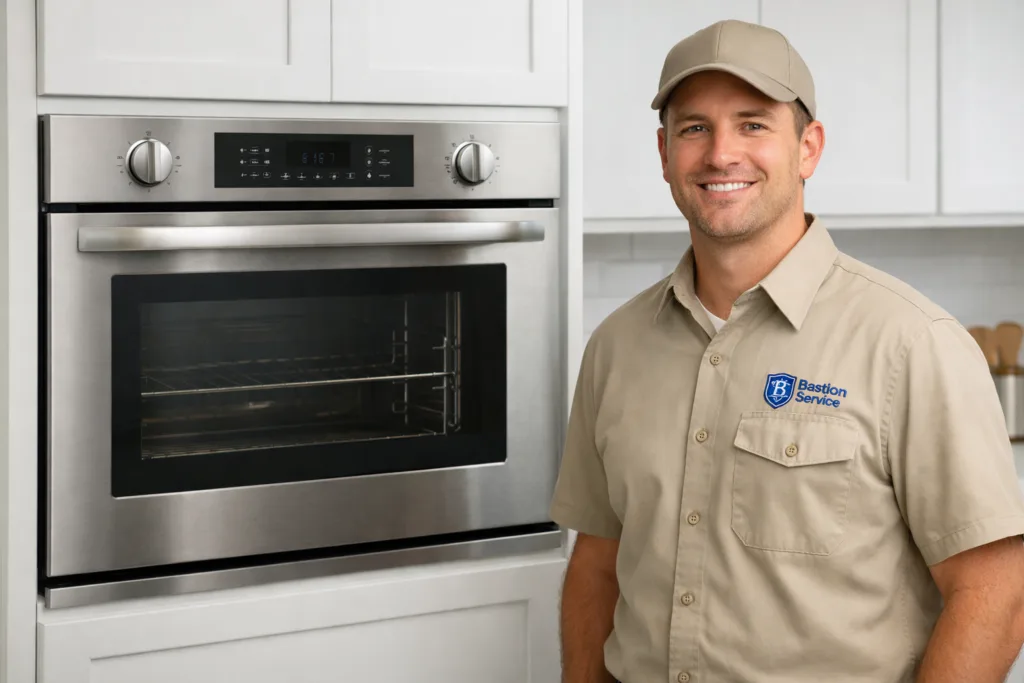
Everyday cooking usually makes oven problems obvious fast. A GE oven may seem to work, but meals take longer, baking turns inconsistent, or the controls stop responding the way they should. In most cases, the best next step is to match the symptom to the likely failure instead of assuming one part is always to blame.
Common GE oven problems in Culver City homes
GE ovens can fail in a few predictable ways, but the same complaint can still come from different components. Paying attention to how the problem shows up helps narrow the repair path and avoids unnecessary part replacement.
Not heating at all
If the oven stays cold after a cycle is started, possible causes include a failed bake element, a weak or failed igniter on gas models, a bad thermal sensor, a wiring issue, or an electronic control fault. Homeowners sometimes notice the light and display still work, which can make the problem seem confusing, but heating circuits can fail even when the rest of the oven appears normal.
Slow preheat
Slow preheat is one of the most common complaints because the oven eventually gets warm enough to cook, just not on time. A weakening igniter, partially failed element, inaccurate sensor, or control issue can all cause a long preheat cycle. This often shows up first with weeknight meals that suddenly need extra time from start to finish.
Uneven baking
When one rack browns faster than another, cookies finish unevenly, or casseroles stay underdone in the center, the problem may involve inconsistent heat distribution, sensor drift, weak element performance, or poor door sealing. Uneven baking often feels subtle at first, then becomes more obvious as results get less predictable from one use to the next.
Temperature swings
Some temperature fluctuation is normal during operation, but large swings are not. If food burns on the outside before the inside is done, or recipes that used to work now come out inconsistently, the oven may be running hotter or cooler than the set temperature. Sensor problems, relay issues, and control board faults are common reasons this happens.
Display or keypad problems
A blank display, flashing code, unresponsive buttons, or a timer that behaves erratically often points to the user interface or main control system. Sometimes the oven can still heat with partial control failure; in other cases, the unit will not start at all because the control cannot properly process the selected cycle.
How symptom patterns help identify the likely cause
Looking at one symptom in isolation does not always tell the whole story. A better approach is to notice what works, what does not, and whether the issue is constant or intermittent.
- Bake fails but broil still works: often suggests a bake element, igniter, or bake circuit issue rather than total power loss.
- Preheat takes much longer than before: may indicate a weakening heating component or an inaccurate sensor.
- The oven shuts off mid-cycle: can point to control, wiring, or overheating protection problems.
- Error codes appear with temperature issues: often means the oven is detecting a sensor or communication fault.
- The clock works but no cooking cycle starts: may involve the keypad, door switch, control lock setting, or main board.
This kind of symptom-based review is especially helpful when deciding how urgent the repair is and whether the oven should stay out of service until it is checked.
When to stop using the oven
Some oven issues are mostly about convenience, but others can lead to damaged parts, ruined food, or safety concerns. It is wise to stop using the appliance if you notice any of the following:
- The oven overheats or seems much hotter than the set temperature.
- The control panel starts and stops cycles unpredictably.
- There is a burning smell that is not related to normal food residue.
- A gas model has delayed ignition or repeated clicking without proper ignition.
- The door does not close securely, especially during high-heat use.
If there is a strong or persistent gas odor around a gas oven, stop using the appliance immediately and address the gas concern before any appliance service is scheduled.
Repair or replace?
Many GE oven problems are worth repairing when the issue is limited to a specific part such as an igniter, heating element, sensor, switch, or control-related component. Repair becomes less attractive when the oven has multiple ongoing failures, severe cavity damage, or repeated electronic problems that make long-term reliability doubtful.
For many households in Culver City, the real question is not simply whether a part can be replaced, but whether the oven as a whole is still in solid condition. If the appliance has been working well aside from one targeted failure, repair is often the sensible route. If problems have been stacking up across heating, controls, and door function, replacement may be the better long-term decision.
Details that help before a service visit
A few observations can make diagnosis faster and more accurate. Before service, it helps to note:
- Whether the problem happens on bake, broil, or both
- How long preheat is taking compared with normal use
- Whether the display shows an error code
- Whether the issue is constant or only happens sometimes
- Whether the oven seems too hot, too cool, or fluctuates during cooking
- Any unusual sounds, smells, or visible sparking
Even small details can matter. Knowing that broil still works, for example, can point the diagnosis in a very different direction than an oven that does nothing at all.
What Culver City homeowners usually want to know first
Most people are trying to answer three practical questions: is the oven safe to use, what part is most likely failing, and is the repair worth doing? Those answers depend on the exact behavior of the appliance, not just the model name or age. One oven with slow preheat may need a straightforward repair, while another with similar symptoms may have a deeper control problem.
For that reason, the most helpful service approach is one that focuses on the specific failure pattern in your GE oven and the condition of the appliance overall. That makes it easier to decide whether to move ahead with repair, pause use of the oven, or start planning for replacement.