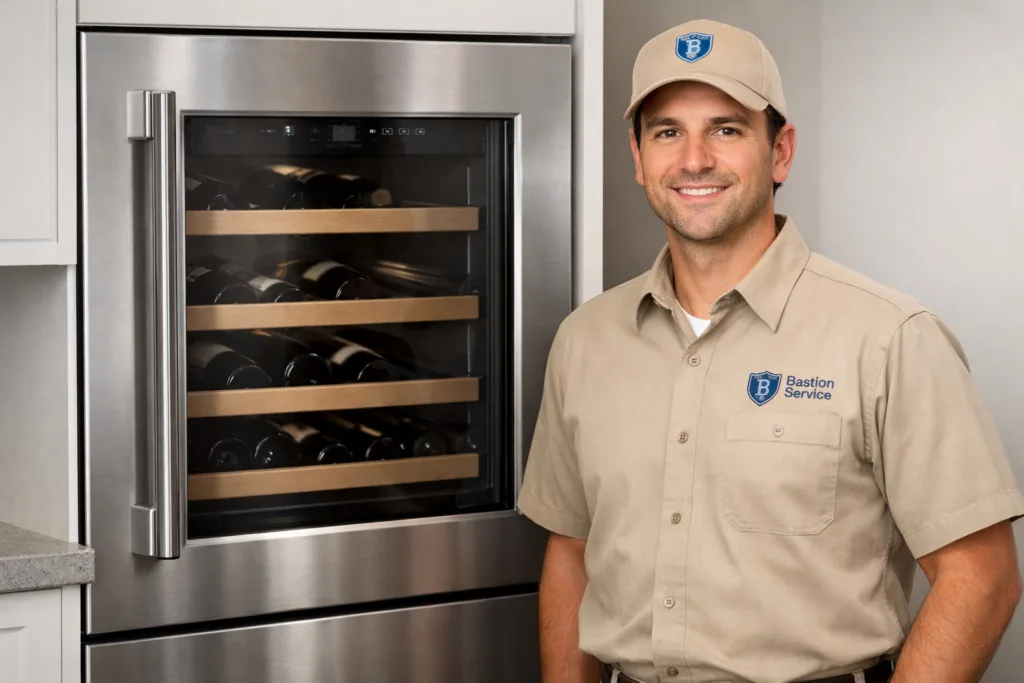
A KitchenAid wine cooler that starts warming up, overcooling, collecting moisture, or making new noise should be checked before the problem affects both bottle storage and the appliance itself. Because these units are designed to hold a narrow temperature range, even minor changes in performance can point to developing issues with airflow, controls, seals, fans, or refrigeration components.
What different symptoms usually mean
Many wine cooler complaints sound similar at first, but the cause can be very different from one unit to the next. A cabinet that feels slightly warm may have an airflow problem, while a unit that is much too warm could be dealing with a failed start component, sensor issue, or compressor-related fault. Moisture around the door may be a gasket problem, while moisture inside the cabinet can also be tied to frost buildup or drainage trouble.
That is why symptom pattern matters. Whether the issue shows up all day, only during warmer hours, after the door has been opened, or as a constant condition helps narrow down the repair path.
Not cooling enough
If the cooler runs but bottles are not staying at the selected temperature, common possibilities include restricted condenser airflow, a weak evaporator fan, a thermostat or sensor reading incorrectly, or a refrigeration problem reducing cooling capacity. In some cases, the unit may still seem cold near one shelf but warm elsewhere, which often points to uneven air circulation inside the cabinet.
When cooling is only slightly off at first, homeowners sometimes keep using the appliance and hope it stabilizes. If the temperature continues to drift, the system may be working harder than normal without actually protecting the contents.
Too cold or freezing in spots
A KitchenAid wine cooler that starts overcooling can be just as concerning as one that runs warm. Freezing near the back wall, ice forming where it should not, or bottles feeling much colder than the control setting can indicate a thermostat problem, sensor fault, or control issue that is no longer regulating the cooling cycle correctly.
Top-to-bottom temperature differences
If one section feels noticeably colder than another, airflow should be checked closely. Fan problems, frost interference, blocked vents, and loading patterns that interrupt circulation can all create uneven storage conditions. In a wine cooler, that inconsistency matters because stability is part of what protects the contents over time.
Moisture, frost, and water around the unit
Condensation is one of the most common signs that something has changed inside the cabinet. You may see moisture on shelves, dampness around the door opening, fogging on glass, frost on the interior wall, or water collecting near the base. These symptoms are often connected to one of a few trouble areas:
- Door gasket wear or gaps that let humid air enter
- Frequent frosting that interferes with normal airflow
- A clogged or misdirected drain path
- Internal ice buildup that later melts and spills where it should not
- Control or sensor problems that cause improper cycling
In Hawthorne homes, this is worth addressing early. Moisture problems rarely stay limited to appearance alone. They can lead to more frost, less stable temperatures, and possible damage to nearby cabinetry or flooring if water escapes the unit.
Noise changes that should not be ignored
Wine coolers make some operating noise, but a noticeable change usually means a part is wearing out or struggling. The type of sound can help narrow the issue:
- Buzzing or humming louder than usual: possible compressor strain, airflow restriction, or mounting vibration
- Clicking without normal cooling: possible start relay or compressor startup problem
- Rattling: loose panels, fan blade interference, or vibration against surrounding surfaces
- Whirring or scraping: evaporator or condenser fan trouble
If the sound is new and repeats regularly, it is usually better to have it checked before the unit shifts from noisy operation to outright cooling failure.
Why the unit may run constantly
A KitchenAid wine cooler that seems to run all the time is often compensating for another problem. It may be trying to overcome warm air entering through a worn gasket, dirty heat-exchange surfaces, poor ventilation, a fan problem, or declining refrigeration performance. Constant operation raises wear on electrical and mechanical parts and can still leave the cabinet unable to hold a steady temperature.
Rapid cycling can also be a warning sign. If the cooler starts and stops too often, the controls, sensor system, or startup components may need attention.
Checks homeowners can do first
Before scheduling service, a few basic observations can help rule out simpler causes:
- Confirm the control setting has not changed
- Make sure the door closes fully and does not rebound open
- Look for visible gasket gaps or tears
- Check whether bottles or shelves are blocking interior airflow
- Note whether the problem is constant or only appears at certain times of day
- Listen for fan noise, clicking, or repeated restart attempts
If those checks do not explain the issue, internal diagnosis is usually the next step.
When to schedule KitchenAid wine cooler repair in Hawthorne
Service is a good idea when the appliance can no longer maintain its set temperature, develops repeated condensation, leaks water, frosts over, cycles abnormally, or begins making new sounds that continue. It also makes sense to schedule a visit when performance has changed even though the cooler still technically runs. Early repairs are often more manageable when the problem is still limited to a fan, control component, sensor, seal, or startup part.
When continued use can make things worse
Using the unit in its current condition may worsen the problem if it is running hot, struggling to start, building heavy frost, or leaking onto the floor. A failing startup circuit can place more stress on the compressor. Frost can block airflow and create larger temperature swings. Water can spread beyond the appliance and affect surrounding materials.
If stored wine is no longer being kept in a stable environment, it is usually best to limit use until the fault is identified.
Repair versus replacement
Many KitchenAid wine cooler problems are repairable, especially when the issue involves a fan motor, thermostat, sensor, electronic control, door gasket, drain issue, or compressor start component. Replacement becomes more likely when the appliance has major sealed-system trouble, repeated expensive failures, or overall wear that makes further repair hard to justify.
The best decision usually depends on:
- The age of the wine cooler
- How well the cabinet and door are holding up overall
- Whether the failure is isolated or part of a larger pattern
- The cost and availability of the required parts
For homeowners in Hawthorne, the most practical approach is to identify the failed component first and then compare the repair scope with the condition of the unit as a whole.
What a proper diagnosis should cover
A thorough service assessment should do more than confirm that the cooler is not performing well. It should verify actual temperature behavior, check airflow through the cabinet, inspect the gasket and moisture pattern, evaluate fan operation, test relevant controls and sensors, and determine whether the compressor and associated refrigeration components are functioning normally.
That kind of symptom-based evaluation is what helps separate a relatively straightforward repair from a larger refrigeration problem and gives you a realistic next step for your KitchenAid wine cooler.