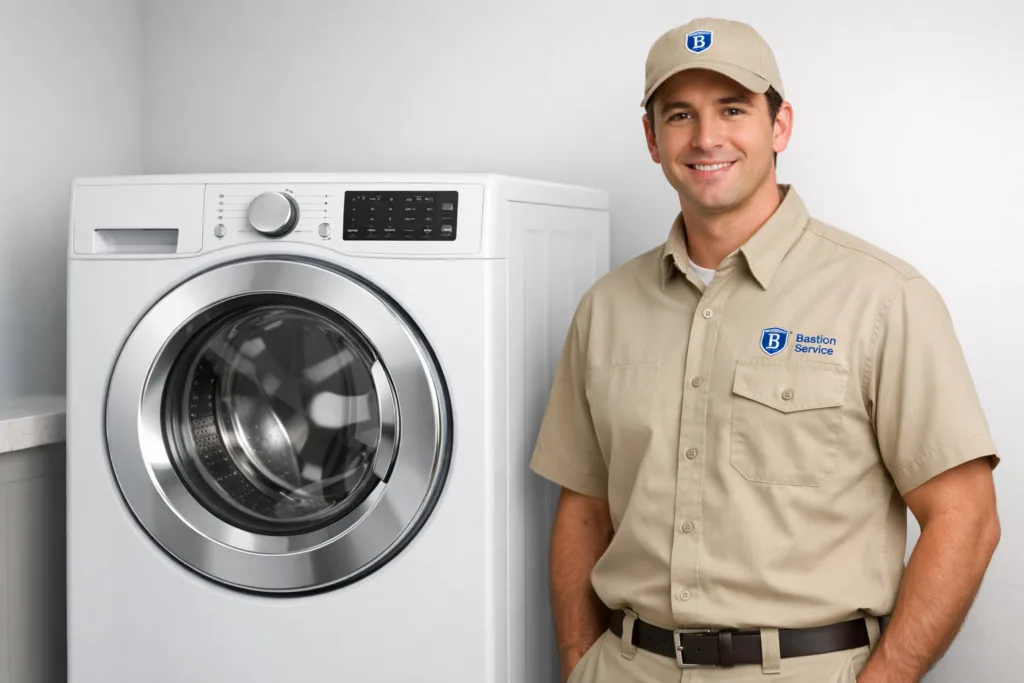
Washer problems are often easiest to solve when the symptom is matched to the point in the cycle where the failure happens. A machine that fills but never tumbles is a different problem from one that washes normally and then leaves water behind, and a washer that leaks only during spin usually points somewhere else than one that leaks as soon as it starts filling. For homeowners in El Segundo, that symptom pattern is usually the fastest way to narrow down what a GE washer is actually doing wrong.
Common GE washer symptoms and what they usually mean
Most service calls come down to a handful of repeat issues. The symptom itself does not confirm the failed part, but it does help separate drainage trouble from lock issues, motor trouble, suspension wear, or control problems.
Washer will not start
If the control panel lights up but the cycle does not begin, a failed lid lock or door lock is a common possibility. On some GE washers, the unit may appear ready but will not proceed because it cannot confirm that the door is secured. In other cases, the problem can involve the start command not registering correctly, inconsistent power to the control, or a fault in the user interface.
If the washer is completely unresponsive, the issue may be more basic, such as incoming power, but it can also point to an internal electrical failure. A machine that starts only sometimes is especially worth checking sooner rather than later, because intermittent behavior often becomes a full no-start condition.
Washer fills but does not agitate or spin
When water enters the tub normally but the cycle does not move forward, attention usually shifts to the drive system. Depending on the GE design, the problem may involve the motor, belt, actuator, clutch-related wear, or a control issue that prevents the machine from advancing into wash or spin.
If the washer hums, clicks, or pauses repeatedly, avoid forcing additional cycles through it. Repeated restart attempts can increase strain on parts that are already failing and may make the final repair larger than it needed to be.
Washer will not drain
Standing water in the tub is one of the most common washer complaints. In many cases, the drain pump is obstructed or worn out. In others, the drain path is restricted, the washer is not reaching the drain stage correctly, or the control is not sending power to the pump when it should.
A useful clue is whether the machine makes any draining sound. A loud hum with little or no water movement often suggests an obstruction or weak pump. Total silence during the drain portion can indicate an electrical or control-side issue instead.
Clothes come out too wet
If a load finishes but laundry is still heavy with water, the washer may not be reaching full spin speed. That can happen because of suspension problems, a drain issue that slows the spin phase, imbalance detection, motor trouble, or a fault earlier in the cycle that causes the machine to shorten or skip part of the spin process.
This symptom can be misleading because it feels like a simple spin problem, but the root cause is sometimes tied to drainage or sensing rather than the spin components alone.
Leaking during or after cycles
Leaks can begin at the inlet hoses, pump assembly, internal connections, door boot, tub seal area, or drain system. The timing of the leak matters. Water on the floor during fill often points to one set of components, while a leak that appears only during agitation or high-speed spin may suggest something very different.
If the washer is leaving regular puddles, it is best to stop using it until the source is identified. Ongoing leaks can damage flooring, baseboards, and the area around the laundry space.
Shaking, banging, or walking across the floor
A single unbalanced load is not unusual, but repeated violent movement is a warning sign. GE washers that shake hard during spin may have worn suspension parts, leveling problems, installation issues, or internal wear affecting basket support.
If the washer bangs loudly every load, continuing to run it can lead to more damage. Movement that seems minor at first can become damage to nearby parts, wiring, or the outer cabinet if left alone.
Why GE washer diagnosis is often model-specific
GE washers are built in several different configurations, and they do not all fail in the same way. Top-load and front-load machines use different lock systems, drain layouts, motor controls, and cycle logic. Even two washers that show the same symptom may need completely different repairs depending on how the machine is designed.
That is why the best repair decisions usually come from testing the washer through its actual cycle behavior rather than assuming the cause from the complaint alone. Watching whether the machine fills, locks, drains, senses load balance, and enters spin correctly helps separate a straightforward repair from a broader control or mechanical issue.
Signs the problem should not be ignored
Some washer issues are more than an inconvenience. A machine that is leaking, failing to unlock properly, tripping power, producing a burning smell, or making grinding noises should not be treated as something to work around for a few more weeks.
Scheduling service makes sense when you notice any of the following:
- The washer stops mid-cycle and will not recover
- Water remains in the tub after the cycle ends
- Spin performance is weak and laundry stays soaked
- The door or lid lock works inconsistently
- The unit leaks onto the floor
- The machine bangs, scrapes, or shakes hard during spin
- The controls respond unpredictably or fail to start the cycle
Early attention can prevent one failed part from creating a second problem. A weak pump, worn suspension set, or faulty lock assembly is often easier to deal with before repeated use affects the control system or other moving parts.
Repair or replace a GE washer?
Whether repair is worthwhile usually depends on four things: the washer’s age, its overall condition, the specific failure, and whether there are multiple issues happening at once. Many GE washer problems are still very repairable when the rest of the machine is in solid shape.
Repair often makes sense for issues such as:
- Drain pump failure
- Door or lid lock problems
- Water inlet valve issues
- Suspension wear
- Single-component motor or control faults
Replacement becomes more likely when the machine has major structural wear, repeated board failures, severe bearing or tub damage, or a repair cost that no longer fits the age and condition of the washer. The most useful answer usually comes after the fault is confirmed and the scope of repair is clear.
What to note before service
A few observations can make a washer issue easier to pinpoint. If possible, note where in the cycle the problem occurs: fill, wash, drain, or spin. Listen for humming, clicking, grinding, or pump noise. Pay attention to whether the failure happens every load or only under certain conditions.
It also helps to write down any displayed error code exactly as shown and check around the washer for water marks, detergent buildup, or signs that the machine has shifted during spin. These details will not replace testing, but they do help narrow the path to the actual failure.
Service focused on the real symptom
When a GE washer in El Segundo starts failing, most homeowners want the same answer: what is wrong, what it affects, and whether the repair is worth doing. The most effective service approach is one that follows the symptom carefully, confirms the source of the problem, and avoids replacing parts based on guesswork. Whether the machine is not draining, not starting, leaking, or falling short at the end of the cycle, the right next step comes from identifying the failure before deciding on the repair path.