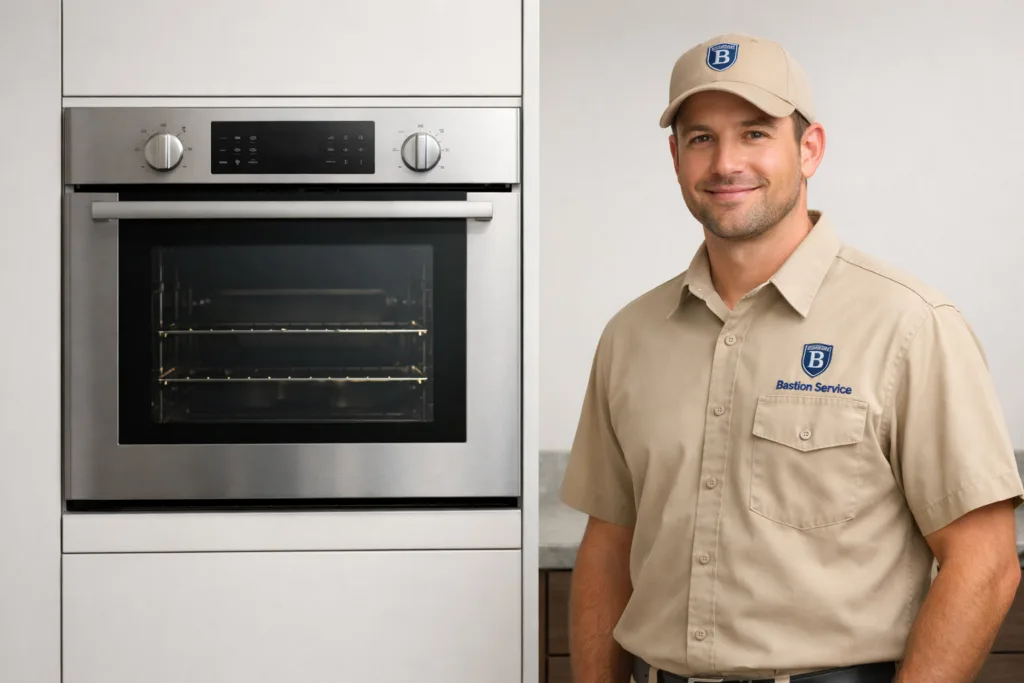
Bosch wall ovens are built for precise cooking, so even a small fault can show up quickly in daily use. A unit that runs cooler than the set temperature, preheats too slowly, or shuts off in the middle of baking usually needs testing rather than guesswork. Similar symptoms can come from different causes, and the right repair depends on which system is actually failing.
Common Bosch wall oven symptoms homeowners notice
Oven will not heat
If the display powers on but the cavity stays cold, the issue may involve a failed bake or broil circuit, a temperature sensor problem, a relay failure on the control board, or a power supply issue. In some cases the oven appears to start normally but never develops enough heat to cook food safely. That difference matters because “not heating” and “heating weakly” often point to different repair paths.
Slow preheating
A wall oven that takes much longer than usual to reach temperature may still have a working element, but not one that is cycling correctly. Sensor drift, reduced heating output, control faults, or problems in the convection system can all affect preheat time. Many homeowners first notice this when recipes that used to be reliable suddenly take longer from start to finish.
Uneven baking or roasting
Hot spots, pale bottoms, overbrowned tops, or food that cooks differently from left to right can indicate temperature regulation problems. On a Bosch wall oven, uneven results may be tied to the sensor, fan operation, element performance, or door sealing. If the oven temperature swings too far above or below the set point, consistent cooking becomes difficult even when the unit still technically works.
Temperature does not match the setting
When a recipe repeatedly burns at 350 degrees or stays underdone at 425 degrees, the oven may be misreading internal temperature. Some cases involve calibration, while others involve a sensor that is sending inaccurate information to the control. If the oven overshoots badly, shuts heat off too early, or never stabilizes, a technician can usually narrow the problem by comparing actual cavity temperature to the control response.
Display errors, beeping, or touch control issues
Electronic symptoms often appear as flashing error codes, nonresponsive buttons, random beeping, or a cycle that cancels on its own. These problems may come from the user interface, the main control, wiring connections, or a latch-related fault that prevents normal operation. Because one electronic issue can imitate another, replacing parts without testing can easily miss the real cause.
Door will not close, lock, or unlock properly
A wall oven door that does not seal tightly can leak heat and affect baking performance. If the self-clean function leaves the door locked, or the latch will not engage at all, the problem may be mechanical, electrical, or both. Hinges, latch motors, switches, and alignment issues can all interfere with normal use.
What these symptoms can mean
Several Bosch wall oven problems look similar from the outside, but the repair can be very different depending on the failed part. Common causes include:
- Weak or failed heating elements
- Out-of-range temperature sensors
- Electronic control board faults
- Door latch and lock mechanism failures
- Convection fan or airflow problems
- Loose or heat-damaged wiring connections
- Power supply issues affecting one side of the heating circuit
This is why symptom pattern matters. An oven that starts heating and then falls behind is not the same as one that never heats at all, and an oven with inaccurate temperature is not always suffering from a bad control board.
When to stop using the oven
Some cooking problems are inconvenient but manageable for a short time, while others are signs to stop using the appliance until it is checked. It is smart to discontinue use if the oven:
- Overheats or scorches food far beyond the set temperature
- Shuts off unexpectedly during cooking
- Shows repeated error codes that interrupt operation
- Will not shut off normally
- Produces electrical burning smells
- Trips breakers or causes flickering at the control
- Remains locked or behaves unpredictably after self-clean
Built-in appliances are harder to ignore when they are part of everyday meal prep, but continued use of an unstable oven can lead to more damage, especially when heat regulation or electronic control is already compromised.
Why Bosch wall oven issues are worth checking early
Many oven failures begin subtly. A little extra preheat time, one rack baking unevenly, or an occasional control glitch may not seem urgent at first. But smaller faults can develop into larger ones if the appliance keeps running under strain. Weak heating components may stress relays, poor door sealing can affect cooking performance across every cycle, and intermittent electronic faults can turn into complete loss of function.
For households in West Los Angeles, early service can be especially helpful when the oven is still usable but clearly no longer performing the way it should. Catching the problem while it is limited to one system often makes the repair decision simpler.
Repair or replace?
In many cases, repair is the better choice when the problem is isolated and the wall oven is otherwise in good condition. A failed sensor, a door-related issue, a single heating problem, or a specific control-related fault can often be addressed without replacing the appliance. Replacement becomes a more serious consideration when there are multiple major failures, extensive electronic damage, or repair costs that no longer make sense for the condition of the unit.
Because wall ovens are built in, replacing them is not always as straightforward as replacing a freestanding appliance. Fit, installation details, and kitchen disruption all matter. That makes an accurate diagnosis especially useful before deciding whether to keep the current Bosch oven in service.
What a service visit should clarify
A worthwhile appointment should answer more than whether the oven is “broken.” It should narrow down which system failed, explain how that failure connects to the symptoms, and outline the most sensible next step. That usually includes checking heating performance, temperature response, control behavior, door operation, and any error-code pattern the oven has been showing.
For homeowners in West Los Angeles, the most useful outcome is understanding whether the issue is mechanical, electrical, or electronic, whether continued use is safe, and whether the repair is likely to restore normal daily cooking without guesswork.
Signs the problem is getting worse
If you have been living with a Bosch wall oven problem for a while, certain changes suggest the condition is progressing. Watch for:
- Preheat times that keep getting longer
- Temperature inconsistency from one use to the next
- Controls that respond intermittently
- Error codes appearing more often
- Door issues that begin affecting heat retention
- Cooking results that vary even with familiar recipes
Those patterns usually mean the issue is no longer isolated to a minor annoyance. They are strong signs that the oven needs attention before it becomes unusable at the worst possible time.
Focused help for a built-in cooking appliance
Wall ovens are expected to deliver stable, predictable heat, and Bosch models depend on multiple components working together to do that well. When one part of that system slips out of range, the symptoms can affect everything from weekday meals to holiday cooking. A careful inspection helps determine whether the fix is straightforward or whether a larger decision is needed based on the oven’s overall condition and repair path.