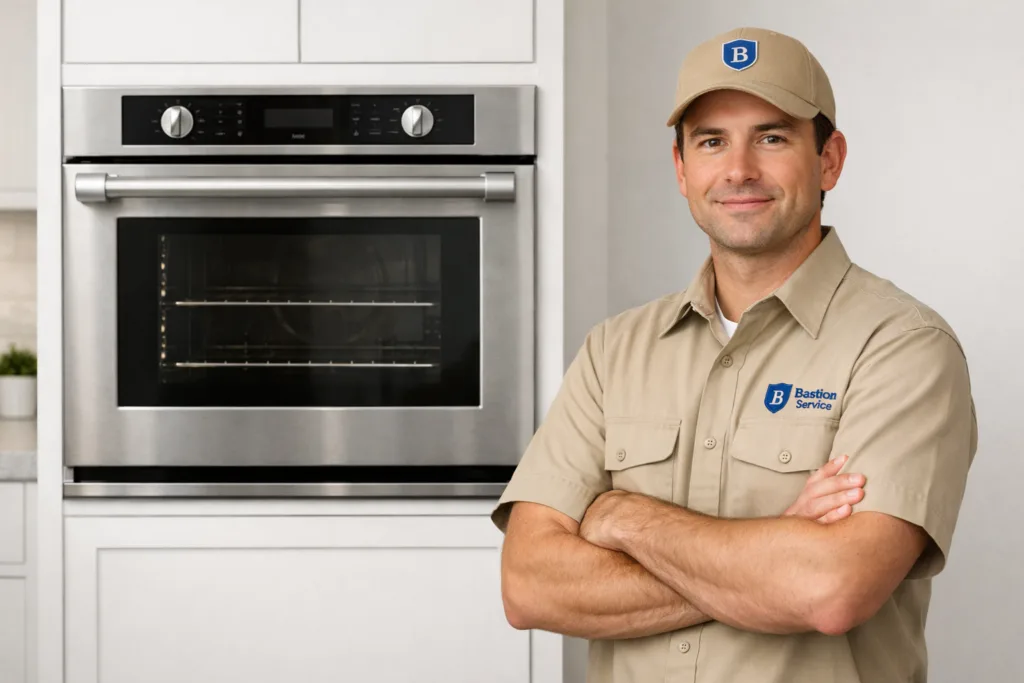
Wall oven failures are often easier to understand when you look at the exact cooking symptom instead of the appliance as a whole. A KitchenAid wall oven may power on normally yet still struggle to reach temperature, overshoot the set point, or heat unevenly from rack to rack. In many West Los Angeles homes, those differences matter because they point to very different repair paths.
Start with what the oven is doing
Homeowners usually notice a problem in one of a few ways: dinner takes much longer than usual, baked goods come out unevenly, the oven will not start, or the display shows an error after a cycle. Those details help separate a likely heating issue from a sensor problem, control fault, latch failure, or power supply concern.
Examples that are especially useful during diagnosis include:
- The oven preheats, but food still comes out underdone.
- Broil works, but bake does not.
- The display is lit, but there is no heat.
- The unit shuts off partway through cooking.
- The door remains locked after self-clean.
- The temperature seems to swing far above or below the setting.
Not heating or slow to preheat
If a KitchenAid wall oven will not heat at all, the cause may be a failed bake element, a broil element problem, a thermal cutoff issue, damaged wiring, or an electronic control failure. When the oven heats very slowly instead of not heating at all, the fault may be more subtle. A weak element, inaccurate temperature sensor, or relay problem can let the oven appear to function while never reaching stable cooking temperature.
One common clue is when preheat takes much longer than it used to, especially if recipes that were previously reliable start requiring extra time. Another clue is when the oven says it has reached the set temperature, but food still needs noticeably longer to finish. That often points to a heating or sensing problem rather than user error.
When bake and broil behave differently
KitchenAid wall ovens rely on different heating components depending on the mode. If broil still works but bake does not, that often narrows the issue toward the bake circuit, related wiring, or the control output for that function. If neither mode heats correctly, the problem may involve shared components such as power supply, sensor feedback, or the main control.
Uneven baking and temperature swings
Uneven cooking is one of the most frustrating wall oven problems because the appliance may still seem partly usable. Cookies may brown on one side but stay pale on the other, casseroles may need extra time in the center, or multiple racks may cook very differently. In some cases, homeowners begin rotating pans more often just to get acceptable results.
Possible causes include:
- A sensor that is no longer reading temperature accurately
- A partially failed heating element
- A convection fan issue on models that use forced air
- Control regulation problems that cause overshooting or undershooting
- Door seal or hinge issues that allow heat to escape
Temperature swings can also show up as inconsistent results from one meal to the next. If the same recipe turns out well one day and poorly the next under the same settings, the oven may not be holding heat evenly through the cycle.
Display, control, and intermittent operation
A wall oven that has a blank display, unresponsive keypad, random resets, or intermittent shutdowns may have a failing control board, touch interface problem, loose connection, or incoming power issue. Because these appliances use dedicated electrical supply, some symptoms that look like a bad control can actually begin with wiring or voltage problems.
Intermittent faults deserve attention because they often progress. An oven that only occasionally shuts off may later stop working altogether. A keypad that responds inconsistently may eventually prevent normal use of bake, broil, timer, or temperature functions.
Error codes are useful clues
Error codes do not always identify the exact failed part, but they can help narrow the problem. Sensor-related codes, latch errors, and communication faults each suggest different areas to inspect. If a code appears repeatedly, especially after clearing it once, that usually means the oven is detecting an active fault rather than a one-time glitch.
Self-clean and door lock problems
Many wall oven issues first appear after self-cleaning. The high temperatures involved can stress components that were already weakening, including door lock assemblies, thermal protection parts, sensors, and electronic controls. A door that will not unlock, an oven that will not restart after cleaning, or a latch-related error code often points to this category of failure.
Door problems are not limited to the lock system. If the door does not close firmly, heat may leak during baking and affect performance. Worn hinges, gasket damage, or alignment problems can all contribute to long cook times and unstable temperatures.
Signs you should stop using the oven
Some symptoms are more than inconvenient and should be treated as reasons to stop use until the cause is identified. These include:
- A burning smell that does not quickly fade
- Breaker trips during preheat or active cooking
- Visible sparking or signs of overheating
- The oven shutting down mid-cycle repeatedly
- Repeated fault codes that return after resetting
- A door that will not unlock after a high-heat cycle
Continued use in those conditions can increase damage to wiring, controls, insulation, and heating components.
When repair usually makes sense
Repair is often the better option when the problem is limited to a specific failed part and the rest of the oven is in good condition. That can include a sensor, element, latch motor, fan motor, gasket, or a single control-related fault. Built-in wall ovens also involve fit and installation considerations, so keeping the existing unit in service can be practical when the repair path is straightforward.
Replacement becomes more likely when there are multiple failing systems, repeated electronic problems, significant internal damage, or age-related wear that makes further repair hard to justify. The decision is rarely just about one symptom; it depends on the condition of the full appliance and the likely reliability after repair.
What a useful service visit should clarify
A productive visit should determine whether the problem is in heating, sensing, control response, airflow, latch operation, or incoming power. For a built-in KitchenAid wall oven, access and installation conditions also matter because restricted airflow, cabinet fit, and past heat stress can affect both the symptom and the repair approach.
For households in West Los Angeles, the goal is simple: find the actual cause, understand whether the oven can be used safely in the meantime, and learn whether repair is likely to restore normal cooking performance without guesswork.
Helpful notes before scheduling service
If possible, write down the model number, any error code shown on the display, and whether the problem affects bake, broil, convection, or all modes. It also helps to note whether the issue started suddenly, worsened over time, or first appeared after self-cleaning. Small details like those can make diagnosis faster and more accurate.
If your KitchenAid wall oven in West Los Angeles is showing slow preheat, unstable temperatures, no heat, or control trouble, symptom-based evaluation is usually the best way to decide the next step and avoid replacing parts that are not actually causing the failure.