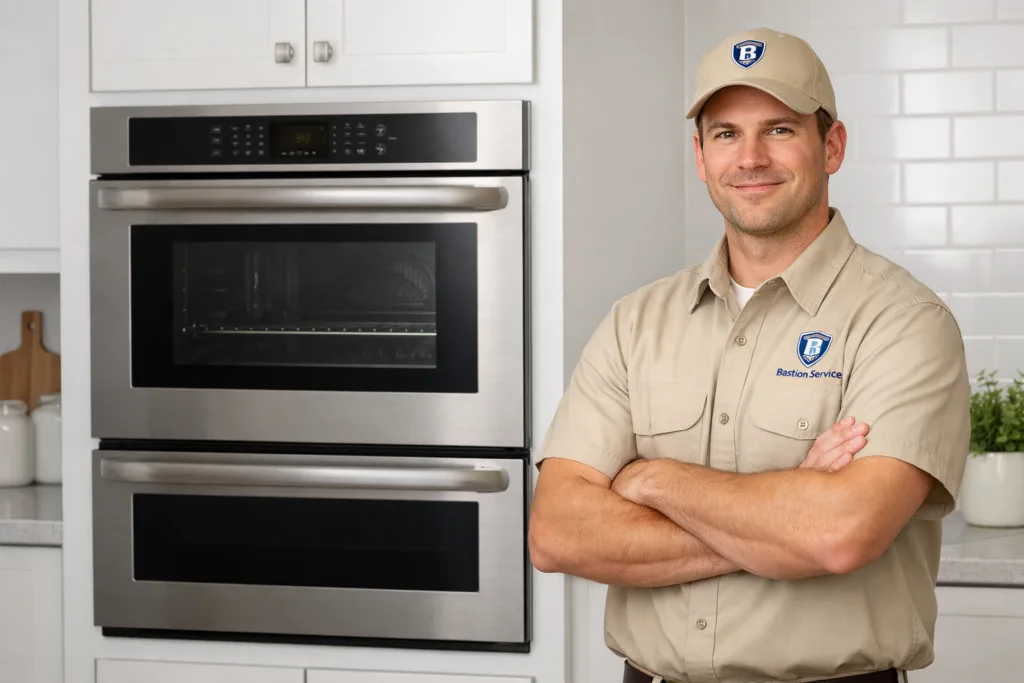
Common GE wall oven symptoms and what they often point to

When a GE wall oven starts behaving differently, the symptom pattern usually tells you where the problem is developing. Two ovens can both seem to be “not working,” but one may have a failed heating circuit while another has a sensor, latch, or control problem. Paying attention to how the failure shows up can make the repair path much easier to understand.
Not heating at all
If the display comes on but the oven never gets warm, the problem may be related to the bake element, broil element, temperature sensor, control board, thermal protection component, or internal wiring. In some cases, the unit appears normal on the screen yet never sends power to the heating system. This is especially important to check before assuming the entire oven is worn out.
Slow preheat
A wall oven that eventually reaches temperature but takes far longer than it used to often has a weak heating element, a sensor reading problem, or a control issue that is not managing the heat cycle correctly. Slow preheat is easy to dismiss at first, but it often shows up before a more complete heating failure. If dinner timing keeps getting thrown off, the issue is usually already beyond a simple settings adjustment.
Uneven baking or unreliable temperature
Food that browns unevenly, finishes too quickly on one side, or stays undercooked in the center may point to temperature regulation trouble. A drifting sensor, partial element failure, convection-related problem, or calibration issue can all create hot and cool zones. These problems tend to show up gradually, which is why homeowners often notice recipe results changing before they notice a full breakdown.
Oven turns on but cooking functions do not run properly
Sometimes the clock, lights, and keypad respond normally, but bake or broil will not start as expected. That can indicate relay failure, a board problem, a safety cutoff issue, or a fault in the power path to the heating components. Because the oven still looks “alive,” this type of problem is often mistaken for a minor glitch when it actually needs service.
Error codes, beeping, or a locked door
GE wall ovens may stop normal cooking when the control detects a sensor fault, communication problem, overheating issue, or latch failure. Self-clean cycles can also leave the door locked if the mechanism does not reset properly. If the same code returns repeatedly or the lock will not release, trying to force the oven back into use can create more damage than the original failure.
Breaker trips or the oven shuts off during use
If the oven trips power while preheating or during a cooking cycle, stop using it until the cause is identified. Shorted elements, damaged wiring, terminal issues, or failing internal components can all create this symptom. Repeated resets may get the oven working again temporarily, but they do not solve the underlying electrical problem.
Why the same symptom can have different causes
Wall ovens are built around several systems working together: heating, temperature sensing, control, door locking, cooling, and power delivery. A failure in any one of them can create overlapping symptoms. For example, “not heating” could mean a failed element, but it could also mean the control is not sending voltage, the sensor is reading incorrectly, or a safety component has opened the circuit.
That is why symptom-based service matters. A parts-guessing approach can lead to replacing the wrong component, especially on a built-in appliance where access is more involved and labor matters. The goal should be to identify the actual failed part or system and confirm that the oven can return to stable, safe operation.
When Marina del Rey homeowners should stop using the oven
Some oven issues are annoying but not immediately hazardous. Others should be treated as a reason to shut the appliance down until it is checked. You should avoid continued use if the oven:
- Trips the breaker
- Shuts off mid-cycle without explanation
- Overheats or burns food unusually fast
- Shows repeated error codes
- Has a door that will not unlock after self-clean
- Produces signs of electrical stress such as intermittent power loss
Continuing to run a wall oven with an unresolved heating or control fault can damage additional parts. A weak element can stress the control system, a sensing problem can lead to overheating, and a door-lock issue can turn a manageable repair into a larger one if the mechanism is forced.
Built-in wall oven repairs require a little more care
In many Marina del Rey homes, a wall oven is installed tightly within cabinetry, which makes diagnosis and repair different from a freestanding range. Access, trim removal, fit, ventilation space, and electrical connections all matter. That does not necessarily make the repair harder in every case, but it does mean the appliance should be evaluated with the installation style in mind.
It also helps to look at the full condition of the oven, not just the immediate failure. If the unit has one isolated problem and has otherwise been cooking well, repair is often straightforward. If it has recurring temperature issues, control irregularities, and latch problems together, the decision may be different.
Repair or replace: how to think it through
Most homeowners are really trying to answer three questions: what failed, is the fix likely to solve the root problem, and does the repair make sense for the oven’s condition. For many GE wall ovens, repair is worthwhile when the issue is limited to a specific component such as an element, sensor, latch, switch, or a defined electrical fault.
Replacement becomes more likely when multiple major issues are happening at once, electronic failures are recurring, the interior condition is poor, or age is making parts support more difficult. A useful evaluation should focus on the actual failure rather than treating every symptom as a reason to replace the appliance.
Repair is often the better choice when:
- The problem is tied to one identifiable part
- The oven has been performing well overall
- The cabinet fit makes replacement more complicated
- The expected repair restores normal temperature control and operation
Replacement may deserve consideration when:
- There are multiple active faults at the same time
- The oven has a history of repeat electronic issues
- Key parts are no longer practical to source
- The unit shows broader wear beyond the current symptom
What homeowners can notice before scheduling service
If you are trying to decide whether to schedule GE wall oven repair in Marina del Rey, a few observations can be helpful. Notice whether the oven fails every time or only during certain cycles. Check whether bake and broil both work, whether preheat completes, whether the display stays stable, and whether the problem started after self-clean. Also pay attention to whether cooking results have changed gradually or all at once.
These details do not replace diagnosis, but they do help narrow the likely cause. A slow decline in performance often suggests a component weakening over time, while a sudden complete failure can point more directly to an electrical or control-side fault.
What a good service visit should help you decide
The most useful outcome is not just getting the oven to power on again. It is understanding what failed, whether the unit is safe to use, and whether repair is the right next step for your household. For a built-in GE oven, that means confirming the problem is actually solved and not just temporarily bypassed.
For homeowners in Marina del Rey, that usually comes down to a simple decision: repair the oven with confidence, stop using it until work is completed, or move on from the unit if the condition no longer supports a sensible fix. A clear diagnosis and a practical repair plan based on the exact symptom pattern make that decision much easier.