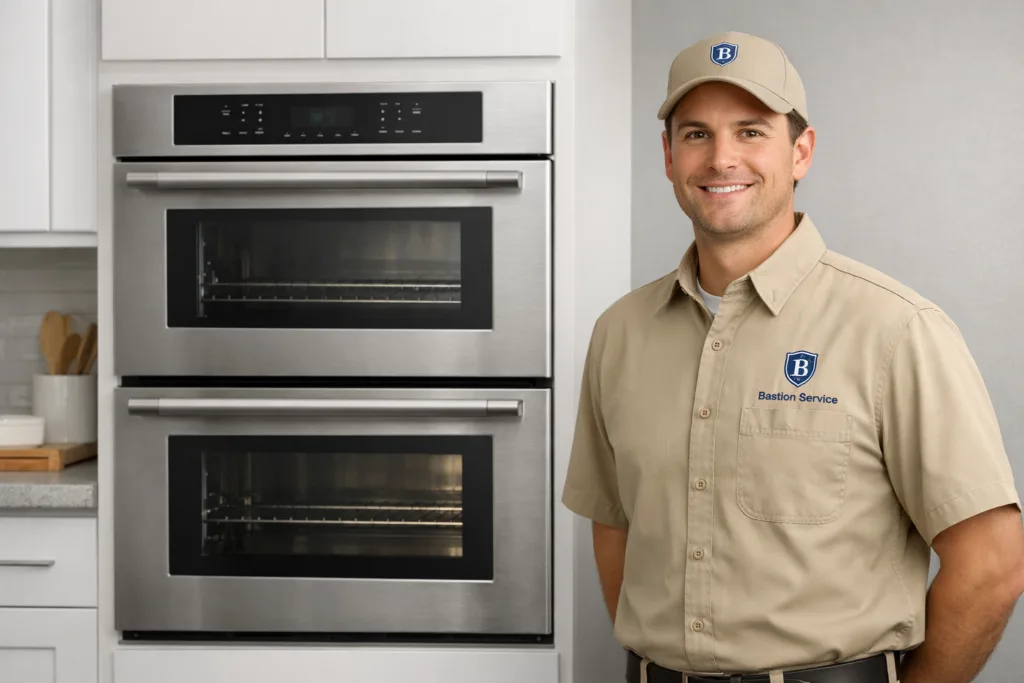
Wall ovens tend to fail in patterns. One household may notice preheat getting slower week by week, while another sees a sudden blank display or a door that will not unlock after a cycle. With a KitchenAid wall oven, those symptoms can look similar at first but come from very different causes, which is why the right repair starts with matching the behavior to the most likely failed component.
What common KitchenAid wall oven symptoms usually point to
A wall oven can still power on and appear normal while one important function is already failing. In many cases, the symptom itself offers the best clue about whether the issue is related to heat production, temperature sensing, airflow, controls, or power delivery.
Not heating or barely heating
If the oven turns on but does not reach cooking temperature, the problem may involve the bake element, broil element, temperature sensor, relay, or electronic control. Some units will start a cycle and never build enough heat for proper cooking. Others warm slightly but stall far below the set temperature.
This often shows up as food staying pale, casseroles taking far too long, or the oven seeming warm without ever becoming fully hot. On double wall oven setups, one cavity may fail while the other still works, which can help narrow the issue to a specific component rather than the entire appliance.
Uneven baking or temperature swings
When cookies brown more on one side, roasts cook unevenly, or recipes suddenly require constant adjustment, heat regulation should be checked. A drifting sensor, weak element, convection fan problem, or control calibration issue can all create inconsistent results.
These symptoms are easy to dismiss as normal wear, but they often indicate a repairable fault. If temperature performance has changed noticeably and the cookware, rack position, and recipe have not, the oven is usually telling you something has shifted mechanically or electrically.
Slow preheat
Slow preheat is one of the most common complaints with a KitchenAid wall oven. In some cases, the oven eventually reaches temperature but takes much longer than it used to. That can happen when an element is partially failing, a sensor is reading incorrectly, or the control is not cycling heat as it should.
A slow-preheating oven may still seem usable for a while, but that delay often grows into broader performance issues, including undercooked food and poor temperature recovery after the door is opened.
Error codes, beeping, or intermittent shutdowns
Error messages and random shutoffs usually point to control, sensor, latch, or wiring problems. A reset may temporarily clear the display, but repeated codes are rarely a one-time glitch. If the oven stops mid-cycle, locks unexpectedly, or powers back on only after cooling down, the fault is typically still present even if the unit works again later.
Door or latch problems
A door that will not close tightly, pops open slightly, or stays locked can affect more than convenience. Poor sealing changes temperature stability and can lengthen cooking times. Latch and hinge issues are also common after heavy use or after a self-clean cycle, when heat stress can affect nearby parts.
Symptoms that should not be ignored
Some oven issues are mostly about cooking performance. Others raise a safety concern or increase the chance of more expensive damage if the appliance keeps being used. Stop using the oven and have it checked if you notice:
- Repeated breaker trips
- A burning or electrical odor
- Visible sparking or flickering at the control area
- The oven overheating or scorching food unexpectedly
- Random loss of power during a cooking cycle
- A door that will not unlock after a high-heat cycle
In Marina del Rey homes where the wall oven is part of the everyday cooking routine, it is tempting to keep working around an intermittent problem. But recurring electrical faults, overheating, and shutdowns usually become more disruptive over time, not less.
Why the same symptom can have different causes
Two ovens can both seem to have a heating problem while needing completely different repairs. For example, an oven that never gets hot may have a failed element, while an oven that overshoots temperature may have a sensor or control issue. A blank display could be tied to incoming power, a fuse, wiring, or the control board itself.
That matters because replacing parts based on guesswork can waste time and money. A symptom-based evaluation looks at what the oven does from startup through a full heating cycle, whether the failure is constant or intermittent, and whether the issue changes between bake, broil, and convection settings.
Problems that often show up after self-clean
Self-clean cycles place intense heat stress on components around the control area, latch system, wiring, and thermal protection parts. If a KitchenAid wall oven stops working right after self-clean, that timing is important. Common post-self-clean complaints include a dead display, a locked door, heating failure, or controls that no longer respond correctly.
That does not always mean the entire oven is at the end of its life. In many cases, one heat-stressed component has failed and the rest of the appliance is still in solid condition.
Repair or replacement for a built-in wall oven
Built-in appliances are different from freestanding models when it comes to replacement. Cabinet fit, trim compatibility, electrical setup, and finish matching can all make replacement more involved than many homeowners expect. Because of that, repair is often worth considering when the problem is isolated to one major component and the oven is otherwise in good shape.
Replacement becomes a stronger option when there are multiple major failures, a long history of repeat breakdowns, or part costs that push the repair beyond a reasonable value decision. The better approach is to judge the appliance by the actual failure and overall condition, not by age alone.
How to make service faster and more accurate
If your oven is still operating at least part of the time, a few observations can help narrow the issue quickly:
- Whether the problem affects bake, broil, or both
- If the oven reaches temperature and then drops off
- Whether the display stays on when heat stops
- If the issue began after a self-clean cycle or power interruption
- Whether one oven cavity works differently from the other
- If the failure is constant or happens only after the oven has been running for a while
Those details help separate a heating issue from a control issue and can make the repair path much clearer.
What homeowners in Marina del Rey usually want to know
Most people dealing with a malfunctioning wall oven are trying to answer three practical questions: is it safe to use, what is likely wrong, and is the repair worth doing. A thorough diagnosis gives those answers in a way that is more useful than general advice or online symptom matching.
For KitchenAid Wall Oven Repair in Marina del Rey, the most helpful service visit is one that identifies the fault based on the oven’s exact behavior, explains what component is involved, and shows whether the repair is straightforward or points toward replacement instead. That is what turns a frustrating cooking problem into a decision you can make with confidence.