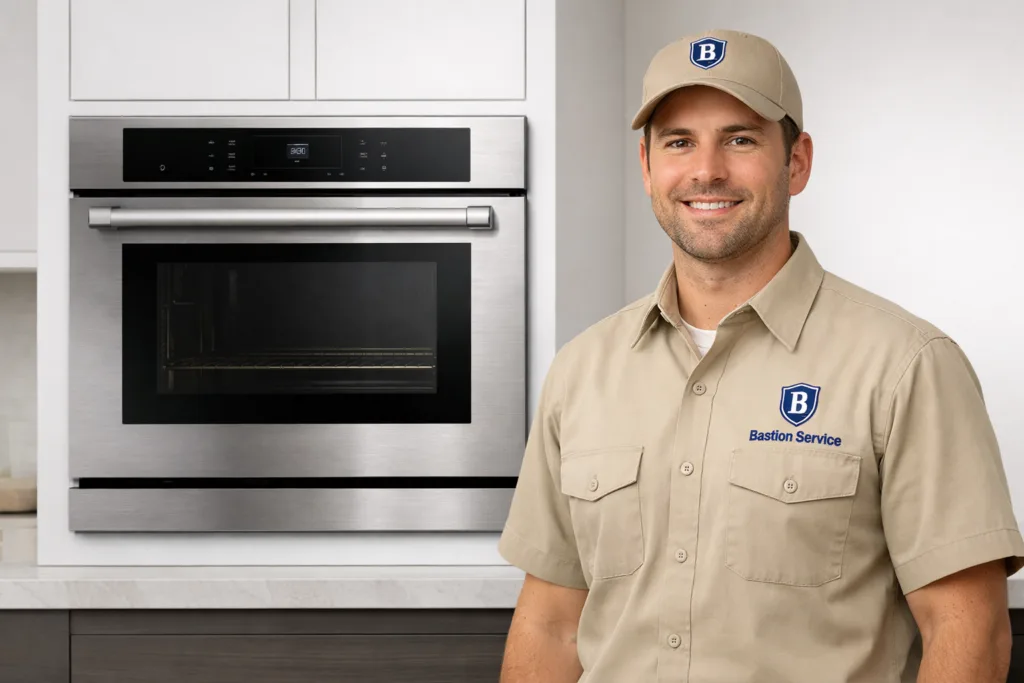
Built-in ovens often fail in ways that look simple at first but have more than one possible cause. A JennAir wall oven that will not heat, bakes unevenly, shuts off during use, or flashes an error may be dealing with a heating component problem, a sensor issue, a control fault, a latch problem, or an electrical supply issue. Sorting out which system is actually responsible is what keeps the repair focused and helps avoid replacing parts that are not the source of the problem.
Common JennAir wall oven symptoms in Marina del Rey homes
Most wall oven problems show up first in cooking performance. Homeowners may notice longer preheat times, inconsistent baking, or a control panel that no longer responds normally. In other cases, the oven still powers on but no longer holds temperature well enough for reliable cooking.
Not heating at all
If the oven light and display work but the cavity never gets hot, the failure may involve the bake circuit, broil circuit, temperature sensor, control board, or wiring. On some units, one failed component prevents normal heating even though the rest of the oven appears to be operating.
Slow preheat
When preheat starts but takes far longer than it should, the oven may be running on only part of the heating system or reading temperature incorrectly. This can happen when an element is weak, a sensor is drifting out of range, or the control is not cycling heat properly.
Uneven baking
Food that browns too fast on one side, stays pale on another rack, or comes out inconsistent from one use to the next usually points to temperature regulation problems. A wall oven can seem functional while still operating well above or below the selected setting.
Temperature swings or overheating
An oven that burns food unexpectedly or overshoots the set temperature may have a faulty sensor input or an electronic control issue. This is worth addressing promptly because overheating affects cooking results and can place extra stress on surrounding components.
Error codes, beeping, or random shutdowns
Intermittent faults are common with control-related problems. If the display flashes, the touch controls stop responding, or the oven shuts off mid-cycle, the cause may involve the user interface, main control, door lock circuit, or power connection. Symptoms that come and go often become more frequent over time.
Door and latch problems
A door that will not close tightly, unlock properly, or stay aligned can affect both safety and temperature performance. Some issues show up after a self-clean cycle, when heat exposure stresses latches, switches, hinges, or electronic parts tied to the lock system.
Why the same symptom can point to different repairs
Wall ovens rely on several systems working together: heating elements, sensors, relays, controls, door switches, and stable electrical supply. Because of that, one symptom does not always equal one failed part.
For example, an oven that will not reach 350 degrees may have:
- A weak or failed bake element
- A broil circuit problem affecting preheat performance
- A temperature sensor sending inaccurate readings
- A control board relay not delivering proper voltage
- A wiring fault that appears only under load
That is why symptom-based guessing can get expensive. The useful first step is identifying which system has actually failed and whether the repair is limited to one component or involves a broader control issue.
Signs the problem is getting worse
Some homeowners keep using the oven as long as it still turns on, but repeated performance issues usually mean the fault is progressing. If meals are becoming less predictable or the unit behaves differently from one cycle to the next, it is usually better to address the issue before it develops into a no-heat or full shutdown condition.
Watch for these warning signs:
- Preheat times that keep getting longer
- Food that suddenly cooks faster or slower than usual
- The display resetting during cooking
- Repeated error codes
- A door that does not seal evenly
- Breaker trips when the oven is in use
When to stop using the oven
Some problems are inconvenient, while others can create additional damage if the oven keeps being used. It is smart to stop using the appliance and schedule service when the oven overheats, loses power during a cycle, trips the breaker, or shows visible damage to an interior heating component.
You should also pause use if the door will not latch correctly or will not unlock after operation. Door and lock issues can affect heat retention, control behavior, and safe operation.
Repair or replace: what usually makes sense
Many JennAir wall oven problems are still worth repairing when the oven is otherwise in solid condition and the issue is isolated to a heating part, sensor, latch assembly, or control-related component. Built-in appliances are more involved to replace than freestanding units, so repair is often the simpler path when the rest of the oven remains structurally sound.
Replacement becomes more likely when there are multiple major failures at once, the oven has a long history of recurring issues, or the needed repair is no longer practical because of overall condition and parts considerations. The decision is easier when the symptom pattern is matched to the actual failed system rather than to a rough guess.
What a service visit should help clarify
For homeowners in Marina del Rey, the real value of wall oven service is understanding more than just whether the oven is malfunctioning. A good evaluation should clarify what failed, whether the oven is safe to leave unused until repair, whether continued operation could cause more damage, and whether the recommended fix is reasonable for the unit’s condition.
That kind of practical repair guidance is especially helpful with built-in JennAir models, where heating performance, controls, and door systems can all influence the final symptom. Once the source of the problem is identified, the next step becomes much easier to judge with confidence.