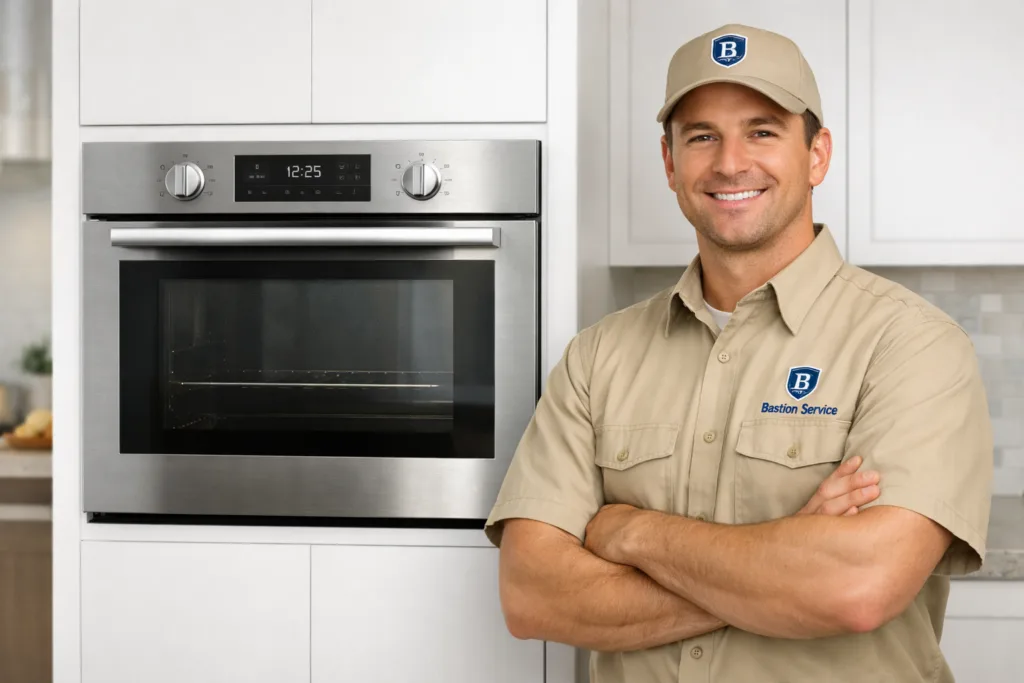
Wall oven problems tend to show up in ways that are easy to notice at home: dinner takes longer than usual, cookies brown on one side first, the display responds but the cavity never gets hot, or the unit shuts down in the middle of a cycle. With Bosch models, those symptoms can trace back to several different components, so the most useful next step is to match the repair plan to the exact behavior of the oven.
What different Bosch wall oven symptoms usually mean
Two ovens can appear to have the same problem while needing very different repairs. An oven that never heats at all is different from one that heats weakly, overshoots the set temperature, or struggles only during preheat. Paying attention to the pattern helps narrow down whether the issue is in the heating circuit, sensor system, controls, door assembly, or power supply.
Not heating or only partially heating
If the control panel turns on but the oven does not heat, possible causes include a failed bake element, broil element, thermal cutoff, relay problem, damaged wiring, or an electronic control fault. In some cases, the oven may still seem partly operational because one heating function is working while another is not. That often leads to food that cooks unevenly and preheat times that get longer week by week.
Slow preheat
Slow preheat is often dismissed as normal aging, but it usually points to a specific fault. A weak element, inaccurate temperature sensor, control issue, or incomplete heating cycle can all make the oven take much longer to reach the set temperature. If preheat used to be consistent and now feels noticeably delayed, that change is worth attention.
Uneven baking and temperature swings
When the center of a dish is undercooked while the edges are done, or one rack browns faster than the other, the problem may be related to temperature regulation rather than total heating failure. Sensor drift, calibration issues, convection fan trouble, or intermittent control problems can all affect cooking consistency. This is especially noticeable with baking, roasting, and recipes that depend on stable heat.
Display, keypad, and control problems
Flashing error codes, beeping, a frozen screen, buttons that do not respond, or a display that resets can indicate a user interface fault, failing control board, or unstable incoming power. Some Bosch control issues are straightforward, while others need model-specific testing before any part decision makes sense. Continued use with erratic controls can lead to canceled cycles, inaccurate temperatures, or unexpected shutoffs.
Door lock and self-clean issues
If the oven door will not lock, will not unlock, or shows a latch-related error after self-clean, the issue may involve the latch motor, switch assembly, control board, or heat-stressed components. Forcing the door or repeatedly cycling power can make the repair more complicated. A door that does not close or lock correctly can also affect temperature retention and safe operation.
Signs the problem is getting worse
Many wall oven faults start small and become more obvious over time. Homeowners in Marina del Rey often notice one of these patterns before a complete failure:
- Preheat takes longer than it used to
- Food comes out undercooked even when the timer is correct
- The oven runs hotter or cooler than the selected setting
- The unit shuts off before the cycle is finished
- The convection fan sounds unusual or does not seem to circulate heat properly
- Error codes return after being cleared
- The breaker trips when the oven starts heating
These changes usually mean the oven is no longer operating predictably. Even when the unit still turns on, performance problems tend to point to a repair need rather than a temporary glitch.
When to stop using the oven
Some issues are more than a cooking inconvenience. Stop using the oven and arrange service if you notice a burning electrical smell, visible sparking, repeated breaker trips, overheating around the control area, or a door that will not close securely. Those symptoms can indicate wiring damage, failing electrical components, or a safety-related fault that should not be ignored.
The same caution applies if the oven temperature seems far above the selected setting or if the controls behave unpredictably during use. A wall oven should heat in a controlled, repeatable way. If it does not, continued operation can put more stress on already failing parts.
Repair or replacement: how to think it through
For many Bosch wall oven problems, repair is a reasonable choice when the appliance is in otherwise good condition and the failure is limited to a serviceable part. Heating components, sensors, latch parts, and some control-related issues can often be resolved without replacing the entire unit.
Replacement becomes more likely when there are multiple major failures, severe heat damage, repeated electronic problems, or parts availability limits that make the repair path less practical. Age matters, but overall condition matters more. A well-maintained oven with one isolated issue may still be worth fixing, while a unit with recurring faults may not be the best long-term investment.
How to make diagnosis faster and more accurate
Before service, it helps to note exactly what the oven is doing. Small details can make a big difference in identifying the cause. Useful observations include:
- Whether the problem happens in bake, broil, convection, or self-clean
- If the display stays on while heating fails
- How long preheat now takes compared with normal use
- Whether the issue is constant or intermittent
- Any error code shown on the display
- Whether the breaker trips immediately or only after the oven starts heating
This kind of symptom-based information helps separate a bad sensor from a control issue, or a heating problem from a power-related fault. It also helps avoid replacing the wrong part first.
What Bosch wall oven repair looks like in a home setting
In residential kitchens, the goal is not just to make the oven turn on again. The real measure of success is whether it preheats normally, holds temperature correctly, and cooks evenly enough for daily use. A repair that restores power but leaves inconsistent baking or unreliable controls is not a complete solution.
For that reason, Bosch Wall Oven Repair in Marina del Rey is best approached by focusing on how the oven performs in real cooking conditions. If the unit has become unreliable, documenting the symptom pattern and having the fault evaluated early can help prevent a minor issue from turning into a larger electrical or control failure.