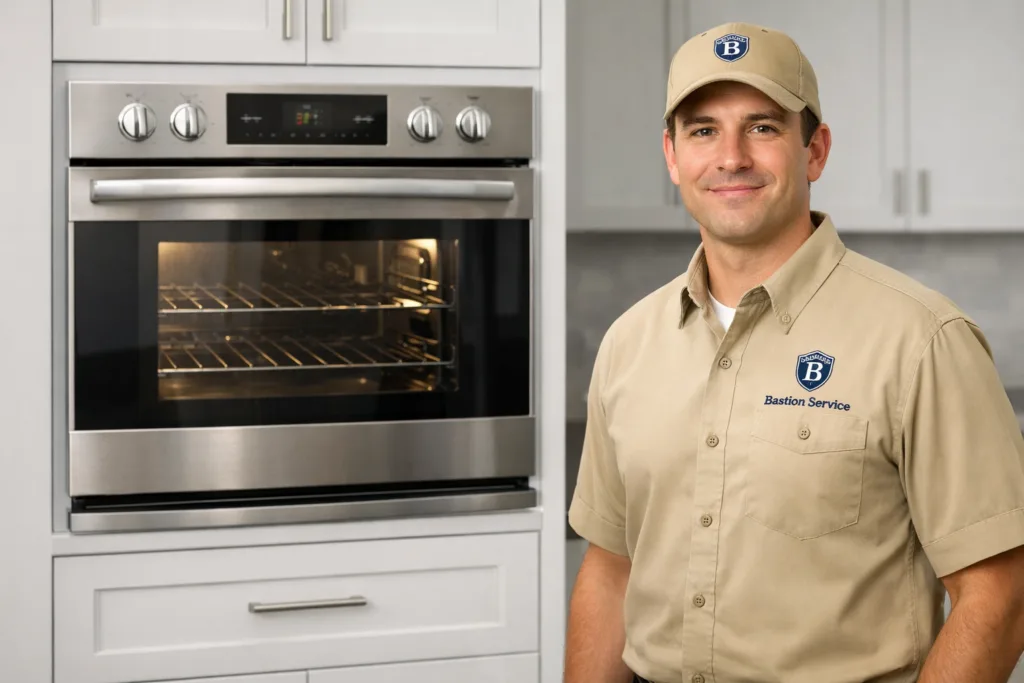
Common Whirlpool oven problems homeowners notice first

Most oven issues show up in everyday cooking long before the appliance stops working completely. A Whirlpool oven may still turn on, beep, and appear normal, yet deliver poor results that make meals unpredictable. In Hermosa Beach homes, the most common complaints usually fall into a few recognizable patterns:
- Not heating at all: The oven starts a cycle, but the cavity stays cool or never gets hot enough to cook.
- Slow preheat: The oven eventually reaches temperature, but it takes much longer than it used to.
- Uneven baking: Food browns unevenly, one side cooks faster, or the center stays underdone.
- Temperature swings: Recipes suddenly run too hot, too cool, or vary from one use to the next.
- Control issues: Buttons do not respond, settings reset, error codes appear, or the oven will not begin a cycle.
- Door or latch trouble: The door does not close tightly, heat escapes, or the self-clean function stops because of a latch fault.
These symptoms can come from different causes, including a weak heating element, a failing igniter on gas models, a drifting temperature sensor, damaged wiring, relay problems, or a control board fault. Because several failures can look similar at first, symptom-based testing matters more than guessing.
What specific symptoms often mean
Oven will not heat during bake or broil
If the display comes on but the oven never gets hot, the failure may be in the heating circuit rather than the power supply. On electric Whirlpool ovens, the issue may involve a bake element, broil element, wiring connection, or control relay. On gas models, a weak igniter can prevent the burner from lighting properly even though the oven appears to start normally.
Some homeowners notice that one function works while another does not. If broil works but bake does not, that can help narrow the problem. If neither mode heats, the issue may be broader and involve controls, power delivery, or safety components.
Preheat takes too long
Slow preheat is often treated like a minor annoyance, but it can be an early sign of a part weakening rather than failing completely. A tired igniter, a partially failed element, or a temperature sensor reading inaccurately can all make the oven work harder and longer to reach the target temperature.
When preheat times increase gradually over weeks or months, homeowners often adapt without realizing the oven is no longer performing correctly. That becomes more obvious when recipes that used to work reliably start coming out late or unevenly.
Food cooks unevenly
Uneven cooking usually points to heat distribution or temperature regulation problems. The oven may be cycling incorrectly, losing heat through the door, or heating more from one source than another. Symptoms often include cookies browning more on one side, sheet-pan meals finishing unevenly, or baked dishes needing extra time in the middle.
Rack position matters in any oven, but noticeable inconsistency from one use to the next is a sign that the appliance may need attention. If the problem appears across multiple recipes, pans, and temperatures, the issue is less likely to be user error and more likely to be a mechanical or electrical fault.
Temperature seems wrong even though the display looks normal
An oven can show the set temperature on the control panel and still run too hot or too cool. That mismatch may come from a sensor drifting out of range, a calibration issue, or a control problem that affects how the oven cycles. Homeowners usually notice this through results rather than measurements first: burned bottoms, pale tops, undercooked centers, or unexpectedly long bake times.
If several recipes from different sources suddenly need adjustment, the oven may no longer be holding a stable temperature. That is especially frustrating in households that cook often and rely on consistent performance.
Control panel works inconsistently
When the panel lights up but the oven does not respond correctly, the fault may involve the touchpad, user interface, electronic control, or internal communication between components. Sometimes the oven starts only on certain settings. In other cases, it cancels cycles, shows error codes, locks unexpectedly, or fails to register button presses.
Control issues can feel random, but the pattern often becomes clearer when you note exactly what happens before the problem appears. Whether the oven fails only during preheat, only after running for a while, or only when certain modes are selected can help identify the source.
Door, seal, and latch problems can affect cooking more than expected
A Whirlpool oven door that does not close squarely can create more than a convenience problem. Heat loss changes cooking times, makes temperature stability worse, and can put extra strain on heating components as the appliance tries to compensate. A worn gasket, bent hinge, or latch problem may also interfere with self-cleaning functions or trigger lock-related errors.
If you notice visible gaps, escaping heat, or a door that feels loose or misaligned, it is worth having that checked instead of continuing to force it closed. Minor hardware issues can turn into larger repair needs if they are ignored.
When the problem is likely repairable
Many Whirlpool oven problems are repairable when the failure is limited to a specific component and the rest of the appliance is in good shape. Common examples include failed elements, igniters, sensors, door hardware, latch assemblies, and some control-related parts. If the oven has otherwise been cooking well and the issue is recent and isolated, repair is often a reasonable path.
Repair tends to make the most sense when it restores normal, everyday use without creating an ongoing cycle of breakdowns. For a household oven, the real goal is simple: stable temperature, reliable heating, and controls that work when needed.
When replacement may be the better option
Replacement becomes more worth considering when an oven has multiple faults at the same time, shows heavy wear, or has a history of repeated service issues. A unit with both heating problems and electronic control failures may be harder to justify repairing than one with a single defective part.
Homeowners in Hermosa Beach often weigh a few practical questions:
- Is this a single failure or part of a larger pattern?
- Has performance been declining for a long time?
- Are important functions still working normally?
- Will the repair likely return the oven to consistent day-to-day use?
Those questions matter more than the symptom alone. A no-heat complaint on a well-kept oven can be straightforward. The same complaint on an older unit with control glitches, door issues, and uneven baking may point in a different direction.
Signs you should stop using the oven until it is checked
Some symptoms are more urgent than others. It is smart to stop using the oven if you notice any of the following:
- The oven trips the breaker
- There is a burning or overheating smell
- The control panel behaves erratically during operation
- Heating elements appear damaged or are not glowing normally on electric models
- The gas burner does not ignite correctly on a gas model
- The door will not close securely
These problems can lead to additional part damage and make the final repair more expensive. They can also make routine cooking less safe and less predictable.
Helpful details to note before service
If you are scheduling Whirlpool oven repair in Hermosa Beach, a few observations can make the visit more efficient. Try to note:
- Whether the problem affects bake, broil, or both
- Whether the issue started suddenly or got worse gradually
- Any error code shown on the display
- Whether the oven reaches temperature and then drops off
- Whether the door closes normally and seals tightly
- Whether the problem happens on every cycle or only certain settings
That kind of symptom history helps separate a heating fault from a sensor issue, a control problem, or a door-related heat loss issue. It also helps determine whether repair is likely to solve the problem cleanly or whether broader wear is affecting performance.
Choosing the right repair path for your Whirlpool oven
The most useful next step is not replacing parts based on guesswork. It is identifying what the oven is actually doing, matching that pattern to the likely failure, and deciding whether the repair will restore dependable cooking. For many households in Hermosa Beach, that means focusing on the symptom first, then the component, then the value of the fix.
Whether the issue is no heat, uneven baking, slow preheat, temperature swings, or an unresponsive control panel, the right repair path starts with understanding the failure clearly enough to make a smart decision.