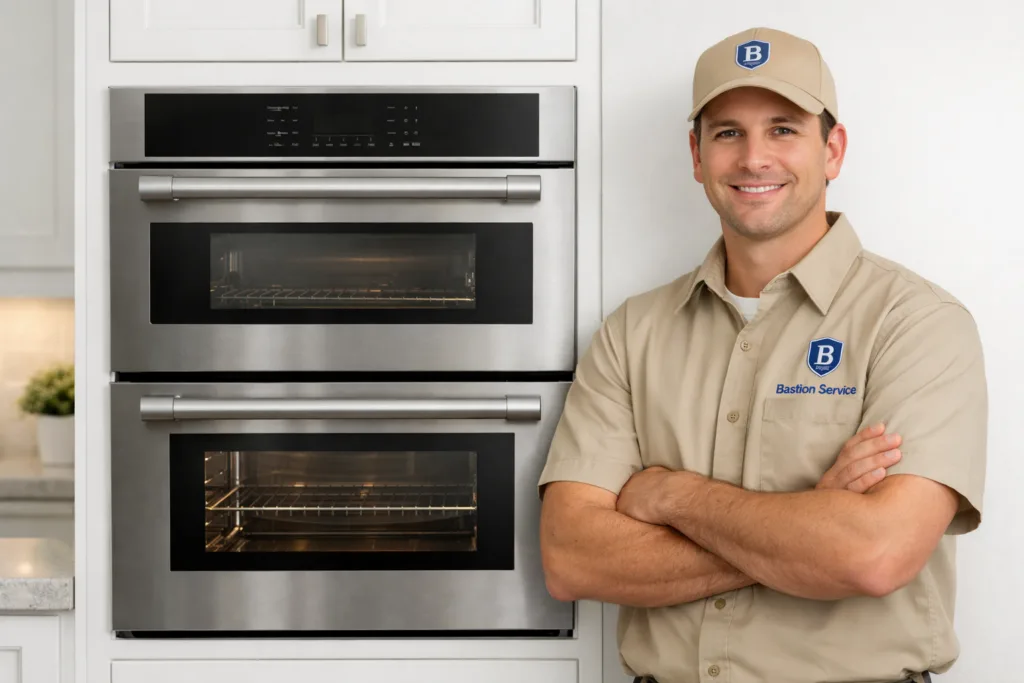
Common Monogram oven symptoms in Hermosa Beach homes

Oven problems rarely show up in just one way. A Monogram oven might still power on and look normal while baking unevenly, taking much longer to preheat, or shutting off in the middle of cooking. Paying attention to the exact pattern helps narrow down whether the issue is related to heating components, temperature sensing, controls, airflow, or the door assembly.
Not heating or heating too slowly
If the oven stays cool, reaches only part of the selected temperature, or seems stuck in an unusually long preheat, several faults are possible. On electric models, a weakened bake or broil element can cause partial heating even when the display appears normal. On gas models, ignition problems can delay or prevent proper heat. A sensor that is reading incorrectly can also make the control board stop heating too early or cycle at the wrong time.
Slow preheat is easy to dismiss at first, but it often signals a part that is already weakening. When that happens, cooking results become less predictable and complete failure may follow.
Uneven baking and temperature swings
Food that browns too quickly on one side, stays raw in the middle, or comes out differently from one rack to another usually points to poor temperature regulation. In some cases the oven is overshooting and then dropping too far before reheating. In others, the convection system is not moving heat correctly, so the cavity develops hot and cool zones.
Homeowners often notice this symptom first with cookies, casseroles, and roasted dishes that used to cook evenly. A worn door gasket, drifting sensor, weak element, or convection-related issue can all create this kind of inconsistency.
Controls respond, but cooking performance is off
When the keypad, clock, and lights all seem fine, it is tempting to assume the oven itself is working normally. But many heating faults happen behind a fully functioning interface. The control may accept settings while a relay fails to send power correctly, or the oven may cycle as though it is at temperature when it is not. That is why symptom-based testing matters more than judging the appliance by the display alone.
Oven will not turn on at all
A fully unresponsive oven can be tied to incoming power, a failed control, wiring trouble, a thermal protection issue, or a problem with the user interface. Built-in Monogram units can make access more involved, so a proper diagnosis usually means checking the actual operating systems rather than relying on resets or assumptions.
Door, latch, and self-clean problems
If the door does not close tightly, the latch stays stuck, or problems started after a self-clean cycle, the oven may be dealing with heat stress, switch failure, misalignment, or damage to latch-related parts. Even when the oven still heats, a poor seal can reduce temperature stability and increase strain on other components.
What different symptom patterns can mean
The same complaint can come from different failures. “Not heating” might mean a bad element, but it can also mean a relay issue, a sensor problem, or a power supply fault. “Runs hot” could be a sensor reading error, a control problem, or a door seal issue that changes how the oven cycles. Looking at the full pattern of behavior is what separates a useful diagnosis from a guess.
- Long preheat with weak cooking results: often tied to reduced heating output or poor cycling.
- Burning the outside while undercooking the center: may suggest inaccurate temperature sensing or uneven heat distribution.
- Intermittent shutdowns: can point to wiring, control, or overheating protection issues.
- Breaker trips during use: may indicate an electrical fault that should be addressed before further operation.
- Error codes with no clear cooking pattern: helpful clues, but not a complete answer without testing.
In Hermosa Beach homes, these distinctions matter because they affect whether the repair is likely to be straightforward or whether the oven may have a broader control or wiring problem.
When service should be scheduled
It is smart to schedule service when preheat time changes noticeably, the oven cannot hold a stable temperature, the controls behave unpredictably, or cooking results have become unreliable enough that normal meal prep is affected. Waiting too long can turn a smaller failure into a more expensive one, especially if overheating, shorting, or repeated strain on the controls is involved.
Households that rely on the oven daily usually benefit from having intermittent problems checked early. A unit that works “most of the time” is often already in the middle of a component failure rather than recovering on its own.
When continued use may be risky
Stop using the oven if you notice any of the following:
- Burning electrical smells that do not go away
- Visible sparking
- Repeated breaker trips
- Smoke not caused by food residue or spillover
- A door that will not close securely
- A gas smell that persists or seems strong on a gas model
If there is a gas odor, address that immediate safety issue first before arranging appliance service. For electrical symptoms, avoid continued operation until the cause has been checked.
Repair or replacement: what usually makes sense
Many Monogram oven problems are repairable when the fault is limited to a sensor, igniter, heating element, latch assembly, fan-related part, or a specific control issue. Repair tends to make sense when the rest of the oven is in solid condition and the failure is isolated.
Replacement becomes more worth considering when the appliance has multiple system problems, heavy wear, recurring electronic failures, or a repair estimate that approaches the value of keeping the oven in service. Age alone does not decide the answer. The better question is whether the confirmed repair path is likely to restore reliable everyday cooking.
What homeowners should note before an appointment
A few details can make troubleshooting faster and more accurate. Before service, it helps to note:
- Whether the issue happens during preheat, baking, broiling, or self-clean
- If the oven is consistently too hot, too cool, or unpredictable
- Any error codes that appeared
- Whether the problem started suddenly or gradually
- If the oven trips power or shuts off mid-cycle
- Whether the door closes and seals normally
These observations often reveal whether the issue is tied to heat production, temperature feedback, control response, or door-related heat loss.
What a useful Monogram oven repair visit should accomplish
A worthwhile service visit should do more than confirm that the oven is malfunctioning. It should identify the system at fault, explain how that failure matches the symptoms you are seeing, and make it easier to decide whether repair is the right next step. For homeowners in Hermosa Beach, that kind of practical repair guidance is the most helpful way to get from inconsistent cooking performance back to a dependable oven.