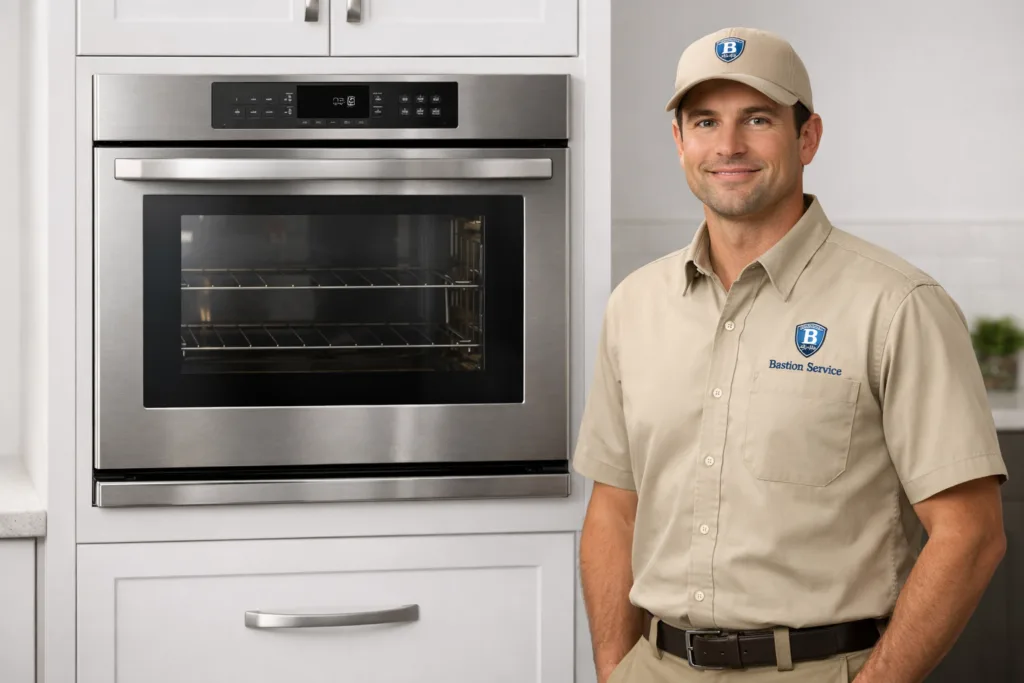
A Whirlpool oven that starts missing temperatures, preheating slowly, or stopping mid-cycle usually gives warning signs before it fails completely. Paying attention to the pattern helps narrow the problem faster. One household may notice cookies browning too fast on the back edge of the pan, while another sees the oven remain lukewarm even after a full preheat cycle. Those details matter because they often point to different components.
Common Whirlpool oven symptoms and what they can mean
Many oven complaints sound similar at first, but the underlying cause can vary. Symptom-based testing is often the best way to separate a bad heating component from a sensor problem, control fault, wiring issue, or door-related heat loss.
Oven will not heat
If the oven stays cold or only warms slightly, the failure may be tied to the bake element, broil element, igniter on gas models, thermal protection components, or the electronic control system. In some cases the display appears normal even though the oven is not actually producing enough heat to cook.
Homeowners in Hawthorne often first notice this problem when preheat seems to finish but food remains undercooked far past the usual time. That mismatch between the display and actual oven temperature is a strong sign that the issue needs more than a reset.
Slow preheat
Slow preheating can happen when one heating circuit is weak rather than fully failed. Electric models may still warm up if only one element is working correctly, but they do it much more slowly and struggle to recover heat after the door is opened. Gas models with a weakening igniter can show a similar pattern, especially when the oven eventually starts but takes much longer than normal.
Uneven baking
Uneven results usually show up as one side of a dish cooking faster than the other, over-browned bottoms, pale centers, or the need to rotate pans every time. Possible causes include poor temperature sensing, a failing convection component, door seal leakage, or inconsistent heating output.
If the problem has become gradually worse, that can be a clue that a component is drifting out of spec rather than failing all at once.
Temperature swings
All ovens cycle on and off to hold temperature, but large swings are different. If roasting takes much longer than it used to, casseroles finish unevenly, or baked goods alternate between overdone and underdone from one use to the next, the oven may not be regulating heat correctly. A sensor issue, control problem, or relay fault can all create that kind of inconsistency.
Display, keypad, and control issues
Unresponsive buttons, a flashing display, random beeping, or settings that do not start correctly may indicate more than a cosmetic control-panel problem. Whirlpool ovens depend on the control system to manage temperature, timing, and safety functions. When the interface behaves erratically, heating performance often becomes unreliable too.
Door problems and heat loss
If the oven door will not close evenly, does not latch properly, or has a worn gasket, heat can escape during cooking. That can lead to long cook times, poor browning, and temperature instability. A door problem is easy to overlook because the oven may still turn on and appear to operate normally.
Signs the issue is getting worse
Some oven problems remain intermittent for a while before becoming a full breakdown. Scheduling service sooner is usually wise if you notice any of the following:
- Preheat times are increasing week by week.
- The oven reaches temperature only on some cycles.
- Food quality changes even when you use the same settings and cookware.
- Error codes return after clearing them.
- The oven shuts off during baking or roasting.
- You smell overheating, see sparking, or hear unusual clicking that does not stop.
Continuing to run an oven with electrical or overheating symptoms can lead to additional damage and should not be treated as a normal nuisance.
Why Whirlpool oven diagnosis should follow the symptom pattern
Two ovens can both seem “not hot enough” for completely different reasons. One may have a failed bake element. Another may have a temperature sensor sending incorrect readings to the control. A third may have a door seal problem that lets heat escape so the unit struggles to maintain cooking temperature.
That is why replacing parts based on guesswork can waste time and money. The more useful approach is to confirm how the oven behaves during preheat, how it cycles, whether both heating functions respond correctly, and whether the complaint is isolated or part of a broader control problem.
When repair makes sense
Repair is often worthwhile when the problem is limited to a serviceable component and the rest of the oven is in good condition. That commonly includes issues involving:
- Heating elements
- Igniters
- Temperature sensors
- Door latches or gaskets
- Select control-related parts
For many households in Hawthorne, the deciding factors are the oven’s age, how well it has held up overall, whether the issue has happened before, and how the repair cost compares with replacement.
When replacement may be the better choice
Replacement becomes more likely when the oven has multiple significant failures, recurring electronic problems, visible cavity damage, or a repair path that approaches the value of the appliance. If performance has been declining across several functions at once, it may not be just one part.
A good service assessment should help clarify whether the current problem is isolated and repairable or part of a larger reliability issue.
What to do before service
You do not need to troubleshoot extensively, but a few observations can help:
- Note whether the problem affects bake, broil, or both.
- Pay attention to how long preheat takes compared with normal.
- Write down any error codes exactly as shown.
- Notice whether the door closes tightly and evenly.
- Stop using the oven if there is sparking, a burning smell, or repeated power loss.
Those details can make the visit more efficient and help identify whether the issue is a heating fault, temperature regulation problem, or control failure.
Whirlpool oven repair for Hawthorne households
In a busy home, oven problems are not just inconvenient; they interrupt normal meals, weekend cooking, and holiday plans. A service-focused evaluation should explain what is failing, what symptoms support that conclusion, and whether repair is practical for the unit you have.
If your Whirlpool oven in Hawthorne is not heating correctly, baking unevenly, taking too long to preheat, or acting unpredictably at the controls, getting the problem checked before it worsens is usually the smartest next step.