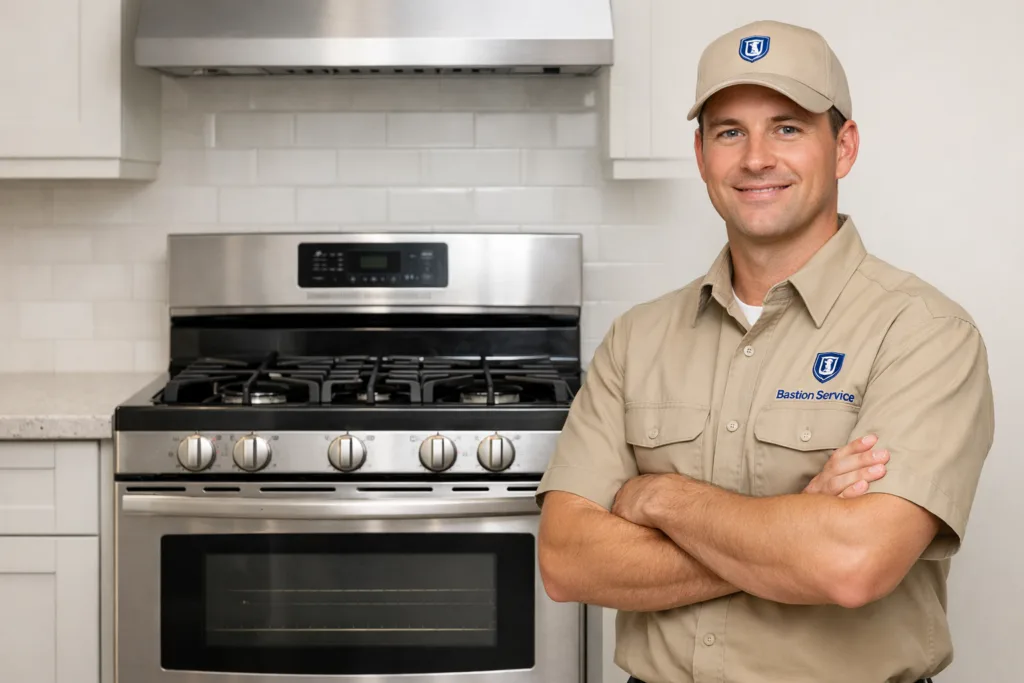
Cooking problems tend to show up before a Kenmore oven fails completely. You might notice longer preheat times, trays that bake unevenly, or temperatures that seem inconsistent from one meal to the next. Those patterns usually point to a specific heating, sensing, door, or control issue that needs to be tested rather than guessed.
How Kenmore oven issues usually show up at home
Some oven failures are obvious, like a unit that will not heat at all. Others are more subtle and easier to misread. An oven can still turn on, light up, and even finish preheat while quietly struggling with weak heat output, poor temperature regulation, or a part that fails only after it gets hot.
That is why symptom patterns matter. If the oven works some days and not others, shuts off midway through cooking, or gives different baking results with the same settings, the cause may be an igniter, element, sensor, relay, wiring connection, or electronic control issue. Looking at the full pattern helps narrow down what is actually failing.
Common Kenmore oven symptoms in Hawthorne homes
Oven will not heat
When a Kenmore oven does not heat at all, the cause depends on whether the unit is gas or electric. In electric models, common causes include a failed bake element, broil element problem, damaged wiring, a bad temperature sensor, or an issue with the control board. In gas models, a weak igniter is one of the most common reasons the oven stops heating properly.
If the display appears normal but the cavity stays cool, that usually means the problem is deeper than a simple settings mistake. Repeated attempts to run the oven without proper heat can also make meal preparation unreliable and may worsen certain electrical faults.
Slow preheat
A Kenmore oven that takes much longer than it used to reach temperature often has a heating component that is weakening but not fully failed. Gas ovens may struggle because the igniter is no longer drawing enough current to open the gas valve consistently. Electric ovens may preheat slowly if one element is underperforming or cycling incorrectly.
Slow preheat also shows up with sensor drift and some control issues. Homeowners often first notice it when everyday meals start taking far longer than expected, even though the oven still appears to be working.
Uneven baking or roasting
If one side of a baking sheet browns faster, the bottom burns before the center finishes, or dishes come out differently each time, the oven may not be distributing heat correctly. A failing bake element, inaccurate sensor, convection fan problem, or calibration issue can all cause uneven cooking.
This kind of problem is especially frustrating because the oven may still seem usable. In practice, though, inconsistent heat makes the appliance difficult to trust for baking, roasting, and longer cook cycles.
Temperature swings
All ovens cycle heat on and off to maintain temperature, but large swings are different. If food is repeatedly undercooked, overbrowned, or finishing much earlier or later than expected, the sensor or control system may not be reading or regulating heat accurately.
Temperature-related complaints can also be linked to door seal problems or a door that is not closing tightly. Heat loss changes how the oven cycles and can create cooking results that feel random from one use to the next.
Oven shuts off during use
An oven that starts normally and then powers down can indicate overheating protection, a failing control, loose electrical connections, or a part that breaks down once it reaches operating temperature. Intermittent shutdowns are often harder to diagnose than total failure because the appliance may restart later and appear normal for a short time.
If shutdowns are becoming more frequent, it is best not to keep pushing the appliance through repeated cycles. Intermittent electrical and heat-related faults tend to become less predictable over time.
Error codes, locked door, or self-clean problems
Repeated error codes, a door that will not unlock, or problems that appear after a self-clean cycle often point to a latch issue, sensor fault, thermal stress, or electronic control problem. Self-clean mode exposes components to intense heat, which can reveal weaknesses that were not obvious during normal use.
If the oven started acting differently right after self-cleaning, that detail can be useful in tracing the source of the problem.
What different symptoms may mean
- No heat at all: failed igniter, bad heating element, control failure, wiring issue, blown thermal protection, or sensor fault.
- Very slow preheat: weak igniter, partially failed element, sensor drift, or incorrect control operation.
- Uneven results: bake element issue, convection fan problem, poor temperature sensing, or door sealing trouble.
- Inaccurate temperatures: sensor, calibration, relay, or control board concerns.
- Stops during cooking: overheating, loose connection, failing control, or heat-sensitive electrical fault.
- Door and lock issues: latch assembly, switch, alignment, or control-related failure.
When to stop using the oven
Stop using the appliance if it is tripping breakers, cutting off unexpectedly, showing signs of electrical burning, failing to regulate heat, or not operating safely with the door closed. These symptoms can move beyond simple cooking inconvenience and point to conditions that should be checked before the oven is used again.
For gas models, a persistent gas odor should be treated as a safety issue first. The appliance should not be used until the source is addressed appropriately. Even when there is no odor, delayed or unreliable ignition is still a sign that the oven needs attention before regular use continues.
Repair or replacement: what usually makes sense
Many Kenmore oven problems are still worth repairing when the fault is limited to a single major component such as an igniter, heating element, sensor, latch, or control-related part. A repair is often more reasonable when the oven is otherwise in solid condition and the interior, door, and wiring have not seen heavy deterioration.
Replacement becomes a more likely discussion when the oven has several major issues at once, recurring electronic failures, significant cavity wear, or a repair path that approaches the value of the appliance. Age matters, but condition matters just as much. An older oven with one identifiable failure may still be a better candidate for repair than a newer unit with multiple ongoing problems.
What homeowners should pay attention to before service
A few details can make the issue easier to identify. It helps to note whether the problem happens during preheat, only after the oven has been running for a while, or only with certain settings like bake, broil, or convection. It is also useful to notice whether the display stays on when heat stops, whether the door feels loose, and whether any error code appears repeatedly.
Those observations can help separate a heat-generation problem from a temperature-reading problem or an intermittent control issue. For households in Hawthorne, that can make the repair path more straightforward and reduce the chance of chasing the wrong part first.
Focused Kenmore oven repair in Hawthorne
When a Kenmore oven starts missing temperature, heating unevenly, or shutting down during cooking, the most helpful service visit is one centered on the exact complaint rather than a broad guess. Whether the issue points to ignition, electric heat, temperature sensing, door function, or controls, the goal is to determine what failed, whether continued use could cause more damage, and whether repair is the sensible next step.
For Hawthorne homeowners, that kind of symptom-based evaluation makes it easier to decide how to move forward with confidence, especially when the oven is still partly working but no longer cooking reliably.