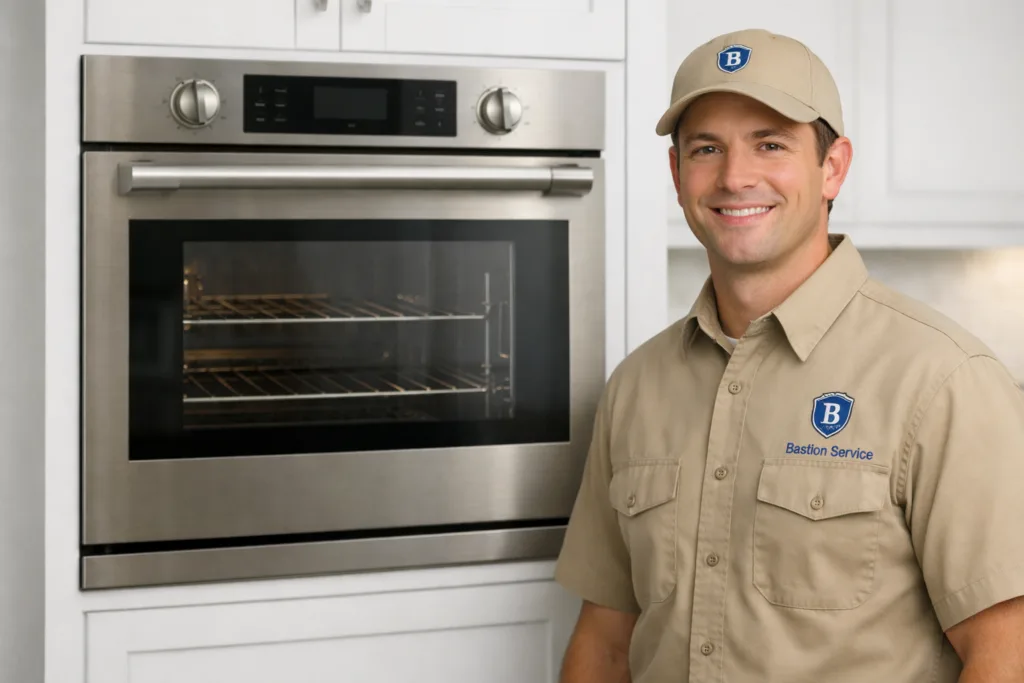
Oven problems rarely stay confined to one symptom. A Monogram unit that seems to preheat slowly may also be cycling unevenly, running cooler than the display suggests, or shutting off at the wrong point in the cooking cycle. That is why the most useful repair approach starts with the way the oven is behaving in daily use, not just the first part that seems likely to have failed.
Common Monogram oven symptoms and what they can mean
Modern Monogram ovens rely on a combination of heating components, sensors, control logic, and model-specific wiring. When one part starts failing, the result can look similar to several other faults. Paying attention to the exact pattern helps narrow the cause and avoid unnecessary parts replacement.
Not heating at all
If the oven turns on but the cavity stays cold, the issue may involve a failed bake element, a weak or dead igniter on gas models, a temperature safety component, a control problem, or a power-related fault. In some cases the display still appears normal even when the heating circuit is not operating. Homeowners often notice this after a preheat cycle that never seems to finish or after food remains uncooked despite a full bake time.
Slow preheat
Slow preheat is one of the more misleading symptoms because the oven may still eventually get hot. A weakened element, aging igniter, sensor inaccuracy, or relay issue can all stretch preheat time. If dinner takes longer than expected every night, or if a recipe that used to be reliable now needs extra time, the oven may be heating inefficiently rather than completely failing.
Uneven baking
Uneven baking usually shows up as cookies browning more on one side, casseroles cooking faster at the back, or one rack producing different results than another. This can point to uneven heat output, sensor drift, airflow problems, or a control that is not cycling the elements correctly. On a premium oven, inconsistent cooking is often a sign that the appliance is no longer regulating temperature the way it should.
Temperature swings
All ovens cycle within a range, but large swings are different. If food burns on top while remaining underdone in the center, or if the oven seems far hotter or cooler than the selected setting, the temperature sensor, calibration, control board, or heating circuit may need attention. This is especially frustrating for baking, roasting, and any recipe that depends on steady heat.
Control panel problems and error codes
A flashing code, random beeping, frozen keypad, or display that resets during use can indicate trouble with the electronic control system, communication faults, or sensor feedback problems. Some errors are direct enough to suggest the likely failed component, while others still require testing because the board may be reacting to a false reading rather than causing the problem itself.
Signs the oven should not keep being used
Some issues are mostly about cooking performance, but others raise safety or component-damage concerns. It is best to stop using the oven if you notice:
- a burning smell that does not go away after normal cleaning residue should be gone
- visible sparking or signs of heat damage
- the breaker tripping when the oven starts or heats
- the appliance shutting off unexpectedly during cooking
- extreme overheating or temperatures that do not respond to settings
- delayed ignition or unusual ignition behavior on gas models
Continued operation under those conditions can damage wiring, controls, or adjacent components. For gas units, any persistent gas odor should be treated as a safety issue first.
Why symptom tracking helps before service
Before scheduling Monogram oven repair in Hawthorne, it helps to write down what the appliance is doing in the simplest possible terms. A few details can make the appointment more productive:
- Does the problem happen during preheat, during baking, or at shutoff?
- Is the oven always affected, or only sometimes?
- Does broil work even if bake does not?
- Is the display normal, dim, blank, or showing a code?
- Has the oven been taking longer to cook food over time?
- Did the issue begin suddenly after self-clean, a power interruption, or heavy use?
These notes can help distinguish between a heating failure, a sensor issue, a control fault, or a power problem. They are often more useful than a general description like “it is not working right.”
Repair decisions that make sense for homeowners
Many Monogram oven repairs are worthwhile when the appliance is otherwise in solid condition and the failure is limited to one main component or a defined circuit. Problems involving igniters, elements, sensors, door-related parts, and some control functions are often practical to repair when caught early.
Replacement becomes a more serious consideration when there are multiple unrelated failures, recurring electronic problems, severe interior damage, or repair costs that stack up across several major parts. The real question is whether the repair is likely to restore stable everyday performance, not simply whether the oven can be made to heat once.
What often causes uneven results in everyday cooking
Households usually notice oven trouble through food, not through hardware. If sheet pans need to be rotated constantly, baked goods rise unevenly, or roasts finish inconsistently from one week to the next, the oven may be struggling to regulate heat accurately. In Hawthorne homes where the oven is used frequently, these smaller performance changes are often the earliest warning that a service issue is developing.
It is also common for homeowners to assume cookware, rack position, or recipe changes are to blame. Sometimes they are. But when the same pans and same meals suddenly produce different outcomes, the appliance itself deserves a closer look.
When to schedule service instead of waiting
Waiting can make sense for a cosmetic issue. It usually makes less sense for a cooking appliance that is already affecting meals, timing, and daily routines. If the oven has stopped reaching temperature, begun showing control issues, or started behaving unpredictably, scheduling service sooner may prevent a smaller fault from leading to additional part failures.
For homeowners in Hawthorne, early attention is often the difference between a targeted repair and a more expensive chain of problems caused by repeated use under faulty conditions. When the symptoms are specific and documented, the repair path is usually easier to evaluate and easier to approve with confidence.