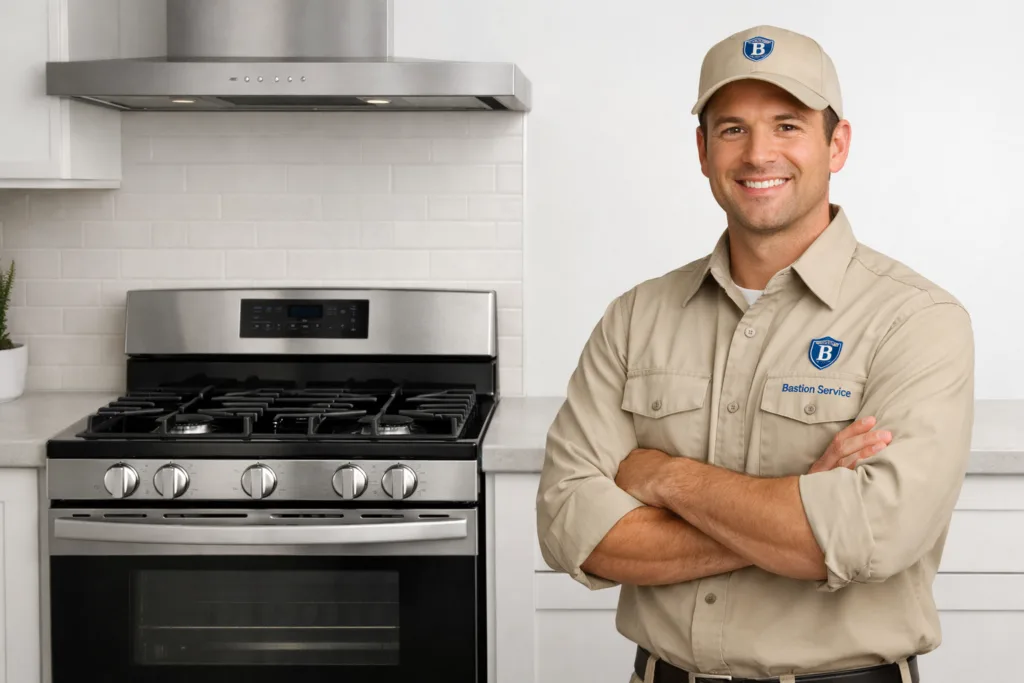
Range problems rarely start the same way twice. One household may notice a front burner that clicks and clicks before lighting, while another sees the oven preheat slowly or cook unevenly from one rack to the next. On a Whirlpool range, those symptoms can come from different components, so the most useful next step is to look at the failure pattern rather than assume the first obvious part is bad.
Common Whirlpool range symptoms in Hawthorne homes
Most service calls fall into a few recognizable categories. Paying attention to what the range does, when it happens, and whether the problem affects the cooktop, oven, or both can help narrow down the repair path.
Oven will not heat
If the oven stays cold, never reaches temperature, or stops heating partway through a cycle, the cause depends on whether the range is gas or electric. Electric models may have a failed bake element, broil element, wiring issue, or control fault. Gas models often point toward a weak igniter, a valve-related problem, or a sensor issue that prevents proper heating.
Homeowners sometimes describe this as “the oven turns on but nothing happens.” Others notice the light and display work normally, but the cavity does not get hot enough to cook. That difference matters because a range can have working controls while still failing to energize or ignite the heating system.
Slow preheat and uneven baking
When meals take longer than normal or one side of a pan browns faster than the other, the range may still be heating but not doing it correctly. A weak igniter on a gas range can delay ignition and reduce heating performance. On electric models, a partially failed element or relay issue can create long preheat times and unstable oven temperatures.
Uneven results also show up as cookies baking differently on the same sheet, casseroles needing extra time in the center, or food that looks done on top but remains undercooked underneath. These are often early signs of a heating system that is drifting out of normal operation.
Surface burner will not ignite or heat
Cooktop problems can be straightforward or more involved. On gas Whirlpool ranges, a burner that clicks repeatedly without lighting may have clogged ports, moisture around the igniter area, a spark issue, or a problem with gas flow to that burner. If the burner lights only after several tries, the symptom may still point to ignition weakness rather than a complete failure.
On electric models, a surface burner that stays cold, overheats, or cycles erratically may involve the element, receptacle, infinite switch, or wiring. If swapping burner positions changes the problem, that can be a clue. If the same burner location continues to fail with a different element installed, the issue may be deeper than the coil or radiant element itself.
Burner keeps clicking after ignition
Continuous clicking is a common complaint on gas ranges. In some cases, the burner does light but the igniter keeps sparking. That can happen when the ignition system is wet, dirty, misaligned, or not sensing normal operation correctly. It can also show up after cleaning if moisture remains around the burner base and switch area.
If the clicking affects more than one burner or starts unexpectedly after the range seemed normal, the repair may involve shared ignition components rather than a single burner assembly.
Display, keypad, or control issues
A Whirlpool range that shows error codes, loses the clock, ignores button presses, or resets itself can have a control board problem, interface issue, loose connection, or incoming power problem. Control faults can mimic other failures too. For example, an oven that will not start may look like a heating issue when the real problem is the board not sending power where it should.
When both oven and cooktop symptoms appear around the same time, it is worth checking for a shared electrical or control-related cause before replacing individual parts.
What different symptom patterns often mean
The details matter. A range that never heats is different from one that heats only sometimes. A single bad burner is different from several functions failing together. Looking at the pattern helps separate wear-part repairs from broader electrical or control issues.
- One burner affected: often points to a localized part such as an igniter, burner head, switch, element, or receptacle.
- Oven temperature off by a little: may involve calibration, sensor drift, or a heating component weakening over time.
- Oven completely cold: can indicate a failed igniter, burned-out element, blown thermal protection issue, wiring failure, or control problem.
- Multiple functions acting strangely: more likely to involve the control system, power supply, or shared wiring.
- Problem happens only occasionally: intermittent relays, loose connections, and heat-related electrical faults become more likely.
This is why part-guessing often wastes time. Two ranges can show the same outward symptom while needing entirely different repairs.
When a Whirlpool range should be checked soon
Some problems are inconvenient but manageable for a short time. Others should not be ignored. Service is worth scheduling sooner if the range trips a breaker, smells like overheating insulation, sparks, struggles to ignite, or produces temperatures that are far from the selected setting.
Repeated failed ignition is especially important on gas models. On electric ranges, scorching around a burner connection or a burner that suddenly runs much hotter than expected should also be addressed quickly. Even when the appliance still works, unstable heating can damage related parts and turn a smaller repair into a more expensive one.
Repair versus replacement
Many Whirlpool ranges are worth repairing when the issue is limited to a common component and the appliance is otherwise in good shape. Burners, igniters, sensors, elements, switches, and some control-related parts are often the kinds of failures that make repair practical.
Replacement becomes more attractive when the range has multiple major problems, significant wiring damage, repeated control failures, or a repair cost that approaches the value of a new unit. Age matters, but condition matters more. A well-kept range with one confirmed fault can still make good sense to repair, while a neglected one with several issues may not.
For homeowners in Hawthorne, the better choice usually becomes clear once the failed component, repair scope, and overall appliance condition are known.
How to get more from a service visit
Before scheduling service, it helps to note exactly what the range is doing. Useful details include whether the problem affects bake, broil, or surface burners, whether it happens every time or only sometimes, and whether any error codes appear. If the issue started after a power outage, spillover, cleaning, or a breaker trip, that context can also help narrow the diagnosis.
A short symptom list is often more valuable than a long guess about which part failed. “Left front burner clicks but does not light unless I use a match” or “oven preheats to 350 but food still takes much longer than before” gives a clearer starting point than simply saying the range is broken.
What homeowners in Hawthorne can expect from symptom-based Whirlpool range repair
Good range service should focus on the actual complaint: not heating, not igniting, clicking, temperature drift, or control failure. From there, the goal is to identify the failed component, check whether related parts have been affected, and determine whether the repair is sensible for the appliance’s condition.
That approach helps Hawthorne households avoid unnecessary part changes and gives a more realistic picture of what it will take to restore safe, consistent cooking performance.