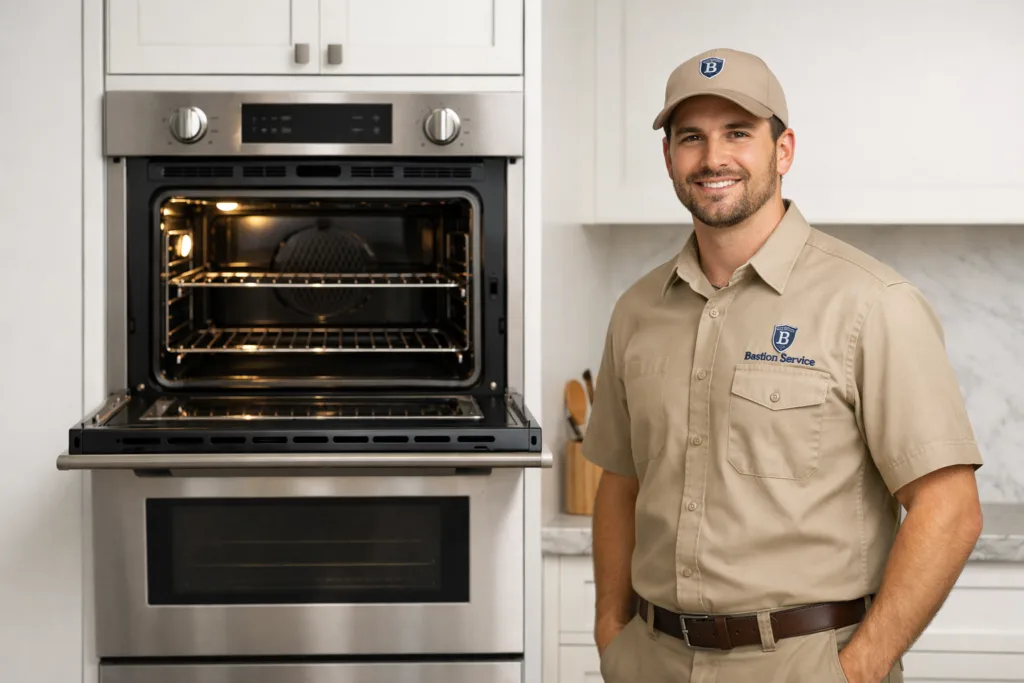
Common Thermador oven issues seen in Hawthorne homes

Thermador ovens are designed to cook with tight temperature control, so small performance changes usually show up quickly in everyday baking and roasting. A meal that suddenly needs extra time, browns unevenly, or comes out inconsistent from one use to the next is often a sign that a specific component is no longer working the way it should.
Because several systems work together inside the oven, the same symptom can have more than one cause. Heating parts, ignition components, temperature sensing, electronic controls, door hardware, and power supply issues can all affect how the appliance performs.
Oven will not heat or heats very weakly
If the oven turns on but never reaches cooking temperature, the failure may be in the heating or ignition system. On electric models, a bake or broil element may be weak or open. On gas models, an igniter can glow and still fail to draw enough current to open the gas valve properly. In some cases, the oven appears to run normally from the display while the actual cavity temperature stays far below the setting.
Homeowners often notice this problem as food that stays pale, casseroles that remain cool in the center, or preheat cycles that seem to continue much longer than normal.
Slow preheating
Slow preheat is one of the most common complaints with Thermador ovens. It can point to a weak igniter, a partially failing element, a sensor reading problem, or a control issue that is not driving the heating system correctly. The oven may eventually get hot enough, but only after an unusually long wait.
This symptom matters because it is easy to dismiss at first. Over time, slow preheat can turn into poor baking results, incomplete heating, or a complete no-heat condition.
Uneven baking and temperature swings
If cookies brown harder on one side, roasts cook unevenly, or dishes are underdone one day and overdone the next, the oven may not be holding a stable temperature. Causes can include a drifting sensor, weakened heating performance, poor heat distribution, or a control system that is cycling improperly.
These issues are especially frustrating because the oven may still seem usable, but recipe timing becomes unreliable. That can make daily cooking difficult even before the problem becomes a full breakdown.
Display problems, error codes, or intermittent operation
A flashing display, random resets, touch controls that stop responding, or recurring error codes often point to a control, interface, wiring, or power-related problem. Intermittent faults can be harder to pin down because they may affect heat, timing, and controls in different ways from one use to another.
If the oven shuts off during cooking or loses power without explanation, it is worth addressing early before the issue spreads to other components.
Door, latch, or self-clean problems
A door that will not close fully can let heat escape and create long cook times or uneven results. A latch that sticks locked after self-clean can make the oven unusable. These problems may involve hinges, switches, lock motors, alignment, or the electronic control that manages the clean cycle.
Forcing the door or repeatedly restarting a cycle can make a simple repair turn into a more expensive one.
Why symptom patterns matter
One reason oven problems get misdiagnosed is that different failures can look nearly identical from the outside. A gas oven with a weak igniter may seem to have a temperature problem. An electric oven with a failing element may still show some heat, but not enough for normal baking. A bad sensor can mimic a heating problem, while a control fault can mimic both.
Looking at the full pattern usually leads to a better repair decision. Helpful details include:
- Whether the oven never heats or only heats slowly
- Whether broil works while bake does not, or the reverse
- Whether the issue happens every time or only intermittently
- Whether the display shows errors, resets, or unusual behavior
- Whether the problem started after a self-clean cycle or power interruption
Those details help separate a single failed part from a broader control or electrical issue.
Signs you should stop using the oven
Some oven problems are mainly inconvenient, but others can lead to worsening damage or safety concerns if the appliance keeps being used. It is best to stop using the oven and arrange service if you notice any of the following:
- The oven overheats or seems much hotter than the selected setting
- Preheat times have become dramatically longer
- The oven shuts off during cooking
- The door will not latch or unlock correctly
- The controls are unresponsive or the display keeps resetting
- There are repeated error codes that return after clearing
If there is a strong or persistent gas smell around a gas oven, do not continue troubleshooting it yourself. Stop using the appliance and follow proper gas-safety steps before scheduling repair.
Repair or replace: what usually makes sense
For many households in Hawthorne, repair is worthwhile when the problem is isolated to a serviceable part such as an igniter, heating element, sensor, latch component, or certain control-related parts. If the oven has otherwise been cooking well and the cabinet, door, insulation, and major systems are in good condition, repair is often the more sensible choice.
Replacement becomes a more serious consideration when the oven has multiple active problems, recurring electronic failures, heavy wear, or a history of repeated repairs that have not restored reliable performance. Age alone does not decide the issue, but overall condition and expected results after repair do matter.
The real question is whether the next repair is likely to return the oven to stable everyday use or only postpone a larger problem.
What homeowners can note before service
You do not need to disassemble anything to make a service visit more productive. A few simple observations can help narrow the problem faster:
- Write down any error code exactly as shown
- Note whether the issue affects bake, broil, convection, or all modes
- Pay attention to whether preheat completes too early or takes too long
- Notice if the problem started suddenly or developed gradually
- Check whether the door closes evenly and seals properly
Even small details can help explain whether the issue is related to heating output, temperature feedback, control response, or mechanical door function.
What a useful oven repair visit should accomplish
A good service call should do more than identify the most obvious failed part. It should confirm why the symptom is happening, check the related systems that could be contributing to it, and explain whether the repair path is straightforward or whether the oven shows signs of broader wear.
For Hawthorne homeowners, that means getting a realistic picture of what is wrong, what should be fixed now, and whether the expected result matches the cost of repair. When the diagnosis is tied closely to the exact symptom pattern, it becomes much easier to decide the next step with confidence.