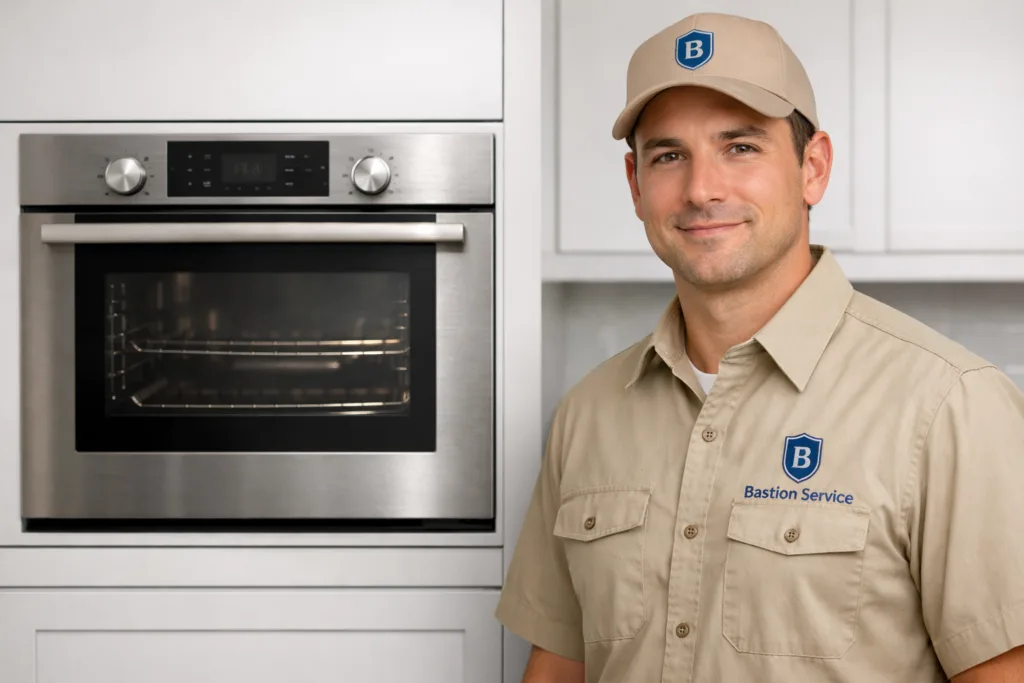
Oven problems tend to show up in everyday cooking first: longer preheat times, baked goods that suddenly come out uneven, or a unit that powers on but does not actually cook. With Bosch ovens, those symptoms can trace back to different components, so the most useful approach is to match the repair path to what the oven is actually doing.
Common Bosch oven problems in Rancho Park homes
Many service calls start with one of a few recognizable patterns. Paying attention to the exact symptom often helps narrow the issue much faster than guessing based on age alone.
Oven not heating
If the oven will not heat at all, the cause may differ depending on whether the unit is gas or electric. Electric models may have trouble with a bake element, broil element, temperature sensor, wiring fault, or control relay. Gas models often point toward an igniter that has weakened enough to stop opening the gas valve properly. In both cases, the oven may appear normal on the display while still failing to reach cooking temperature.
Slow preheat
A Bosch oven that eventually heats but takes much longer than usual can be frustrating because it is easy to overlook at first. Slow preheat may suggest a heating component that is still working but not performing correctly, a sensor issue that is sending inaccurate temperature feedback, or a control problem that is not energizing the system as it should. This kind of issue often becomes more obvious when weeknight meals start taking noticeably longer to finish.
Uneven baking
When cookies brown on one side, casseroles cook faster on the top rack, or the center of a dish stays behind while the edges overcook, the problem may involve airflow, a weak element, sensor inaccuracy, or calibration drift. Uneven results are especially noticeable for homeowners who use the oven regularly and know how a favorite recipe should look.
Temperature swings
All ovens cycle somewhat during operation, but wide temperature swings can lead to inconsistent cooking and baking. If food alternates between underdone and overdone even when you use the same settings, the oven may not be regulating heat correctly. In some cases, the sensor is reading poorly; in others, the control may not be managing the heating cycle as intended.
Controls not responding
A touch panel or control board issue may show up as buttons that do not respond, a display that behaves erratically, settings that will not start, or a unit that shuts down during operation. Sometimes the display lights up normally while the oven functions remain unavailable, which usually means the problem is more involved than a simple power interruption.
How symptom patterns help identify the likely cause
Small details matter with oven diagnosis. An appliance that fails only during preheat can point in a different direction than one that loses temperature halfway through baking. A unit that works in broil mode but not bake mode suggests a different failure path than one that does neither.
Helpful details include:
- Whether the problem happens every time or only occasionally
- Whether the issue began suddenly or worsened gradually
- If the oven struggles more on bake, broil, convection, or self-clean
- Whether error codes appear before, during, or after heating
- If the fan runs unusually long or the oven shuts off mid-cycle
These observations can make the service process more efficient and reduce unnecessary part swapping.
When the oven should stop being used
Some oven issues are mainly inconvenient, but others call for stopping use until the unit is checked. If the oven overheats, trips the breaker, fails to ignite reliably, produces burning smells from electrical components, or shows repeated shutdowns during operation, continued use can increase the chance of further damage.
For gas models, a persistent gas odor is a separate safety concern. If you notice a strong or ongoing gas smell, stop using the appliance and address that immediate concern before arranging repair.
Problems that often appear after self-clean
High-heat self-clean cycles can sometimes expose weak components that were already close to failure. After self-clean, some Bosch ovens may show a door latch problem, a control fault, a blown thermal protection component, or a unit that no longer heats correctly. If the timing lines up closely with a self-clean cycle, that detail is worth mentioning because it can help narrow the diagnosis.
Repair or replacement: what usually makes sense
For many Rancho Park homeowners, repair is still the practical option when the issue is limited to a single component such as an igniter, sensor, heating element, latch, or related electrical part. If the oven is otherwise in solid condition and has been performing well, a targeted fix can restore normal use without the cost and disruption of replacement.
Replacement becomes more likely when there are multiple major faults at once, repeated control-related failures, or signs of broader wear that make future repairs less predictable. The key is understanding whether the current symptom points to one repairable issue or to a larger pattern of decline.
What to note before scheduling service
If you are arranging Bosch oven repair in Rancho Park, a few notes ahead of time can be genuinely helpful. Try to identify whether the oven:
- Never reaches the set temperature
- Heats very slowly
- Cooks unevenly from rack to rack
- Shuts off before the cycle is complete
- Displays an error code or repeated beeping
- Works in one mode but not another
It also helps to mention whether the problem started after a power outage, after self-clean, or after a period of unusual noise or longer preheat times. Those details often point the diagnosis in the right direction much sooner.
Focused help for an oven you rely on every day
A Bosch oven does not have to fail completely to need attention. Performance issues like temperature inconsistency, delayed heating, and unreliable controls can affect daily cooking just as much as a total no-heat condition. For households in Rancho Park, the goal is to understand the fault clearly, address the part of the system that is actually failing, and make a repair decision that fits the condition of the appliance.