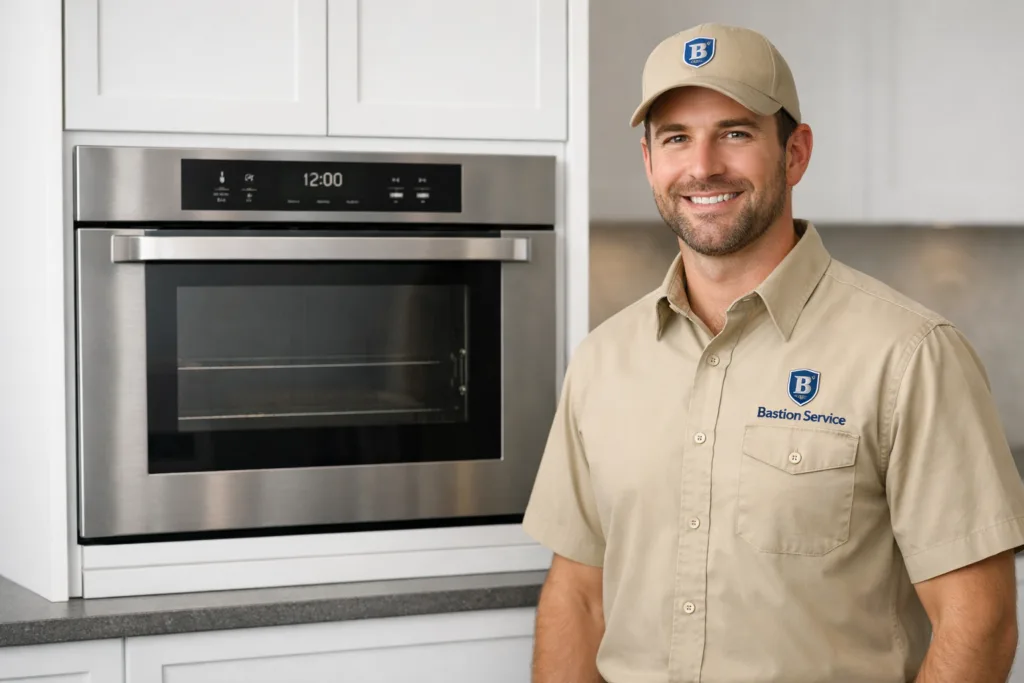
Signs your Miele oven needs attention

Cooking problems usually show up before a complete failure. In many Rancho Park homes, the first sign is a change in results: cookies browning unevenly, casseroles taking much longer than normal, or roasts cooking faster on one side than the other. In other cases, the oven may power on but struggle to preheat, stop mid-cycle, or flash an error on the display.
These symptoms are worth taking seriously because several different faults can create similar behavior. A temperature sensor issue, weak heating circuit, convection problem, door seal leak, or electronic control fault can all affect how the oven performs. The most useful repair path starts with matching the symptom pattern to the likely system involved.
Common Miele oven problems and what they often mean
Oven will not heat
If the display comes on but the cavity stays cool, the problem may be tied to a failed bake or broil element, a sensor that is not reading correctly, a relay issue, or a control fault. Some ovens fail completely, while others heat only a little and never reach the selected temperature. Partial heating can be misleading because the appliance still appears to run even though it cannot cook properly.
Uneven baking or roasting
When one rack cooks faster than another or food develops hot and cool spots, the issue may involve airflow, sensor accuracy, convection fan operation, or one heating circuit not cycling as it should. This is especially noticeable with baking, where consistency matters. If the same recipes suddenly stop turning out well, the oven may no longer be regulating heat correctly.
Slow preheat
Long preheat times often point to a component that is weakening rather than fully failed. An element may still energize but not at full output, or the control may not be managing heat the way it should. Homeowners sometimes adapt by adding extra time, but that usually leads to more guesswork and does not solve the underlying problem.
Temperature swings during cooking
If food alternates between underdone and overdone, or if the oven seems hotter or cooler than the selected setting, the cause may be a sensor problem, calibration drift, or an issue in the control system. Temperature instability can be subtle at first, especially if the oven eventually finishes cooking, but repeated inconsistency usually means service is warranted.
Control panel problems or error messages
Beeping, resetting, unresponsive buttons, or intermittent error codes can point to control board faults, interface issues, wiring interruptions, or a related component causing the oven to stop operation as a protective response. Noting when the fault appears matters. Some issues happen only during preheat, convection use, or self-clean, which helps narrow the source.
Door, latch, or self-clean issues
A door that does not close tightly can let heat escape and create what looks like a heating problem. Latch trouble can interrupt self-clean cycles or prevent normal operation if the oven cannot confirm the correct door position. In some cases, a damaged seal or misaligned door creates ongoing temperature complaints even though the heating system itself is still working.
What Rancho Park homeowners should watch for before the problem gets worse
Small performance changes often become bigger failures. If preheat is taking longer each week, if broil works but bake does not, or if the oven shuts off unexpectedly during use, those are signs the issue is progressing. A fault that starts as an occasional inconvenience can turn into a no-heat condition with little warning.
It is also smart to stop using the oven if it trips power, overheats, locks unexpectedly, or gives off unusual burning smells unrelated to normal cooking residue. Problems involving electrical behavior, repeated shutdowns, or door-lock functions are better addressed before more strain is placed on the appliance.
Repair or replace?
That decision usually comes down to the exact failed part, the oven’s age, overall condition, and whether the problem is isolated or part of a larger pattern. Many Miele oven issues are repairable when the fault is limited to a sensor, heating component, fan-related part, latch assembly, or a specific control-related failure.
Replacement becomes a more realistic option when there are multiple major issues at once, heavy wear across the appliance, or repair costs that do not make sense for the condition of the unit. For most households in Rancho Park, the deciding factor is not the symptom alone but what testing shows once the cause is narrowed down.
Details that help speed up diagnosis
Before service, it helps to note exactly how the oven is behaving. Useful details include whether it powers on at all, whether the issue affects bake, broil, or convection only, whether preheat ever completes, and whether the problem is constant or intermittent. If an error code appears, write it down along with what the oven was doing at the time.
It can also help to note whether the issue started after self-clean, after a power interruption, or after a period of unusually slow preheating. For uneven cooking, pay attention to whether the top, bottom, rear, or one side of the oven seems more affected. Those patterns often reveal whether the problem is tied to heat production, airflow, or temperature sensing.
Why symptom-based service matters for Miele ovens
Miele ovens are built for precise cooking performance, so even a relatively narrow fault can create very noticeable day-to-day results. A weak heating element does not always look dramatic, but it can ruin baking consistency. A drifting sensor may not stop the oven from running, yet it can make every recipe less predictable.
For that reason, Miele Oven Repair in Rancho Park is most effective when the service approach stays focused on the appliance’s real behavior in the home. Looking at when the problem happens, which cooking modes are affected, and whether the issue involves heat, airflow, controls, or door function leads to a more reliable repair plan and helps avoid unnecessary part replacement.