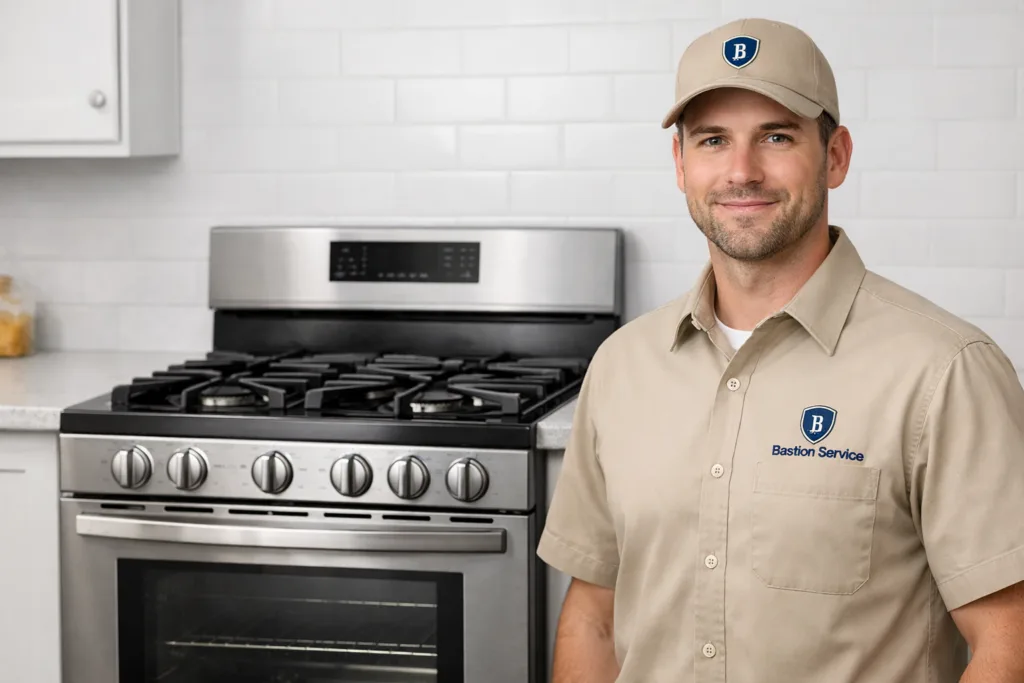
Common Summit range problems seen in Fairfax homes

Range trouble usually shows up as a cooktop issue, an oven heating problem, or a control failure. The useful part is matching the symptom to the most likely system involved so the repair is based on evidence rather than part swapping.
Burner will not ignite
If a burner clicks but does not light, the cause may be as simple as a misaligned burner cap or moisture around the ignition area. In other cases, the problem is tied to the spark electrode, ignition switch, wiring, or a shared spark module. When only one burner is affected, the fault is often local to that burner assembly. When several burners act the same way, a common ignition component is more likely.
A burner that lights inconsistently should not be brushed off as normal wear. If ignition has changed suddenly, or if clicking continues longer than it used to, the range should be checked before the problem spreads to daily cooking and meal prep.
Burner clicks repeatedly
Continuous clicking can happen before ignition, after ignition, or even when the burner is off. Spills, cleaning moisture, worn switches, and ignition faults can all create this symptom. The pattern matters. Clicking that stops once the burner dries out points in a different direction than clicking that returns every time the range is used.
If there is a strong gas smell or the burner does not ignite normally, stop using that burner until the cause is identified.
Oven not heating properly
A Summit oven that will not heat, heats too slowly, or overheats can involve the bake element, broil element, igniter, temperature sensor, relay, or electronic control. The exact part depends on the design of the range and how the failure appears during use.
Homeowners often notice this first through longer preheat times, uneven baking, undercooked centers, scorched bottoms, or temperature swings from one meal to the next. These signs matter even if the oven still reaches temperature eventually.
Uneven baking and roasting
When food consistently browns more on one side, cooks too fast on the bottom, or comes out differently each time, the range may be cycling heat incorrectly. A weak igniter, drifting sensor, damaged door seal, or control problem can all affect temperature stability. This kind of issue does not always mean the oven has fully failed. Often, it means the oven is no longer regulating heat accurately.
Controls, display, or settings not responding
If the display is blank, buttons do not respond, settings reset unexpectedly, or functions start only some of the time, the fault may be in the user interface, control board, power supply, wiring, or switches. Some control complaints seem major but come from a smaller electrical issue. Others point to a failing board that affects both the cooktop and oven functions.
What these symptoms usually tell you
The same complaint can come from different failures, which is why symptom pattern matters. A burner that will not light at all is different from one that lights after several clicks. An oven that stays cold is different from one that overheats. A control panel that is completely dead is different from one that works intermittently.
Looking at the symptom in context helps answer practical questions:
- Is the issue isolated to one burner or one function?
- Is the problem getting worse over time?
- Does the range fail consistently or only under certain conditions?
- Is the fault mechanical, electrical, or ignition-related?
- Is repair likely to solve a single problem, or are multiple systems showing wear?
When to stop using the range and schedule service
Some problems are annoying but manageable for a short time. Others should push the range out of regular use until it is checked. If a burner will not ignite cleanly, the oven temperature is no longer trustworthy, or the controls behave unpredictably, continued use can create added wear and make the original issue harder to isolate.
It makes sense to schedule service when you notice:
- Preheat taking much longer than before
- One burner working differently from the rest
- Clicking that continues after the burner lights
- Food repeatedly coming out undercooked or burned despite normal settings
- Error displays or controls that stop responding during use
- Oven temperatures running too hot or too cool
Why early range repair often matters
Small changes in performance are often the first warning that a Summit range is moving toward a full failure. A weak igniter can become a no-heat call. Unstable burner ignition can turn into a burner that no longer lights at all. A temperature sensor that drifts can lead to cooking results that become harder to predict week after week.
Addressing the issue earlier can reduce the chance of extra strain on related components and helps keep the repair focused on the original fault instead of a chain of secondary problems.
Repair or replace?
For many Fairfax homeowners, that decision depends on the age of the range, the overall condition of the appliance, and whether the problem is limited to a serviceable component. Repairs are often reasonable when the fault is concentrated in a part such as an igniter, heating element, sensor, switch, or control-related component and the rest of the unit is in solid condition.
Replacement becomes more appealing when the range has repeated major failures, visible overall wear, or repair needs that extend beyond a single system. The key is understanding whether the current problem is a focused repair or part of a larger decline in reliability.
What to expect from a Summit range service visit
A proper service call typically starts by confirming the exact complaint and testing how the range behaves under operation. That may include checking burner ignition, verifying oven heat response, reviewing temperature behavior, inspecting wiring and connections, and determining whether the issue is isolated or shared across functions.
For a household in Fairfax, the goal is simple: restore safe, predictable cooking performance without guessing at the cause. Whether the symptom is a burner that will not light, an oven that will not hold temperature, or controls that act intermittently, the right repair starts with the actual behavior of the appliance.
Helpful steps before service
Before scheduling Summit Range Repair in Fairfax, it helps to note exactly what the range is doing. A short description of the symptom can make diagnosis faster and more accurate.
- Which burner or oven function is affected
- Whether the problem happens every time or only occasionally
- Any recent spills, cleaning, power interruptions, or unusual noises
- Whether the display shows an error or the controls reset
- How long the problem has been happening
Those details can help separate a one-burner ignition issue from a broader electrical or control problem and make the repair path easier to judge.