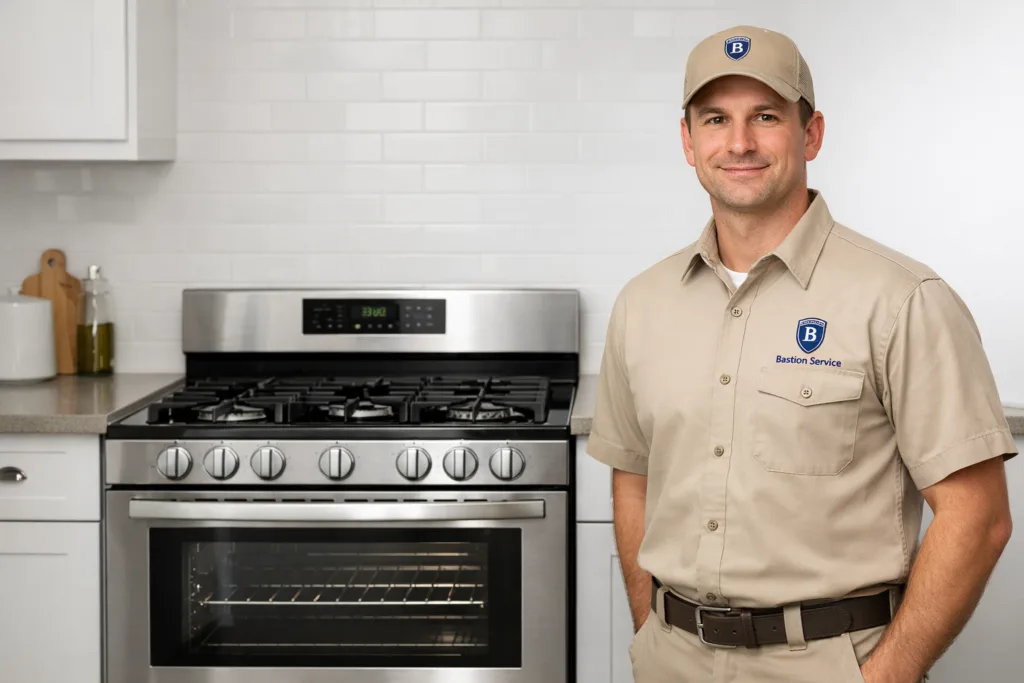
Cooking problems with a Blomberg range rarely stay minor for long. A burner that clicks a few extra times, an oven that takes longer to preheat, or a control panel that responds inconsistently can all point to wear in different parts of the appliance. The useful starting point is matching the symptom to the system involved so the repair path makes sense.
How Blomberg range problems usually show up at home
Most range complaints fall into one of a few categories: ignition trouble, poor oven heating, temperature inaccuracy, burner performance issues, or control failures. The challenge is that similar symptoms can come from very different causes. For example, an oven that is not reaching temperature might have a weak igniter, a faulty sensor, a heating element problem, or a control issue.
In Fairfax homes, these problems usually become noticeable during normal routines:
- Dinner takes longer because the oven preheats slowly
- One burner works sometimes and fails other times
- Baked food browns unevenly or comes out undercooked
- The range keeps clicking after ignition
- The display flashes, beeps, or stops accepting commands
Burners that click, fail to light, or heat unevenly
Gas burner clicking without ignition
When a gas burner clicks but does not light, the fault may be as simple as burner cap misalignment or moisture around the ignition area. It can also involve a worn spark igniter, ignition switch trouble, or a problem in the spark module. If the clicking continues after the burner should already be lit, the system may still be sensing an ignition problem.
This kind of issue should not be ignored. Repeated failed ignition attempts can interrupt daily cooking and may point to a developing fault rather than a one-time inconvenience.
Weak flame or uneven heating
A burner that lights but produces a weak or uneven flame may have blocked burner ports, fuel flow problems, or ignition-related issues that affect flame quality. Homeowners often notice this when pans heat slowly, one side of the cookware gets hotter than the other, or simmer settings become unreliable.
Electric surface element not responding correctly
On electric configurations, a surface element that stays cool, overheats, or does not change with the selected setting may be dealing with a failed element, an infinite switch problem, or damaged wiring. If a burner seems stuck on high, stop using that section of the range until it is checked. That symptom can damage cookware and create a safety concern.
Oven heating problems and what they often mean
Oven not heating at all
If the oven remains cold, the likely causes depend on the model and fuel type. Common possibilities include a failed igniter, a bad bake element, a broil-related issue affecting startup, a sensor fault, or an electronic control failure. From the user side, this often looks like a range that powers on normally but never actually begins cooking.
Slow preheating
Slow preheating is one of the most common complaints because it can develop gradually. A weak igniter may still operate but not strongly enough to support proper heating. Electric heating components can also weaken over time. In either case, the oven may eventually reach temperature, but only after much longer than normal.
Uneven baking or roasting
When food cooks unevenly, the issue may involve inaccurate temperature sensing, heating components not cycling correctly, convection-related problems on applicable models, or control irregularities. A range that seems functional at first glance can still produce poor results if the actual cavity temperature is drifting away from the setting.
When the oven temperature feels wrong
Some Blomberg ranges still turn on and complete a cycle even when the oven is no longer holding the selected temperature correctly. That is why temperature complaints are so frustrating. The appliance appears to be working, but real-world cooking results say otherwise.
Signs of a temperature problem include:
- Recipes consistently needing more time than before
- Food overbrowning on top while staying underdone inside
- Items burning at the edges and remaining pale in the center
- Large differences in results from one use to the next
Possible causes include sensor drift, calibration problems, a relay or control board issue, or heating parts that are no longer cycling as they should.
Control panel and display issues
Modern ranges rely on controls to coordinate burner functions, oven cycling, timers, and safety responses. If the control panel goes blank, shows error codes, beeps unexpectedly, or stops responding to touch inputs or knob commands, the problem may involve the interface, main control, or power supply path.
Sometimes the fault is limited to one function, such as the oven not starting while surface cooking still works. In other cases, multiple features begin acting strangely at the same time. That pattern usually suggests the problem is not a single heating component but something affecting the appliance more broadly.
Symptoms that call for faster service
Some problems are inconvenient but manageable for a short time. Others should move to the top of the list because continued use can increase risk or lead to more expensive damage.
Stop using the range and arrange service promptly if you notice:
- A persistent or strong gas smell
- Burners that repeatedly fail to ignite properly
- An oven that overheats or will not shut off
- A surface element that stays too hot or will not regulate
- Repeated electrical tripping
- Burning or melting odors from the control area
These symptoms point to issues that should be evaluated before normal cooking continues.
Repair or replace: what usually makes sense
Many Blomberg range problems are worth repairing when the issue is limited to one area and the rest of the appliance is in good shape. Ignition parts, sensors, switches, heating components, and some control-related failures can often be addressed without replacing the entire range.
Replacement may be more sensible when several major systems are failing together, when the appliance has a pattern of repeated breakdowns, or when the cost of correcting the fault is too close to the value of the unit. The real decision point comes after diagnosis, once the symptom has been tied to a specific repair path instead of guesswork.
What Fairfax homeowners usually want to know
Most households are trying to answer three practical questions: is the range safe to use, what is causing the symptom, and is the repair worthwhile? A useful service visit should make those answers clearer rather than more complicated.
If your Blomberg range in Fairfax is interrupting meals, producing unreliable oven results, or showing burner or control problems, the most efficient next step is a focused inspection that identifies the failed system and outlines whether repair is the sensible move for your home.