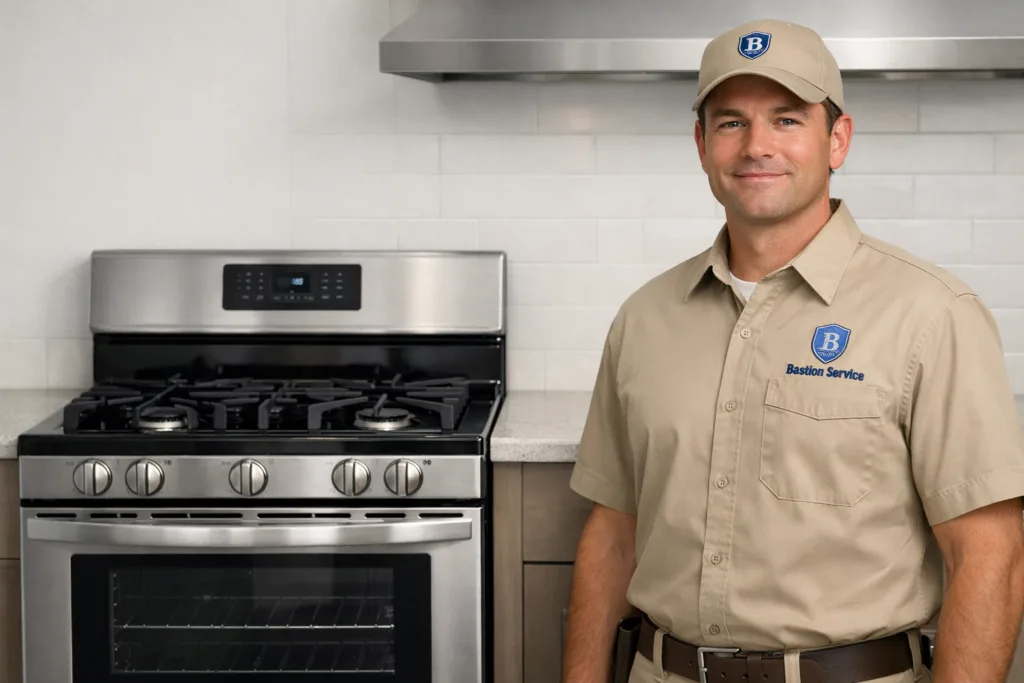
Range problems tend to show up in everyday cooking first: a burner that clicks too long, an oven that says it is preheated when it is not, or heat that seems different from one meal to the next. On Kenmore models, those symptoms can come from several different components, so the most useful next step is to match the behavior of the appliance to the likely failure instead of guessing at parts.
Common Kenmore range issues seen in Fairfax homes
Gas burners click but do not light
If a burner clicks repeatedly, lights only after several tries, or sparks after the flame is already on, the problem may involve the ignition system, burner cap positioning, debris in the burner head, or moisture around the igniter. Sometimes the issue is isolated to one burner. In other cases, multiple burners acting up at once can point to a broader spark or switch problem.
A brief clicking sound during normal ignition is expected. What is not normal is constant clicking, delayed ignition, or a burner that only lights with a match. If you notice a strong gas odor that does not clear quickly, stop using the range until the issue is evaluated.
Oven will not heat or takes far too long to preheat
When the oven stays cold, warms only slightly, or takes much longer than usual to reach temperature, the cause may be a failed igniter, bake element, broil element, sensor, or electronic control. On some Kenmore ranges, the display may appear normal even while the heating system is not performing correctly, which is why symptom-based testing matters.
Homeowners often notice this problem when baking times stretch out, casseroles stay cool in the center, or roasting becomes inconsistent. If the broiler still works but baking does not, that can help narrow down the issue. If neither function works properly, the diagnosis often shifts toward power, control, or multiple-component failure.
Uneven oven temperature and inconsistent results
An oven that runs too hot one day and too cool the next can be frustrating because the problem does not always look dramatic. You may see cookies browning on one side, food finishing early on the top rack, or recipes suddenly needing extra time with no obvious reason. Temperature drift can come from a weak sensor, a failing control, poor ignition performance on gas models, or an element that heats intermittently on electric models.
This is also the kind of issue that leads to unnecessary part replacement when the root cause is not confirmed first. A sensor may test out of range, but the real problem could still be the control board or a heating component that is cycling incorrectly.
Electric surface elements do not heat correctly
On electric Kenmore ranges, a surface burner may stop heating, heat only on one setting, cycle erratically, or fail to maintain steady temperature. Coil models can have element or receptacle problems, while smooth-top ranges may have an issue below the glass surface, in the switch, or in the related wiring.
If a burner is slow to respond or only heats part of the pan, that often points to a failing component rather than normal wear. If a burner stays too hot even on a lower setting, the switch itself may be part of the problem and should be checked promptly.
Symptoms that help narrow down the cause
A few details can make a range problem easier to identify:
- Whether the issue affects one burner or several
- Whether the oven eventually heats or stays cool the entire time
- Whether the problem is constant or intermittent
- Whether the display shows an error code
- Whether circuit breakers trip during use
- Whether ignition problems happen more after cleaning or spillovers
These clues matter because similar complaints can come from very different failures. For example, “oven not heating” may mean a bad igniter on one model and a failed bake element or control issue on another.
When the problem may be more than routine wear
Some symptoms suggest that the range should not keep being used as usual. That includes burners that spark continuously, elements that do not respond to the control setting, repeated breaker trips, visible damage to a smooth-top cooking area, or oven heat that cuts in and out during use. A range with those behaviors may still turn on, but continued operation can increase the chance of added component damage.
Intermittent problems deserve attention too. If the appliance works normally one day and struggles the next, the issue can still worsen over time. Loose electrical connections, failing switches, weak igniters, and unstable controls often begin with inconsistent behavior before they fail completely.
Repair or replace: what makes sense for a Kenmore range?
Many Kenmore range repairs are worthwhile when the failure is limited to a serviceable part such as an igniter, sensor, switch, element, or related component. Repair becomes less attractive when the appliance has several issues at once, has ongoing control failures, or shows broader age-related wear that affects reliability beyond a single symptom.
For many households in Fairfax, the decision comes down to three questions:
- Is the problem isolated or are multiple systems failing?
- Will the repair return the range to reliable daily use?
- Does the appliance’s overall condition support putting more money into it?
That is where clear diagnosis and a practical repair plan are most helpful. A contained repair can make good sense. A larger pattern of failure may point in a different direction.
What homeowners can notice before service
You do not need to disassemble anything to gather useful information. It helps to note whether the issue happens during preheat, during longer cooking cycles, or only on certain burners. If the oven seems off, compare actual cooking results rather than relying only on the display. If a gas burner struggles to light, look for obvious cap misalignment or heavy food residue, but avoid forcing parts or attempting deeper repairs around ignition components.
It is also helpful to pay attention to changes in timing. A burner that used to light instantly but now takes several clicks, or an oven that suddenly adds ten to fifteen minutes to familiar recipes, is often signaling that a component is weakening rather than failing all at once.
Focused Kenmore range repair for Fairfax households
Range issues interrupt routine cooking quickly because even a small heating problem can affect every meal. Whether the symptom is ignition trouble, weak oven heat, erratic temperatures, clicking, or a control-related issue, the most effective repair path starts with identifying which part of the system is actually failing. That keeps the decision grounded in the real condition of the appliance and helps homeowners in Fairfax decide whether repair is the right next step for their Kenmore range.