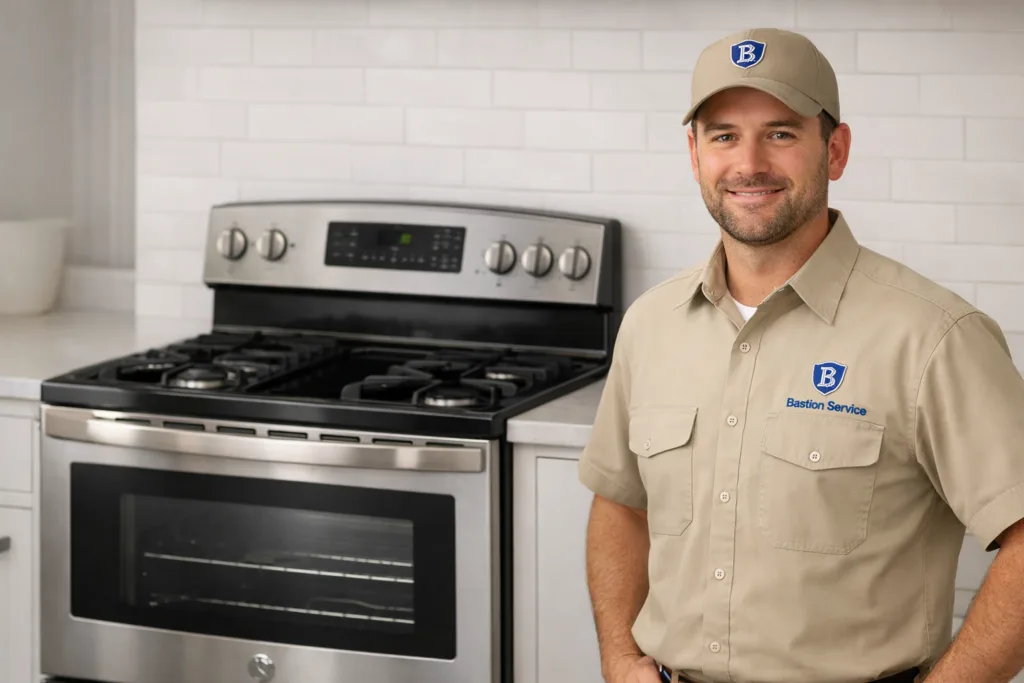
Common GE range problems in Fairfax homes

Most range problems show up in a familiar way: a burner will not light, the oven takes too long to preheat, the temperature seems off, or the controls stop responding normally. On GE models, those symptoms can come from very different components, so the pattern of the failure matters almost as much as the failure itself.
In Fairfax households, the most common complaints usually include:
- Surface burners that click but do not ignite
- Burners that heat unevenly or stop heating altogether
- Ovens that run too hot, too cool, or fluctuate during cooking
- Slow preheat times
- Error codes or unresponsive touch controls
- Doors that do not seal properly, allowing heat to escape
Because a range combines heating, ignition, sensors, switches, wiring, and electronic controls, a single symptom does not always point to a single obvious part. That is why it helps to look at what the appliance is doing consistently, not just what happened once.
What different symptoms often mean
Burner keeps clicking
A burner that clicks repeatedly may have moisture around the igniter, food buildup in the burner head, a misaligned cap, or a failing ignition component. If the burner eventually lights but keeps clicking, the problem may be related to the spark system not recognizing proper ignition. If the clicking starts happening on multiple burners, the issue may be broader than one burner assembly.
Burner will not ignite
When a gas burner will not light at all, the cause may be a clogged port, a bad spark electrode, a switch issue, or a gas flow problem. On electric models, a surface element that stays cold can point to a failed element, receptacle, switch, or wiring fault. If the same burner is the only one affected, that often helps narrow the problem to a local component rather than the entire range.
Oven not heating
If the oven stays cool or barely warms up, electric GE ranges may have a failed bake element, broil element, or relay issue. Gas models often develop weak igniters that glow but do not draw enough current to open the gas valve properly. Homeowners sometimes notice this first when preheat takes much longer than usual or dinner finishes far behind schedule.
Oven temperature is inaccurate
An oven that reaches heat but does not hold the selected temperature may have a sensor problem, calibration issue, control fault, or heat-loss issue from the door seal. Uneven temperatures often become obvious during baking, especially when one rack browns faster than another or familiar recipes suddenly need major timing adjustments.
Display or controls not responding
A blank display, flickering clock, beeping, or buttons that stop working can point to a control panel issue, electronic control board fault, loose connection, or power supply problem. In some cases, a control failure affects both the user interface and the heating system, which is why control complaints should not be treated as cosmetic only.
Signs the problem is getting worse
Some range issues begin as occasional annoyances and then become more consistent over time. A burner that lights on the third try today may stop lighting altogether later. An oven that seems a little cool can turn into a larger temperature-control problem that affects every meal.
Watch for patterns like these:
- Preheat times getting longer week by week
- Repeated ignition attempts becoming necessary
- Cooking results changing even when recipes stay the same
- Controls resetting, flashing, or showing intermittent errors
- Heat escaping around the oven door
- Burners that only work on certain settings
These are often signs that the failed part is not just inconvenient but actively affecting performance across normal daily use.
When to stop using the range and schedule service
Some problems are mostly about convenience, but others raise safety concerns or risk additional damage. If a GE range in Fairfax has a persistent gas smell, trips the breaker, sparks unexpectedly, overheats, or behaves erratically, it should not be pushed through normal use while waiting for the issue to sort itself out.
It is usually time to schedule service when:
- The oven cannot be trusted for normal meal preparation
- A burner fails repeatedly or only works intermittently
- The appliance loses power during cooking
- Error codes appear along with heating or ignition trouble
- The range is overheating or underheating in a way that affects everyday use
Continuing to use a malfunctioning range can put extra strain on igniters, switches, heating elements, and controls. Early attention often prevents a smaller fault from spreading into a more expensive repair path.
Repair or replace: what Fairfax homeowners should consider
Many GE range problems are repairable, especially when the issue is limited to one igniter, one heating element, one sensor, one switch, or another isolated part. In those cases, repair is often the sensible choice if the appliance is otherwise in solid condition.
Replacement may be worth thinking about when the range has multiple unrelated failures, significant wear across several systems, recurring control problems, or a repair history that keeps growing. Age matters, but condition matters more. A well-kept range with one failed component can still make sense to repair, while an older unit with repeated breakdowns may not.
The best decision usually comes from matching the symptom, the part involved, and the overall condition of the appliance rather than assuming every heating problem means the range is nearing the end.
What to check before service
There are a few simple observations that can help make a service visit more productive. Homeowners do not need to disassemble anything, but it helps to note how the problem behaves.
- Does the issue affect one burner or all burners?
- Does the oven fail during preheat, during baking, or all the time?
- Is the clicking constant or only after cleaning or spills?
- Are there any error codes on the display?
- Does the problem happen every day or only intermittently?
Even details that seem minor, like whether the broiler still works while bake does not, can help separate a heating-part failure from a control-related issue.
What a useful GE range repair visit should accomplish
A worthwhile service call should do more than identify a bad part by guesswork. It should connect the symptom to the failed component, confirm whether other related systems are involved, and explain whether the fix is straightforward or part of a larger appliance condition issue.
That matters with GE ranges because a complaint that sounds simple can have more than one cause. A burner issue may involve ignition rather than gas flow. An oven temperature complaint may come from the sensor, the control, the element, or heat loss at the door. A focused diagnosis helps avoid replacing parts that do not solve the original problem.
For homeowners in Fairfax, the most helpful outcome is a clear diagnosis and a practical repair plan based on the exact symptom pattern, the condition of the range, and whether the repair is likely to restore normal cooking performance without chasing repeat failures.